+
Heavy Industries Sector Performance And Policy Measures
ECONOMY & POLICY

Heavy Industries Sector Performance And Policy Measures

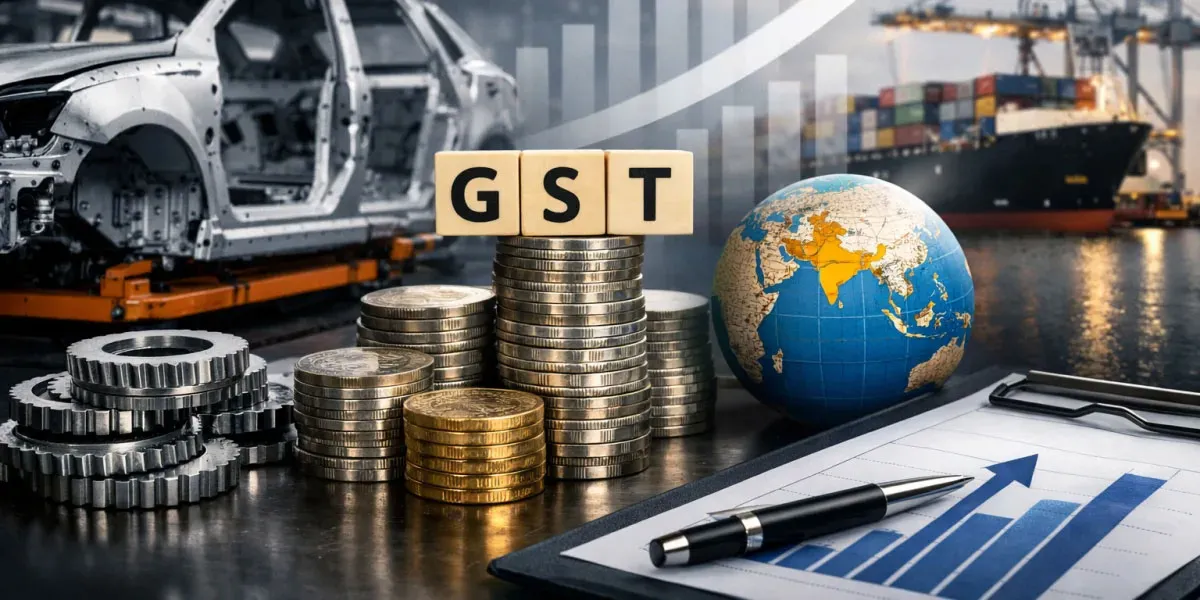
As per information from the Society of Indian Automobile Manufacturers, the automobile sector accounts for 15 per cent of the country's GST revenue collections and supports 30 million (mn) jobs across the automotive value chain, including 4.2 mn direct and 26.5 mn indirect jobs. The ministry presented these figures in a status update on the heavy industries sector. The assessment described the sector as central to manufacturing growth and revenue.

Production, sales and exports for January to December 2025 were reported in million units: passenger vehicles production 5.38 mn, sales 4.49 mn and exports 0.86 mn; commercial vehicles production 1.11 mn, sales 1.03 mn and exports 0.09 mn; three wheeler production 1.22 mn, sales 0.79 mn and exports 0.43 mn; two wheeler production 25.5 mn, sales 20.5 mn and exports 4.94 mn. The presentation noted these flows as indicators of domestic demand and external market engagement.

The capital goods industry was assessed to contribute about 1.9 per cent of gross domestic product and to underpin domestic manufacturing capability. Production, import and export data for 2024–25 were provided in Rs crore and converted into million (mn) for clarity, with machine tools production Rs 142,860 mn, dies and moulds Rs 184,000 mn and earthmoving and mining machinery Rs 807,500 mn.

The ministry outlined schemes to promote domestic manufacturing and technological upgradation, noting the Production Linked Incentive scheme for automobile and auto components with an outlay of Rs 259,380 mn to incentivise advanced technologies with minimum 50 per cent domestic value addition, a PLI for advanced chemistry cell batteries of Rs 181,000 mn to support domestic manufacturing ecosystem for 50 GWh and the PM EDRIVE scheme with Rs 109,000 mn for electric mobility from 1 April 2024 to 31 March 2028. The phase two capital goods competitiveness scheme was cited with 29 sanctioned projects to support technology, testing and skilling. The information was given by the Minister of State for Heavy Industries in a written reply to the Lok Sabha and underlined intent to bolster manufacturing and skills across the heavy industries ecosystem.

As per information from the Society of Indian Automobile Manufacturers, the automobile sector accounts for 15 per cent of the country's GST revenue collections and supports 30 million (mn) jobs across the automotive value chain, including 4.2 mn direct and 26.5 mn indirect jobs. The ministry presented these figures in a status update on the heavy industries sector. The assessment described the sector as central to manufacturing growth and revenue. Production, sales and exports for January to December 2025 were reported in million units: passenger vehicles production 5.38 mn, sales 4.49 mn and exports 0.86 mn; commercial vehicles production 1.11 mn, sales 1.03 mn and exports 0.09 mn; three wheeler production 1.22 mn, sales 0.79 mn and exports 0.43 mn; two wheeler production 25.5 mn, sales 20.5 mn and exports 4.94 mn. The presentation noted these flows as indicators of domestic demand and external market engagement. The capital goods industry was assessed to contribute about 1.9 per cent of gross domestic product and to underpin domestic manufacturing capability. Production, import and export data for 2024–25 were provided in Rs crore and converted into million (mn) for clarity, with machine tools production Rs 142,860 mn, dies and moulds Rs 184,000 mn and earthmoving and mining machinery Rs 807,500 mn. The ministry outlined schemes to promote domestic manufacturing and technological upgradation, noting the Production Linked Incentive scheme for automobile and auto components with an outlay of Rs 259,380 mn to incentivise advanced technologies with minimum 50 per cent domestic value addition, a PLI for advanced chemistry cell batteries of Rs 181,000 mn to support domestic manufacturing ecosystem for 50 GWh and the PM EDRIVE scheme with Rs 109,000 mn for electric mobility from 1 April 2024 to 31 March 2028. The phase two capital goods competitiveness scheme was cited with 29 sanctioned projects to support technology, testing and skilling. The information was given by the Minister of State for Heavy Industries in a written reply to the Lok Sabha and underlined intent to bolster manufacturing and skills across the heavy industries ecosystem.

Next Story
Infrastructure Energy

Jyoti Structures expands manufacturing capacity in Nashik

The announcement Jyoti Structures (JSL) reported steady operational performance in 2025, supported by stable project execution across its power transmission portfolio. The company commissioned galvanisation operations at its second Nashik manufacturing unit, adding 33,000 MT of annual capacity. This increased aggregate tower manufacturing capability at Nashik to approximately 69,000 MT per annum, aimed at improving fabrication accuracy, scheduling control and delivery predictability. JSL also expanded its workforce to over 750 employees, onboarding more than 70 engineers during the year. C..

Next Story
Infrastructure Energy

TSPL Mega Health Camp Reaches 338 Residents in Mansa

Talwandi Sabo Power (TSPL), Punjab’s largest and North India’s largest private thermal power plant, organised a Mega Health Camp at Village Raipur, Mansa, under its flagship healthcare initiative Project SEHAT. The camp benefitted 338 community members through free consultations and diagnostic services.A team comprising a General Physician, Gynaecologist, Dermatologist and Dentist provided medical advice and treatment. Beneficiaries received free diagnostic tests including BP, HB, blood sugar, malaria, dengue and blood group tests, along with free medicines.The camp was inaugurated by Vill..

Next Story
Infrastructure Transport

Mumbai Coastal Road Musical Path Plays Jai Ho

Mumbai inaugurated India’s first musical path on the Coastal Road that plays the song Jai Ho for motorists. The civic administration said the installation used Hungarian technology and that the intention was to implement the concept of Sangeet Marg in future projects. A senior official suggested implementing a pilot on the Samruddhi Expressway, which connects Mumbai and Nagpur. City officials described the inauguration as a symbolic demonstration of collaboration between municipal authorities and foreign partners. The inauguration was attended by the Consul General of Hungary Ferenc Jari, f..

Advertisement

Subscribe to Our Newsletter

Get daily newsletters around different themes from Construction world.

STAY CONNECTED

Advertisement

Advertisement

Advertisement

Open In App