Hyundai and TVS Partner to Commercialise Electric Three-Wheelers in India
ECONOMY & POLICY

Hyundai and TVS Partner to Commercialise Electric Three-Wheelers in India

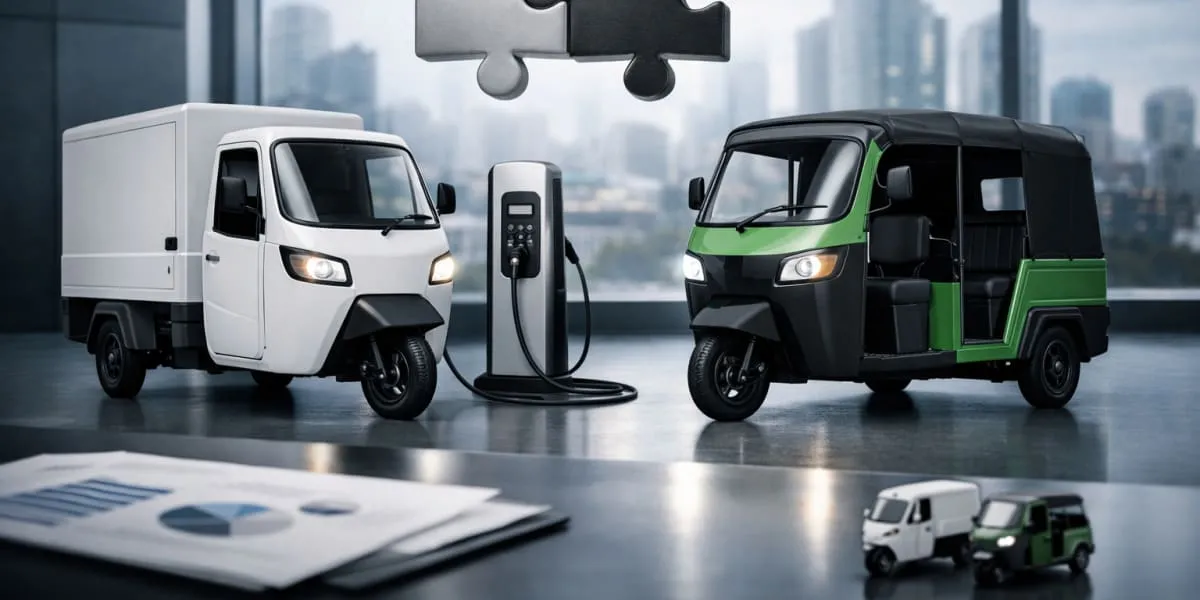
Hyundai Motor Company and TVS Motor Company Ltd. have signed a joint development agreement to advance and commercialise electric three-wheelers (E3W) designed specifically to address India's last-mile mobility needs. The partnership formalises collaboration first showcased by the E3W concept at the Bharat Mobility Global Expo 2025 and signals a concerted effort to bring tailored, sustainable urban transport solutions to Indian consumers and additional markets. The agreement marks a key step towards scalable electrification of light commercial mobility.

Under the arrangement, Hyundai Motor Company will lead the design and co-development process by leveraging its research and development expertise, advanced mobility technologies and human-centric design approach while TVS Motor Company will co-develop the product using its electric three-wheeler platform and deep local market knowledge. TVS Motor will take responsibility for local sales and manufacturing, with production in India to serve domestic demand and support future exports, thereby combining global engineering and local execution. The joint approach is intended to merge design excellence with proven three-wheeler engineering to meet varied use cases.

A cornerstone of the collaboration is the commitment to localise component manufacturing for the model, with major parts to be sourced and produced within India. This strategy is intended to strengthen the automotive supply chain ecosystem, create employment opportunities, reduce overall vehicle costs and ensure rapid after-sales support and spare parts availability for customers. The vehicle will proceed from concept to product through rigorous testing, localisation refinement and certification to meet Indian regulatory standards and customer expectations.

The concept vehicle showcased features such as adaptive ground clearance for monsoon-affected roads, enhanced safety systems, ergonomic design for extended commutes, improved thermal management for tropical climates and flexible interior configurations for passenger and goods transport. Both companies have established cross-functional teams to accelerate development timelines and regulatory approvals and aim to deliver a product that balances technology, affordability, sustainability and safety in India, the world's largest three-wheeler market.

Hyundai Motor Company and TVS Motor Company Ltd. have signed a joint development agreement to advance and commercialise electric three-wheelers (E3W) designed specifically to address India's last-mile mobility needs. The partnership formalises collaboration first showcased by the E3W concept at the Bharat Mobility Global Expo 2025 and signals a concerted effort to bring tailored, sustainable urban transport solutions to Indian consumers and additional markets. The agreement marks a key step towards scalable electrification of light commercial mobility. Under the arrangement, Hyundai Motor Company will lead the design and co-development process by leveraging its research and development expertise, advanced mobility technologies and human-centric design approach while TVS Motor Company will co-develop the product using its electric three-wheeler platform and deep local market knowledge. TVS Motor will take responsibility for local sales and manufacturing, with production in India to serve domestic demand and support future exports, thereby combining global engineering and local execution. The joint approach is intended to merge design excellence with proven three-wheeler engineering to meet varied use cases. A cornerstone of the collaboration is the commitment to localise component manufacturing for the model, with major parts to be sourced and produced within India. This strategy is intended to strengthen the automotive supply chain ecosystem, create employment opportunities, reduce overall vehicle costs and ensure rapid after-sales support and spare parts availability for customers. The vehicle will proceed from concept to product through rigorous testing, localisation refinement and certification to meet Indian regulatory standards and customer expectations. The concept vehicle showcased features such as adaptive ground clearance for monsoon-affected roads, enhanced safety systems, ergonomic design for extended commutes, improved thermal management for tropical climates and flexible interior configurations for passenger and goods transport. Both companies have established cross-functional teams to accelerate development timelines and regulatory approvals and aim to deliver a product that balances technology, affordability, sustainability and safety in India, the world's largest three-wheeler market.

Next Story
Real Estate

Sri Lotus FY26 pre-sales jump 137% to ₹1,157 crore

Sri Lotus Developers & Realty Limited, a Mumbai-based developer focused on luxury and ultra-luxury residential and commercial projects, has reported a strong FY26 performance supported by robust pre-sales growth, disciplined execution and a steady redevelopment pipeline.The company announced its audited financial results for the quarter and year ended March 31, 2026, highlighting its continued net debt-free status and industry-leading realisations of ₹69,000 per sq. ft.For FY26, Sri Lotus reported total revenue of ₹769 crore, EBITDA of ₹281 crore, and profit after tax of ₹243 crore..

Next Story
Infrastructure Urban

Sunkonnect targets 9.6 lakh tonnes CO₂ cut in event sector

Sunkonnect has announced a plan to reduce the carbon footprint of India’s rapidly expanding event and exhibition industry by 5% over the next five years, backed by a newly launched suite of net-zero solutions.India’s event and exhibition industry was valued at around USD 14.3 billion (₹1.2 lakh crore) in 2024 and is growing at a CAGR of 7.6%. However, the sector’s environmental impact remains significant, with a single participant at a major event generating up to 2 tonnes of CO₂ emissions, largely driven by travel, which can account for as much as 90% of total emissions.Sunkonnect s..

Next Story
Infrastructure Energy

TBS Group’s Akanetsu commissions Tokyo green hydrogen facility

Akasaka Heating & Cooling Supply Co., Ltd. (Akanetsu), a TBS Group company, has held a commissioning ceremony for its Hydrogen Heat Source Facility, marking the start of full-scale operations from May 2026.The company supplies heating, cooling and electricity to multiple buildings in the Akasaka 5-chome district of Minato-ku, Tokyo. As part of its heat source facility renewal, Akanetsu introduced hydrogen utilisation equipment with safety-focused design, positioning green hydrogen as a next-generation energy option.The facility is being described as the first commercial initiative of its k..

Advertisement

Subscribe to Our Newsletter

Get daily newsletters around different themes from Construction world.

STAY CONNECTED

Advertisement

Advertisement

Advertisement