India And Australia Seek Uranium Supply Deal And Deeper Defence Ties
ECONOMY & POLICY

India And Australia Seek Uranium Supply Deal And Deeper Defence Ties

India and Australia plan to pursue an expanded strategic partnership during Prime Minister Narendra Modi's visit to Australia, with energy arrangements including uranium supply under consideration alongside deeper defence and economic cooperation. Officials indicated that energy, defence industrial ties and maritime security will feature prominently on the agenda. The outreach reflects an effort to translate earlier dialogues into concrete agreements.

Both sides are set to renew and upgrade the 2009 Joint Declaration on Defence and Security Cooperation and to finalise a Maritime Security Collaboration Roadmap intended for white shipping. White shipping information describes the exchange of advanced data on the identity and movements of commercial non-military merchant vessels and is intended to improve shared maritime domain awareness. The roadmap is presented as a vehicle to standardise information sharing and operational coordination.

The two countries have increased maritime engagement since the 2021 Mutual Logistics Support Agreement, which enabled greater interoperability through joint exercises, strategic dialogues and training. Defence Minister Rajnath Singh and his Australian counterpart, Deputy Prime Minister and Minister for Defence Richard Marles, co-chaired the second India-Australia Defence Ministers’ Dialogue in June, where they discussed advances in bilateral maritime security cooperation. They also discussed collaboration on maritime patrol aircraft operations and options to strengthen undersea domain awareness.

Officials said a Memorandum of Understanding regarding the Provision of Defence Articles and Defence Services is being worked out as the next step in deepening defence industrial collaboration. Australia’s first defence trade mission visited India in October last year and the Australia-India Defence Industry Roundtable was convened, signalling growing commercial links. There is a possibility of establishing a joint working group on defence industry research and materiel to support sustained cooperation. The talks are positioned to broaden interoperability, industrial ties and strategic coordination between the two countries.

India and Australia plan to pursue an expanded strategic partnership during Prime Minister Narendra Modi's visit to Australia, with energy arrangements including uranium supply under consideration alongside deeper defence and economic cooperation. Officials indicated that energy, defence industrial ties and maritime security will feature prominently on the agenda. The outreach reflects an effort to translate earlier dialogues into concrete agreements. Both sides are set to renew and upgrade the 2009 Joint Declaration on Defence and Security Cooperation and to finalise a Maritime Security Collaboration Roadmap intended for white shipping. White shipping information describes the exchange of advanced data on the identity and movements of commercial non-military merchant vessels and is intended to improve shared maritime domain awareness. The roadmap is presented as a vehicle to standardise information sharing and operational coordination. The two countries have increased maritime engagement since the 2021 Mutual Logistics Support Agreement, which enabled greater interoperability through joint exercises, strategic dialogues and training. Defence Minister Rajnath Singh and his Australian counterpart, Deputy Prime Minister and Minister for Defence Richard Marles, co-chaired the second India-Australia Defence Ministers’ Dialogue in June, where they discussed advances in bilateral maritime security cooperation. They also discussed collaboration on maritime patrol aircraft operations and options to strengthen undersea domain awareness. Officials said a Memorandum of Understanding regarding the Provision of Defence Articles and Defence Services is being worked out as the next step in deepening defence industrial collaboration. Australia’s first defence trade mission visited India in October last year and the Australia-India Defence Industry Roundtable was convened, signalling growing commercial links. There is a possibility of establishing a joint working group on defence industry research and materiel to support sustained cooperation. The talks are positioned to broaden interoperability, industrial ties and strategic coordination between the two countries.

Related Stories

Gold Stories

Next Story
Infrastructure Urban

KONE Opens India's First Digital Experience Centre in Pune

KONE, a global elevator and escalator manufacturer, has inaugurated its first Digital Experience Centre (DEC) in India, located in Pune. The facility aims to showcase how artificial intelligence (AI), connectivity and data-driven technologies can enhance customer experiences and improve building operations.The centre was inaugurated by Jussi Herlin, Executive Vice Chair, KONE Corporation; Philippe Delorme, President and CEO, KONE; and Nandan Nilekani, Co-founder and Chairman of the Board, Infosys.Designed as an interactive customer environment, the facility demonstrates digital solutions cover..

Next Story
Infrastructure Urban

CII GreenCo Launches Circularity Guidelines for Indian Industry

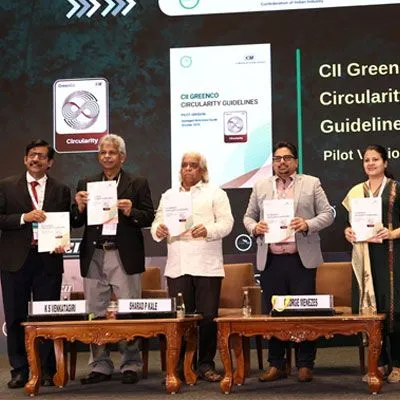
The Confederation of Indian Industry (CII) GreenCo Council has launched the CII GreenCo Circularity Guidelines – Pilot Version at the 17th CII GreenCo Waste & Resource Management Summit 2026 in Chennai. The initiative aims to strengthen resource efficiency, waste reduction and circular economy practices across Indian manufacturing and process industries.The guidelines introduce a structured framework with circularity indices covering raw materials, consumables, packaging and other resource inputs. These indicators will help industries assess existing practices, identify opportunities to ..

Next Story
Infrastructure Energy

Global Electronics Association Launches IPC-1783-CO2E Standard

The Global Electronics Association has introduced IPC-1783-CO2E, a new international standard aimed at improving consistency, transparency and comparability in product carbon footprint reporting across the electronics manufacturing industry.The standard, titled International Standard for Data Collection and Reporting of CO2 Equivalent (CO2e) Emissions for the Electronics Manufacturing Supply Chain, provides industry-specific guidance for collecting, estimating and reporting carbon emissions data.With increasing regulatory requirements and customer expectations, electronics manufacturers face c..

Advertisement

Subscribe to Our Newsletter

Get daily newsletters around different themes from Construction world.

STAY CONNECTED

Advertisement

SPECIAL OFFER
QR Code