+
Auto Component Suppliers Sit On Rs 98,000 Crore Inventory
ECONOMY & POLICY

Auto Component Suppliers Sit On Rs 98,000 Crore Inventory

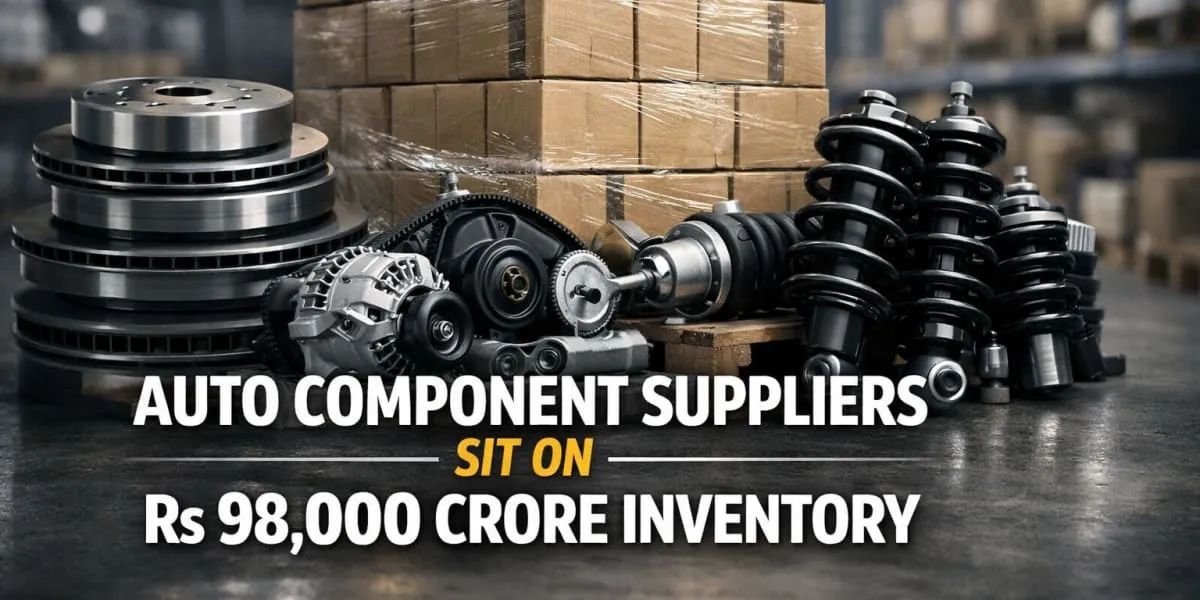
Auto component suppliers are sitting on Rs 98,000 crore (Rs 980 bn) of inventory, the report said. The accumulation reflects slower domestic demand for vehicles and a mismatch between production schedules and retail offtake. The report attributed the stockpile to cautious buying by original equipment manufacturers and longer lead times for certain parts. The figure represents a significant portion of sector inventories and raises questions about supply chain resilience.

The elevated inventory burden has strained working capital for many suppliers and lengthened cash conversion cycles, particularly affecting smaller firms in the supply chain. The report highlighted that carrying costs and the risk of obsolescence have increased as components remain unsold for extended periods. Input cost inflation has added pressure on margins while turnover has weakened. Smaller vendors without diversified order books are most vulnerable to the cash squeeze.

The analysts urged suppliers to adopt tighter inventory management, enhance demand forecasting and coordinate more closely with vehicle manufacturers to align production with consumption. They recommended that lenders and policy makers consider targeted inventory financing to ease liquidity constraints and support operational continuity. Adoption of digital inventory tools was described as a means to improve visibility and reduce excess stock. Pilot programmes to monetise inventory were cited as a practical interim step.

Industry executives noted that normalisation of inventories will require a sustained recovery in vehicle sales and clearer signals from original equipment manufacturers on production plans. The report suggested that a combination of market measures and financing solutions could mitigate the immediate stress on the sector. It added that transparent data sharing between suppliers and OEMs would shorten cycles and improve resource allocation. The pace of correction will depend on demand momentum and implementation of the suggested measures.

Auto component suppliers are sitting on Rs 98,000 crore (Rs 980 bn) of inventory, the report said. The accumulation reflects slower domestic demand for vehicles and a mismatch between production schedules and retail offtake. The report attributed the stockpile to cautious buying by original equipment manufacturers and longer lead times for certain parts. The figure represents a significant portion of sector inventories and raises questions about supply chain resilience. The elevated inventory burden has strained working capital for many suppliers and lengthened cash conversion cycles, particularly affecting smaller firms in the supply chain. The report highlighted that carrying costs and the risk of obsolescence have increased as components remain unsold for extended periods. Input cost inflation has added pressure on margins while turnover has weakened. Smaller vendors without diversified order books are most vulnerable to the cash squeeze. The analysts urged suppliers to adopt tighter inventory management, enhance demand forecasting and coordinate more closely with vehicle manufacturers to align production with consumption. They recommended that lenders and policy makers consider targeted inventory financing to ease liquidity constraints and support operational continuity. Adoption of digital inventory tools was described as a means to improve visibility and reduce excess stock. Pilot programmes to monetise inventory were cited as a practical interim step. Industry executives noted that normalisation of inventories will require a sustained recovery in vehicle sales and clearer signals from original equipment manufacturers on production plans. The report suggested that a combination of market measures and financing solutions could mitigate the immediate stress on the sector. It added that transparent data sharing between suppliers and OEMs would shorten cycles and improve resource allocation. The pace of correction will depend on demand momentum and implementation of the suggested measures.

Related Stories

Gold Stories

Next Story
Building Material

Aditya Birla Group Launches Ultravolt Wires And Cables Business

Aditya Birla Group has entered the wires and cables market through Ultravolt, extending UltraTech's move from building materials into building solutions. The shift builds on UltraTech Building Solutions, a multi-category platform that already addresses customers across different stages of construction and extends beyond cement into ready-mix concrete, waterproofing, tile-fixing solutions and mortars. The company intends to enter with scale, seeking presence across 100,000 retailers in more than 500 districts and availability through 5,000 plus UltraTech Building Solutions (UBS) outlets. The po..

Next Story
Infrastructure Transport

Tamil Nadu Shortlists Two Sites For Second Chennai Airport

The Tamil Nadu government has shortlisted two sites near Chennai for a proposed second airport, and officials have submitted the findings of a preliminary study to the Airports Authority of India (AAI). The locations are Cheyyur in Chengalpattu district, about 100 km south of Chennai, and Manellore near Gummidipundi in Tiruvallur district, about 50 km north-northwest of the city. Both sites were identified within a week after the administration decided to drop the earlier Parandur plan on environmental grounds. State officials recommended that the AAI carry out feasibility studies and indicate..

Next Story
Infrastructure Urban

Hyundai Motor India Targets 30 Per Cent Rural Sales

Hyundai Motor India Ltd expects rural markets to account for 30 per cent of its total sales within three to four years, the managing director and chief executive officer Tarun Garg said. The company is planning two new products in the segment, a mid-size sport utility vehicle and a compact electric sport utility vehicle, which are expected to support the push into smaller towns and villages. HMIL is intensifying its rural focus through network expansion and targeted aftersales services. In the first quarter of the fiscal year, rural contribution reached 25.9 per cent, up from 22.6 per cent in ..

Advertisement

Subscribe to Our Newsletter

Get daily newsletters around different themes from Construction world.

STAY CONNECTED

Advertisement

SPECIAL OFFER
QR Code