+
India and France Amend Double Taxation Avoidance Convention
ECONOMY & POLICY

India and France Amend Double Taxation Avoidance Convention

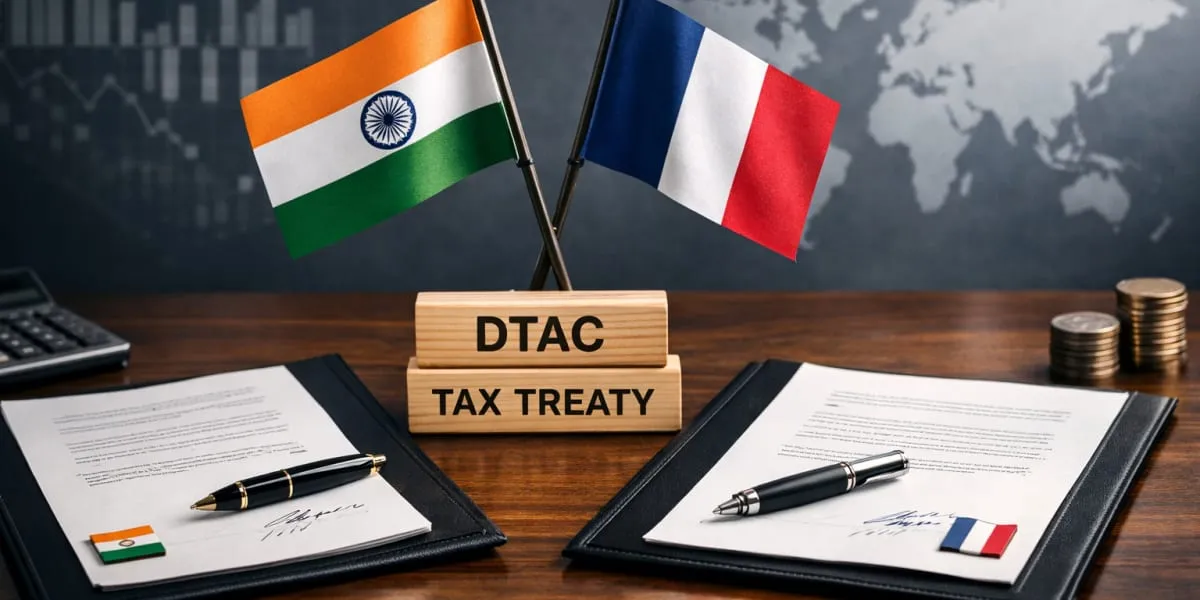
During the visit of the President of France to India, the Governments of the Republic of India and the French Republic signed a Protocol amending the India France Double Taxation Avoidance Convention (DTAC) which was originally signed on 29 September 1992. The Protocol was signed by the Chairperson of the Central Board of Direct Taxes (CBDT) for India and by the Ambassador of France to India for France. The update is intended to modernise tax rules and strengthen bilateral economic cooperation.

The Protocol grants taxing rights for capital gains from the sale of company shares to the jurisdiction where the company is resident and removes the Most Favoured Nation (MFN) clause from the DTAC. It replaces a single dividend withholding rate of 10 per cent with a split rate of five per cent for shareholders holding at least 10 per cent of capital and 15 per cent for other cases. The amendment clarifies Fees for Technical Services (FTS) by aligning the definition with the India United States Double Taxation Avoidance Agreement and expands the scope of Permanent Establishment (PE) to include Service PE.

The Protocol updates provisions on exchange of information and introduces an article on assistance in the collection of taxes in line with international standards, which should facilitate mutual tax cooperation. It incorporates the applicable provisions of the Base Erosion and Profit Shifting (BEPS) Multilateral Instrument (MLI) that became applicable after both countries signed and ratified the MLI. The changes aim to provide greater clarity and predictability for taxpayers on cross border transactions.

The changes will enter into effect after completion of internal procedures under the laws of both countries and subject to the terms agreed between the two Governments. Officials expect the updated DTAC to provide greater tax certainty, boost the flow of investment, technology and personnel and support bilateral economic ties. The Amending Protocol updates the treaty to present international standards while seeking to balance the interests of both India and France.

During the visit of the President of France to India, the Governments of the Republic of India and the French Republic signed a Protocol amending the India France Double Taxation Avoidance Convention (DTAC) which was originally signed on 29 September 1992. The Protocol was signed by the Chairperson of the Central Board of Direct Taxes (CBDT) for India and by the Ambassador of France to India for France. The update is intended to modernise tax rules and strengthen bilateral economic cooperation. The Protocol grants taxing rights for capital gains from the sale of company shares to the jurisdiction where the company is resident and removes the Most Favoured Nation (MFN) clause from the DTAC. It replaces a single dividend withholding rate of 10 per cent with a split rate of five per cent for shareholders holding at least 10 per cent of capital and 15 per cent for other cases. The amendment clarifies Fees for Technical Services (FTS) by aligning the definition with the India United States Double Taxation Avoidance Agreement and expands the scope of Permanent Establishment (PE) to include Service PE. The Protocol updates provisions on exchange of information and introduces an article on assistance in the collection of taxes in line with international standards, which should facilitate mutual tax cooperation. It incorporates the applicable provisions of the Base Erosion and Profit Shifting (BEPS) Multilateral Instrument (MLI) that became applicable after both countries signed and ratified the MLI. The changes aim to provide greater clarity and predictability for taxpayers on cross border transactions. The changes will enter into effect after completion of internal procedures under the laws of both countries and subject to the terms agreed between the two Governments. Officials expect the updated DTAC to provide greater tax certainty, boost the flow of investment, technology and personnel and support bilateral economic ties. The Amending Protocol updates the treaty to present international standards while seeking to balance the interests of both India and France.

Next Story
Infrastructure Urban

We’ve cut 50,000 tonnes of carbon emmissions since 2019

MatchLog is challenging a decades-old logistics norm and empty container miles by directly matching import flows with export demand. Indeed, the platform is unlocking measurable cost savings, cutting emissions and driving structural change in landside operations. Dhruv Taneja, Founder and Global CEO, outlines the quantified impact, adoption  journey and the evolving future of container reuse in an exclusive interview with Construction World. MatchLog has partnered with carriers such as Maersk, ONE and HMM in India. Could you share quantified outcomes from one specific corri..

Next Story
Infrastructure Transport

Airports: Capacity is Key

A lotus-inspired terminal design in Navi Mumbai International Airport. A terminal in a garden in Bengaluru’s Kempegowda International Airport. A peacock-inspired canopy in Chhatrapati Shivaji Maharaj International Airport. A nature-inspired terminal in Guwahati’s Lokpriya Gopinath Bordoloi International Airport.Truly, “India’s airports are no longer constrained by architectural ambition,” avers Ravikanth Mididhodi, Chief Technical Officer, J&F, a German-based engineering firm with over 25 years of global legacy in delivering advanced engineering and BIM services for air..

Next Story
Real Estate

In 2025, Amaravati attracted ₹ 28,075 crore in investments

In an exclusive interview with Construction World, Kanna Babu, IAS, Commissioner, Andhra Pradesh Capital Region Development Authority (APCRDA), reveals how Amaravati is entering a decisive new phase of capital city development. With 36 MoUs worth ₹ 45,589 crore, a ₹ 58,000 crore tender pipeline, and rising institutional investments, he explains the strategic execution, infrastructure rollout, and governance framework driving Amaravati’s emergence as a structured, investment-ready, and future-focused capital.APCRDA has recently secured major financial tie-ups, including loans from NA..

Advertisement

Subscribe to Our Newsletter

Get daily newsletters around different themes from Construction world.

STAY CONNECTED

Advertisement

Advertisement

Advertisement

Open In App