+
India and Nepal Sign MoU to Strengthen Conservation Cooperation
ECONOMY & POLICY

India and Nepal Sign MoU to Strengthen Conservation Cooperation

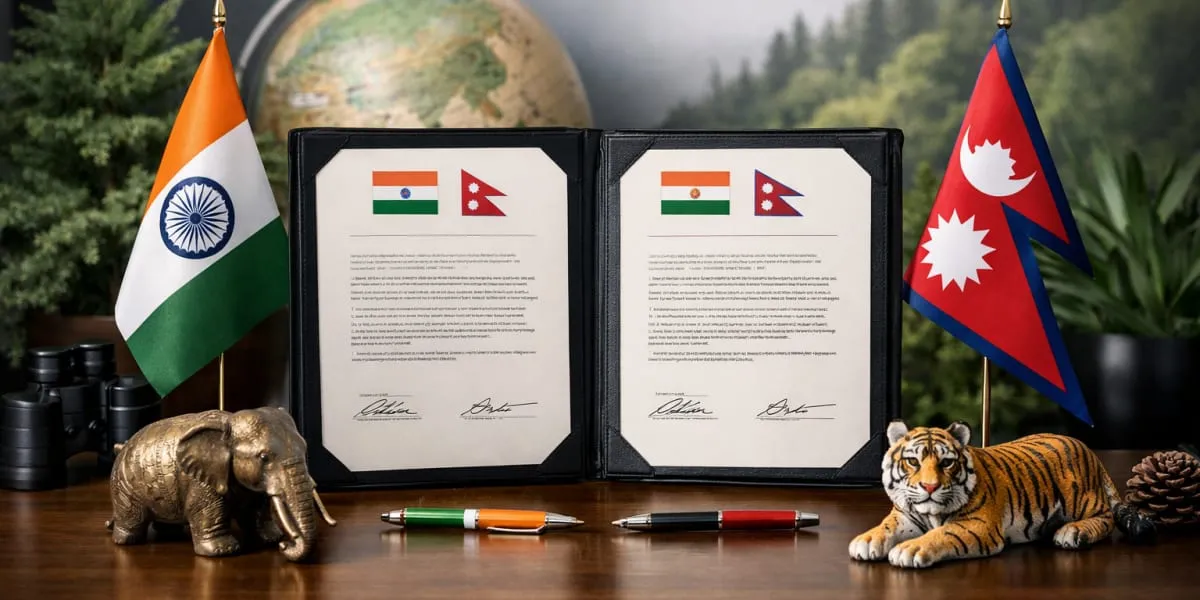
On 25 February 2026 the Union Ministry of Environment, Forest and Climate Change of India signed a Memorandum of Understanding with the Ministry of Forests and Environment of Nepal to promote bilateral cooperation in forests, wildlife, environment, biodiversity conservation and climate change. The agreement was signed in New Delhi in the presence of the Union Minister of Environment, Forest and Climate Change Bhupender Yadav and the Cabinet Minister for Forests and Environment of Nepal Madhav Prasad Chaulagain. The MoU provides a framework for exchange of knowledge, technical expertise and best practices between the two Governments.

Both countries are endowed with rich biodiversity and have established extensive networks of protected areas within their territories, and both are parties to multiple multilateral environmental agreements. In view of shared ecosystems and transboundary wildlife habitats the Governments identified a need to strengthen coordination and cooperation across policy, enforcement and conservation planning. The MoU is intended to provide an institutional basis for such cooperation.

The memorandum envisages cooperation in formulation of biodiversity conservation strategies at the landscape level with emphasis on key species including elephant, Gangetic dolphin, rhinoceros, snow leopard, tiger and vultures. It also envisages strengthened forest and protected area management, restoration of wildlife corridors and interlinking areas towards the creation of transboundary conservation landscapes, measures to address biodiversity conservation threats and actions to combat forest and wildlife crime. Capacity building of frontline enforcement staff and promotion of smart green infrastructure in biodiversity hotspots are further areas of collaboration.

The signing is expected to deepen India–Nepal cooperation in conservation of wildlife and biodiversity and to contribute to protection of shared ecosystems and sustainable management of natural resources in the region. The Governments anticipate that coordinated action under the MoU will enhance landscape level conservation outcomes and reduce threats to migratory and transboundary species. Continued exchange of technical expertise and best practices is expected to support implementation of joint measures.

On 25 February 2026 the Union Ministry of Environment, Forest and Climate Change of India signed a Memorandum of Understanding with the Ministry of Forests and Environment of Nepal to promote bilateral cooperation in forests, wildlife, environment, biodiversity conservation and climate change. The agreement was signed in New Delhi in the presence of the Union Minister of Environment, Forest and Climate Change Bhupender Yadav and the Cabinet Minister for Forests and Environment of Nepal Madhav Prasad Chaulagain. The MoU provides a framework for exchange of knowledge, technical expertise and best practices between the two Governments. Both countries are endowed with rich biodiversity and have established extensive networks of protected areas within their territories, and both are parties to multiple multilateral environmental agreements. In view of shared ecosystems and transboundary wildlife habitats the Governments identified a need to strengthen coordination and cooperation across policy, enforcement and conservation planning. The MoU is intended to provide an institutional basis for such cooperation. The memorandum envisages cooperation in formulation of biodiversity conservation strategies at the landscape level with emphasis on key species including elephant, Gangetic dolphin, rhinoceros, snow leopard, tiger and vultures. It also envisages strengthened forest and protected area management, restoration of wildlife corridors and interlinking areas towards the creation of transboundary conservation landscapes, measures to address biodiversity conservation threats and actions to combat forest and wildlife crime. Capacity building of frontline enforcement staff and promotion of smart green infrastructure in biodiversity hotspots are further areas of collaboration. The signing is expected to deepen India–Nepal cooperation in conservation of wildlife and biodiversity and to contribute to protection of shared ecosystems and sustainable management of natural resources in the region. The Governments anticipate that coordinated action under the MoU will enhance landscape level conservation outcomes and reduce threats to migratory and transboundary species. Continued exchange of technical expertise and best practices is expected to support implementation of joint measures.

Next Story
Infrastructure Urban

Implementation Status of Jal Jeevan Mission

Since August 2019 the Government has implemented Jal Jeevan Mission to provide assured potable water through household tap connections in rural India. At the start of the mission only 32.3 million (mn) rural households, representing 16.7 per cent, were reported to have tap water connections. States and union territories have reported that 125.8 mn additional rural households have since been provided with tap connections. As a result, of about 193.6 mn rural households roughly 158.2 mn, or 81.71 per cent, are reported to have tap water supply at home.\n\nThe State, district and village level st..

Next Story
Infrastructure Urban

Jal Jeevan Mission Reaches Eighty One Per Cent Rural Coverage

The Government reported substantial progress under the Jal Jeevan Mission, launched in August 2019 to provide tap water to every rural household. At launch only 32.3 million (mn) rural households had tap connections and states and Union territories reported provision of 125.8 mn additional households by March 2026. Consequently, out of about 193.6 mn rural households around 158.2 mn, or 81.71 per cent, are reported to have tap water at home. The Finance Minister announced extension of the mission until 2028 in the 2025-26 budget speech. The Swachh Bharat Mission Grameen, launched in October 20..

Next Story
Infrastructure Urban

Empowering Local Governance for Sustainable Rural Water Supply

The Ministry of Jal Shakti has aligned the Jal Jeevan Mission (JJM) with the 73rd Amendment to strengthen village level planning and community ownership of water supply. Gram Panchayats, village water and sanitation committees and Pani Samitis are to plan, implement, manage and maintain piped water systems, with gram sabha processes formalising handover and oversight. Implementation support agencies including non government organisations, community based organisations and self help groups have been empanelled to train local committees and promote women participation. Under JJM, the department ..

Advertisement

Subscribe to Our Newsletter

Get daily newsletters around different themes from Construction world.

STAY CONNECTED

Advertisement

Advertisement

Advertisement