






+
India Emerges As Second Largest Mobile Manufacturer
ECONOMY & POLICY

India Emerges As Second Largest Mobile Manufacturer

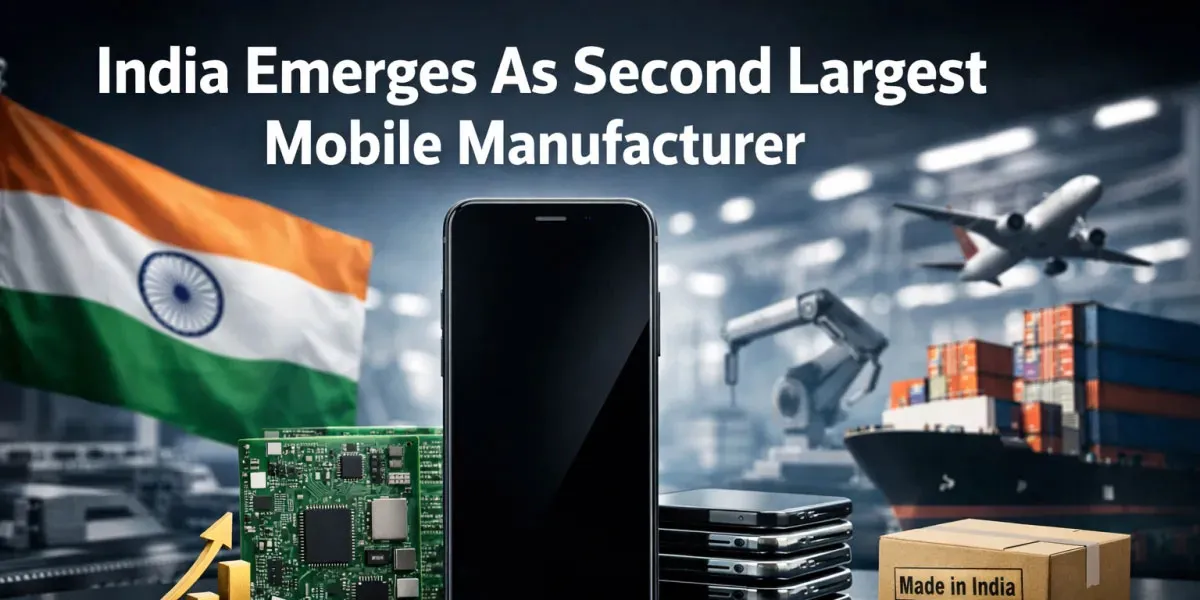
Government initiatives under Make in India and Atmanirbhar Bharat have expanded electronics manufacturing in India over past eleven years, reflected in production and export growth across sectors. Production of electronics goods rose from Rs 1.9 trillion (tn) in 2014–15 to Rs 11.3 tn in 2024–25, while exports increased from Rs 190 billion (bn) to Rs 3.3 tn over same period. Mobile phone production increased from Rs 180 bn to Rs 5.5 tn and mobile exports rose from Rs 10 bn to Rs 2 tn, signalling the country becoming a net exporter of mobile phones. The rise has been attributed to targeted policy measures and incentives.

The Production Linked Incentive scheme for Large Scale Electronics Manufacturing introduced in 2020 sought to boost domestic mobile manufacturing and has coincided with production more than doubling from Rs 2.14 tn in fiscal 2019–20 to Rs 5.5 tn in fiscal 2024–25. Mobile phone exports grew from Rs 270 bn to Rs 2 tn in the same period and the scheme reported investments of Rs 151.72 bn and additional employment of 171,448 persons by December 2025. A subsequent PLI 2.0 for IT hardware launched in 2023 aimed to foster manufacturing of laptops, tablets and servers and to strengthen supply chains.

Cumulative outputs under the PLI schemes were reported at Rs 4.96 tn in fiscal 2023–24, Rs 7.67 tn in fiscal 2024–25 and Rs 10.39 tn up to 31 December 2025, with incremental production of Rs 2.03 tn, Rs 2.71 tn and Rs 2.45 tn respectively. The schemes were said to have yielded cumulative production of Rs 165.31 bn, cumulative investment of Rs 8.57 bn and direct employment of 4,776 by December 2025. Policy measures cited include SPECS, electronics manufacturing clusters, the Semicon India Programme and preference in public procurement for domestically produced goods.

The government highlighted tax reforms, exemption on basic customs duty for capital goods and permission for full foreign direct investment in electronics manufacturing. Officials presented this as strengthening domestic ecosystem across consumer, industrial and telecom electronics and advancing India as a manufacturing hub.

Government initiatives under Make in India and Atmanirbhar Bharat have expanded electronics manufacturing in India over past eleven years, reflected in production and export growth across sectors. Production of electronics goods rose from Rs 1.9 trillion (tn) in 2014–15 to Rs 11.3 tn in 2024–25, while exports increased from Rs 190 billion (bn) to Rs 3.3 tn over same period. Mobile phone production increased from Rs 180 bn to Rs 5.5 tn and mobile exports rose from Rs 10 bn to Rs 2 tn, signalling the country becoming a net exporter of mobile phones. The rise has been attributed to targeted policy measures and incentives. The Production Linked Incentive scheme for Large Scale Electronics Manufacturing introduced in 2020 sought to boost domestic mobile manufacturing and has coincided with production more than doubling from Rs 2.14 tn in fiscal 2019–20 to Rs 5.5 tn in fiscal 2024–25. Mobile phone exports grew from Rs 270 bn to Rs 2 tn in the same period and the scheme reported investments of Rs 151.72 bn and additional employment of 171,448 persons by December 2025. A subsequent PLI 2.0 for IT hardware launched in 2023 aimed to foster manufacturing of laptops, tablets and servers and to strengthen supply chains. Cumulative outputs under the PLI schemes were reported at Rs 4.96 tn in fiscal 2023–24, Rs 7.67 tn in fiscal 2024–25 and Rs 10.39 tn up to 31 December 2025, with incremental production of Rs 2.03 tn, Rs 2.71 tn and Rs 2.45 tn respectively. The schemes were said to have yielded cumulative production of Rs 165.31 bn, cumulative investment of Rs 8.57 bn and direct employment of 4,776 by December 2025. Policy measures cited include SPECS, electronics manufacturing clusters, the Semicon India Programme and preference in public procurement for domestically produced goods. The government highlighted tax reforms, exemption on basic customs duty for capital goods and permission for full foreign direct investment in electronics manufacturing. Officials presented this as strengthening domestic ecosystem across consumer, industrial and telecom electronics and advancing India as a manufacturing hub.

Next Story
Resources

Hisense Opens First India Manufacturing Plant at Sri City

Hisense has inaugurated its first manufacturing facility in India at Sri City, Andhra Pradesh, through a joint venture with Epack Manufacturing Technologies Private Limited, a wholly owned subsidiary of Epack Durable Limited.The 10-acre facility, developed with an investment exceeding USD 30 million, is located within Epack Durable’s industrial park at Sri City and will commence commercial production from February 2026. Once fully operational, the plant will manufacture Room Air Conditioners (RACs) exclusively for Hisense India, accounting for 100 per cent of the brand’s domestic RAC outpu..

Next Story
Real Estate

Superb Realty Launches Altura, Focuses on IAQ-Led Office Design

Superb Realty has launched Superb Altura, a mixed-use Grade A commercial development at Amar Mahal junction in the Chembur–Ghatkopar corridor, positioning indoor air quality and intelligent building systems at the centre of its design strategy amid rising pollution levels in Mumbai.The development reflects a shift in office real estate priorities, where occupiers increasingly evaluate how buildings manage health, energy efficiency and operational resilience in high-pollution urban environments. Altura integrates advanced systems that continuously monitor and optimise indoor environments, cov..

Next Story
Infrastructure Transport

CPCL Tops NHAI’s First DPR Consultant Ranking

Chaitanya Projects Consultancy (CPCL) has secured the top position in the National Highways Authority of India’s first-ever provisional DPR consultants rating, achieving a score of 80.75 out of 100. The ranking places CPCL ahead of 55 peer firms, including Pentacle Consultants (78), L&T Infrastructure Engineering (76), MSV International Technology (74), and Transys Consulting (72).The rankings, released in the fourth week of January 2026, mark NHAI’s first structured and transparent evaluation of DPR consultants to improve quality standards under Bharatmala and other national highway p..

Advertisement

Subscribe to Our Newsletter

Get daily newsletters around different themes from Construction world.

STAY CONNECTED

Advertisement

Advertisement

Advertisement

Open In App














