+
India Eyes 200 bn Data Centres Push To Become Global AI Hub
ECONOMY & POLICY

India Eyes 200 bn Data Centres Push To Become Global AI Hub

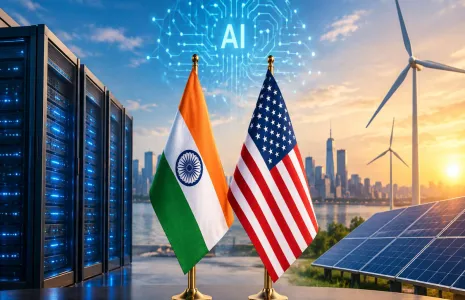
India is targeting 200 billion dollars (200 bn) in data centre investment as part of a push to become a global artificial intelligence hub. Officials framed the ambition at an international AI summit where India joined a US-led alliance on supply chains known as Pax Silica. The government presented the initiative as a means to attract long term capital, bolster domestic infrastructure and secure critical chip and silicon supplies. Industry executives said incentives, streamlined approvals and dedicated zones are expected to accelerate deployment.

Planners highlighted that scaled data centre capacity is essential to support compute intensive AI research and commercial applications. The expansion will require coordinated upgrades to power grids, fibre connectivity and cooling facilities, and policymakers signalled a focus on sustainable energy sourcing. Private investment, sovereign and global funds are being positioned to back campus style facilities, while smaller edge centres are expected to proliferate across metropolitan and regional nodes. Regulators are working on clarity for cross border data flows to reassure multinational operators.

Participation in the Pax Silica alliance was described as part of a broader effort to deepen supply chain resilience and attract responsible technology partners. The declaration signed at the summit emphasised collaboration on trusted supply chains, research partnerships and standards alignment to support AI deployment. Observers noted that aligning trade and investment rules with like minded economies could reduce bottlenecks in semiconductors and specialised inputs required for large scale data centre build out. Skills development and research collaboration were cited as complementary priorities.

Analysts cautioned that realising the 200 bn target will depend on long term policy consistency, grid investment and land availability near urban centres. They forecast phased growth with initial concentration in established technology corridors before gradual decentralisation to secondary cities. The government and industry leaders committed to monitoring progress and adjusting incentives to ensure the sector contributes to job creation and national competitiveness in AI.

India is targeting 200 billion dollars (200 bn) in data centre investment as part of a push to become a global artificial intelligence hub. Officials framed the ambition at an international AI summit where India joined a US-led alliance on supply chains known as Pax Silica. The government presented the initiative as a means to attract long term capital, bolster domestic infrastructure and secure critical chip and silicon supplies. Industry executives said incentives, streamlined approvals and dedicated zones are expected to accelerate deployment. Planners highlighted that scaled data centre capacity is essential to support compute intensive AI research and commercial applications. The expansion will require coordinated upgrades to power grids, fibre connectivity and cooling facilities, and policymakers signalled a focus on sustainable energy sourcing. Private investment, sovereign and global funds are being positioned to back campus style facilities, while smaller edge centres are expected to proliferate across metropolitan and regional nodes. Regulators are working on clarity for cross border data flows to reassure multinational operators. Participation in the Pax Silica alliance was described as part of a broader effort to deepen supply chain resilience and attract responsible technology partners. The declaration signed at the summit emphasised collaboration on trusted supply chains, research partnerships and standards alignment to support AI deployment. Observers noted that aligning trade and investment rules with like minded economies could reduce bottlenecks in semiconductors and specialised inputs required for large scale data centre build out. Skills development and research collaboration were cited as complementary priorities. Analysts cautioned that realising the 200 bn target will depend on long term policy consistency, grid investment and land availability near urban centres. They forecast phased growth with initial concentration in established technology corridors before gradual decentralisation to secondary cities. The government and industry leaders committed to monitoring progress and adjusting incentives to ensure the sector contributes to job creation and national competitiveness in AI.

Next Story
Infrastructure Urban

IICA Constitutes High Level Advisory Group On Ease Of Doing Business

The Indian Institute of Corporate Affairs (IICA), functioning under the aegis of the Ministry of Corporate Affairs (MCA), has constituted a high level Advisory Group (AG) on ease of doing business under the chairmanship of Gyaneshwar Kumar Singh, Director General and Chief Executive Officer of IICA. The initiative follows the Ministry order dated 31 December 2025 and aligns with the Government of India vision of Viksit Bharat 2047 to foster a robust, transparent and competitive business ecosystem. The Advisory Group has been tasked to provide strategic guidance on simplifying corporate complia..

Next Story
Infrastructure Urban

IICA Renews MoU With NALSAR University Of Law

The Indian Institute of Corporate Affairs (IICA) has renewed a memorandum of understanding with NALSAR University of Law, Hyderabad (NALSAR) for five years to deepen academic collaboration and capacity building. The renewal was formalised in New Delhi with the agreement signed by Shri Gyaneshwar Kumar Singh, Director General and Chief Executive Officer of IICA, and Prof. Srikrishna Deva Rao, Vice-Chancellor of NALSAR University of Law. The ceremony included senior officials and faculty from both institutions. The collaboration will support faculty and student exchanges, joint research and publ..

Next Story
Technology

India To Champion Edge Artificial Intelligence Solutions

The Research Symposium on Artificial Intelligence (AI) and Its Impact convened on 18 February 2026 as part of the India AI Impact Summit 2026, bringing together leading researchers, policymakers, technologists and industry leaders. The event was designed to bridge frontier research and real\n\nworld application by examining how AI can drive scientific breakthroughs while remaining aligned with public interest, safety and inclusive growth. The programme included plenary keynotes, research dialogues on frontier questions, Global South panels and poster presentations by international researchers...

Advertisement

Subscribe to Our Newsletter

Get daily newsletters around different themes from Construction world.

STAY CONNECTED

Advertisement

Advertisement

Advertisement

Open In App