India Proposes Biomanufacturing Working Group With Delaware
ECONOMY & POLICY

India Proposes Biomanufacturing Working Group With Delaware

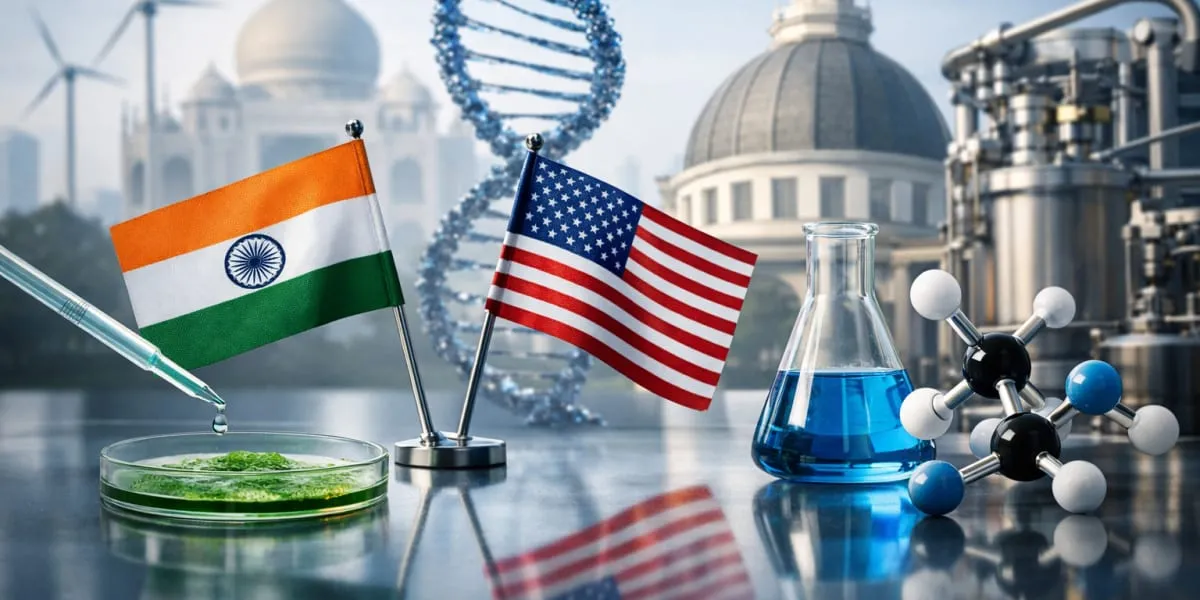
Union Minister for Science and Technology Dr Jitendra Singh proposed a small India–Delaware biomanufacturing working group to convert discussions into collaborations in research, manufacturing and startup ecosystems. The proposal was made during his meeting with a visiting US delegation led by Delaware Governor Matt Meyer at Seva Teerth. Both sides focused on bilateral collaboration in pharma, biotechnology, clean energy and innovation-led industrial growth.

The minister said science, technology and biotechnology are a key pillar of the India–US strategic partnership and that India seeks deeper engagement with US states that have strong innovation ecosystems. He highlighted India’s emergence as a hub for biotechnology and pharmaceutical innovation, with capacities from research and development to large-scale, cost-efficient manufacturing. He noted the Council of Scientific and Industrial Research, with 37 laboratories and over 7,500 scientists, anchors much of the country’s industrial research effort.

He cited Delaware’s bio-science ecosystem and the National Institute for Innovation in Manufacturing Biopharmaceuticals (NIIMBL) as potential collaborators in advanced biomanufacturing, AI-enabled processes and rapid scale-up technologies. He said India’s manufacturing strengths and Delaware’s proximity to major US pharmaceutical companies can support co-development of affordable biologics, biosimilars and vaccines for global health.

He outlined avenues for cooperation including joint biomanufacturing platforms, translational research bridges, startup incubation and workforce co-training in Good Manufacturing Practice manufacturing, regulatory science and quality systems. He identified regulatory science alignment and resilient supply chains for biopharmaceutical inputs as priorities. He noted that the Ministry of Science and Technology supports around 150 incubators and that the government has established a Rs one trillion (tn) research, development and innovation fund to catalyse private-sector and deep-tech investment.

Delegation members from government, universities and industry discussed opportunities in clean hydrogen, workforce development, startup incubation and corporate incorporation frameworks. Both sides agreed that a structured working group would carry discussions into actionable programmes such as joint research calls, startup exchanges and institutional partnerships, adding a state-level dimension to the India–US strategic partnership.

Union Minister for Science and Technology Dr Jitendra Singh proposed a small India–Delaware biomanufacturing working group to convert discussions into collaborations in research, manufacturing and startup ecosystems. The proposal was made during his meeting with a visiting US delegation led by Delaware Governor Matt Meyer at Seva Teerth. Both sides focused on bilateral collaboration in pharma, biotechnology, clean energy and innovation-led industrial growth. The minister said science, technology and biotechnology are a key pillar of the India–US strategic partnership and that India seeks deeper engagement with US states that have strong innovation ecosystems. He highlighted India’s emergence as a hub for biotechnology and pharmaceutical innovation, with capacities from research and development to large-scale, cost-efficient manufacturing. He noted the Council of Scientific and Industrial Research, with 37 laboratories and over 7,500 scientists, anchors much of the country’s industrial research effort. He cited Delaware’s bio-science ecosystem and the National Institute for Innovation in Manufacturing Biopharmaceuticals (NIIMBL) as potential collaborators in advanced biomanufacturing, AI-enabled processes and rapid scale-up technologies. He said India’s manufacturing strengths and Delaware’s proximity to major US pharmaceutical companies can support co-development of affordable biologics, biosimilars and vaccines for global health. He outlined avenues for cooperation including joint biomanufacturing platforms, translational research bridges, startup incubation and workforce co-training in Good Manufacturing Practice manufacturing, regulatory science and quality systems. He identified regulatory science alignment and resilient supply chains for biopharmaceutical inputs as priorities. He noted that the Ministry of Science and Technology supports around 150 incubators and that the government has established a Rs one trillion (tn) research, development and innovation fund to catalyse private-sector and deep-tech investment. Delegation members from government, universities and industry discussed opportunities in clean hydrogen, workforce development, startup incubation and corporate incorporation frameworks. Both sides agreed that a structured working group would carry discussions into actionable programmes such as joint research calls, startup exchanges and institutional partnerships, adding a state-level dimension to the India–US strategic partnership.

Next Story
Infrastructure Urban

HVAC: Cool Advice

India’s Cooling Action Plan forecasts cooling demand to grow nearly eight times in the next 20 years. In light of the fact that cooling is no longer just a comfort product but lies at the intersection of national development, public health, climate action and energy security, this means the HVAC industry shoulders a very serious responsibility. Mihir Sanghavi, Managing Partner, Auro Engineering Company, Immediate Past President RATA, Secretary, ISHRAE, and Regional Representative, ASHRAE Region XV, describes that responsibility as “identifying a system that can serve for 15 to 20 years o..

Next Story
Infrastructure Urban

Wanted: 2 Million Workers

Construction, India’s second largest employer by industry, employs about 50 million workers but could additionally absorb another 40 million workers, according to estimates shared by the Construction Skill Development Council of India (CSDCI) in 2023. Within this, citing trade estimates, Rahul Bahl, Managing Director, Krishna Buildestates, says the shortage of trained, skilled workers is currently about 2 million, and is expected to rise to 5 million by 2030.Not only is the construction industry struggling to find workers but construction labour productivity in India significantly trails glo..

Next Story
Infrastructure Transport

The Critical Path

In Ircon International Ltd v. Afcons Infrastructure Ltd, OMP (Comm) 279/2019, the Delhi High Court examined how delay and extension of time (‘EOT’) are to be assessed in construction contracts, particularly in the context of the ‘critical path’ while dealing with challenge to an arbitral award under Section 34 of the Arbitration and Conciliation Act 1996 (‘the Act’). The High Court’s observations regarding the critical path are of significant import for construction and infrastructure projects and related arbitration. The parties entered into a contract for construction of T..

Advertisement

Subscribe to Our Newsletter

Get daily newsletters around different themes from Construction world.

STAY CONNECTED

Advertisement

Advertisement

Advertisement