



India Records Highest Annual Wind Addition
ECONOMY & POLICY

India Records Highest Annual Wind Addition

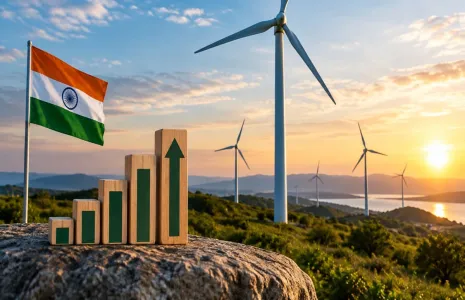
India has recorded its highest-ever annual wind capacity addition of six point zero five gigawatts (GW) in financial year 2025–26, surpassing the previous landmark of five point five GW set in financial year 2016–17. The annual addition represents an increase of nearly 46 per cent over the capacity in financial year 2024–25 and signals a decisive acceleration in onshore wind deployment. The scale of yearly additions indicates improvements in manufacturing throughput and project commissioning timelines, with developers achieving faster grid synchronisation.

With this addition, the country’s cumulative installed wind power capacity has crossed 56 GW, reinforcing momentum in the sector driven by improved policy clarity, transmission readiness and competitive tariff discovery. The growth is attributed to improved project execution and greater pipeline maturity across key wind states. The development is also supported by the progressive roll-out of green energy open access and an expanding portfolio of wind?solar hybrid projects.

States such as Gujarat, Karnataka and Maharashtra emerged as primary contributors to capacity addition during the year, underpinning the nationwide uptick. Policy measures cited as enabling factors include concessional custom duty on certain components and a graded waiver of inter?state transmission system charges until June, 2028, along with competitive bidding mechanisms and a separate Wind Renewable Consumption Obligation framework. Technical support from the National Institute of Wind Energy and other institutions has bolstered planning and execution capacity. The combination of state level efforts and central schemes has improved site selection, land acquisition and transmission planning, smoothing the path from award to commissioning.

The record addition significantly strengthens India’s renewable energy portfolio and contributes to the national target of 500 GW of non?fossil fuel based energy capacity by 2030. The wind sector has evolved since its initiation in the early 1990s into a robust market with a strong domestic ecosystem and policy framework. Continued policy support, transmission readiness and a sizeable project pipeline are expected to sustain momentum. Emphasis on hybridisation and open access models is likely to broaden participation and encourage further investment in grid?connected wind deployment.

India has recorded its highest-ever annual wind capacity addition of six point zero five gigawatts (GW) in financial year 2025–26, surpassing the previous landmark of five point five GW set in financial year 2016–17. The annual addition represents an increase of nearly 46 per cent over the capacity in financial year 2024–25 and signals a decisive acceleration in onshore wind deployment. The scale of yearly additions indicates improvements in manufacturing throughput and project commissioning timelines, with developers achieving faster grid synchronisation. With this addition, the country’s cumulative installed wind power capacity has crossed 56 GW, reinforcing momentum in the sector driven by improved policy clarity, transmission readiness and competitive tariff discovery. The growth is attributed to improved project execution and greater pipeline maturity across key wind states. The development is also supported by the progressive roll-out of green energy open access and an expanding portfolio of wind?solar hybrid projects. States such as Gujarat, Karnataka and Maharashtra emerged as primary contributors to capacity addition during the year, underpinning the nationwide uptick. Policy measures cited as enabling factors include concessional custom duty on certain components and a graded waiver of inter?state transmission system charges until June, 2028, along with competitive bidding mechanisms and a separate Wind Renewable Consumption Obligation framework. Technical support from the National Institute of Wind Energy and other institutions has bolstered planning and execution capacity. The combination of state level efforts and central schemes has improved site selection, land acquisition and transmission planning, smoothing the path from award to commissioning. The record addition significantly strengthens India’s renewable energy portfolio and contributes to the national target of 500 GW of non?fossil fuel based energy capacity by 2030. The wind sector has evolved since its initiation in the early 1990s into a robust market with a strong domestic ecosystem and policy framework. Continued policy support, transmission readiness and a sizeable project pipeline are expected to sustain momentum. Emphasis on hybridisation and open access models is likely to broaden participation and encourage further investment in grid?connected wind deployment.

Next Story
Infrastructure Transport

AFCONS & Navayuga set world records with Missing Link Expressway

Maharashtra’s most ambitious greenfield bypass — a 13.3-km alignment carrying twin record-setting tunnels and India’s tallest cable-stayed road bridge — was thrown open to traffic on Maharashtra Day, finally completing the Mumbai–Pune Expressway after a 23-year wait. CW reports…The 650-m cable-stayed bridge over Tiger Valley at sunset — the package executed by Afcons Infrastructure Ltd carries 182-m pylons, the tallest on any Indian road bridge.On 1 May 2026, Chief Minister Devendra Fadnavis, flanked by Deputy Chief Ministers Eknath Shinde and Sunetra Pawar (representing the late..

Next Story
Infrastructure Transport

Mumbai–Pune Missing Link boosts realty prospects

The recently opened ‘missing link’ on the Mumbai–Pune Expressway is set to significantly transform connectivity between the two cities by reducing travel time and bypassing the challenging ghat section. The new alignment, featuring tunnels and viaducts, is designed to improve safety, ease congestion and ensure a smoother, faster commute for both passenger and commercial traffic.With improved travel efficiency, the corridor is expected to strengthen intercity movement, encouraging more frequent travel for work, leisure and logistics. This enhanced accessibility is likely to benefit real e..

Next Story
Infrastructure Urban

How Hormuz is Hijacking Indian Highways

At the recently held RAHSTA Round Table on 29th April in Pune, and earlier during our webinars for Cement Expo by Indian Cement Review and by FIRST Construction Council on manufacturing construction equipment for the world, one thread lay common: the industry is being subjected to a cost-push chain reaction moving from crude oil → freight/insurance → steel, cement fuel, bitumen, polymers, packaging, logistics and finally project margins. Indeed, the West Asia crisis caused by the war and the Hormuz Strait blockade, which does not directly concern us, has turned around and hit us. If the wa..

Advertisement

Subscribe to Our Newsletter

Get daily newsletters around different themes from Construction world.

STAY CONNECTED

Advertisement

Advertisement

Advertisement