



India Signs 10-Year Uranium Supply Deal With Canada
ECONOMY & POLICY

India Signs 10-Year Uranium Supply Deal With Canada

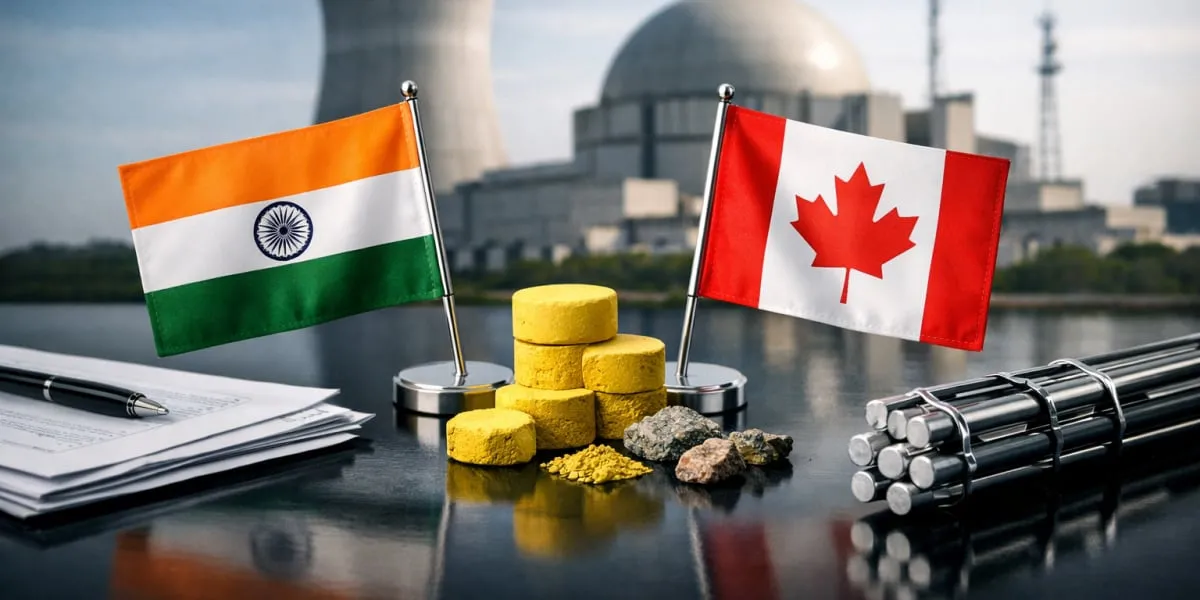
India and Canada are poised to sign a 10-year uranium supply agreement valued at $2.8 billion (bn) that would mark a diplomatic reset and provide a steady fuel source for Indian reactors. The contract envisages Cameco Corporation (Cameco), Canada’s largest uranium producer, supplying nuclear fuel over the coming decade. The arrangement follows high-level visits and delegation-level talks between Canadian leaders and the Indian prime minister.

The proposed deal represents a nearly 10-fold increase from the previous $350 million arrangement agreed in 2015 and would translate, at around $86 per pound, into annual shipments of approximately 3.3 million (mn) pounds of uranium oxide. That volume would represent roughly 10 per cent of Cameco’s annual sales volumes. The scale underscores the commercial significance for Canadian mines and for India’s reactor fleet supply chains.

India, the world’s third-largest energy consumer, plans a 10-fold expansion of nuclear capacity to 100 gigawatts by 2047. Domestic uranium production currently stands at about 600 tonnes (t) annually, while reactor demand is expected to cross 1,880 tonnes, creating a widening supply gap. Securing imported uranium is intended to free up indigenous production for other reactors and support the expansion roadmap.

Canada supplies about 13 to 15 per cent of global uranium output and is seeking to diversify markets beyond long-standing energy ties with the United States, which currently receives roughly 93 per cent of Canadian crude oil exports. The uranium agreement is part of a broader economic dialogue that includes critical minerals, crude oil, liquefied natural gas and advanced technology cooperation. Leaders are expected to resume talks on a Comprehensive Economic Partnership Agreement with ambitions to double bilateral trade to $50 billion (bn) by 2030.

Officials described the pact as providing greater energy security for India and sustained demand for Saskatchewan’s high-grade uranium deposits. For India the arrangement is presented as a means to ensure a reliable external fuel supply while the domestic industry catches up with reactor demand.

India and Canada are poised to sign a 10-year uranium supply agreement valued at $2.8 billion (bn) that would mark a diplomatic reset and provide a steady fuel source for Indian reactors. The contract envisages Cameco Corporation (Cameco), Canada’s largest uranium producer, supplying nuclear fuel over the coming decade. The arrangement follows high-level visits and delegation-level talks between Canadian leaders and the Indian prime minister. The proposed deal represents a nearly 10-fold increase from the previous $350 million arrangement agreed in 2015 and would translate, at around $86 per pound, into annual shipments of approximately 3.3 million (mn) pounds of uranium oxide. That volume would represent roughly 10 per cent of Cameco’s annual sales volumes. The scale underscores the commercial significance for Canadian mines and for India’s reactor fleet supply chains. India, the world’s third-largest energy consumer, plans a 10-fold expansion of nuclear capacity to 100 gigawatts by 2047. Domestic uranium production currently stands at about 600 tonnes (t) annually, while reactor demand is expected to cross 1,880 tonnes, creating a widening supply gap. Securing imported uranium is intended to free up indigenous production for other reactors and support the expansion roadmap. Canada supplies about 13 to 15 per cent of global uranium output and is seeking to diversify markets beyond long-standing energy ties with the United States, which currently receives roughly 93 per cent of Canadian crude oil exports. The uranium agreement is part of a broader economic dialogue that includes critical minerals, crude oil, liquefied natural gas and advanced technology cooperation. Leaders are expected to resume talks on a Comprehensive Economic Partnership Agreement with ambitions to double bilateral trade to $50 billion (bn) by 2030. Officials described the pact as providing greater energy security for India and sustained demand for Saskatchewan’s high-grade uranium deposits. For India the arrangement is presented as a means to ensure a reliable external fuel supply while the domestic industry catches up with reactor demand.

Next Story
Resources

RR Kabel Appoints Kamaljeet Kaur as CHRO

RR Kabel has appointed Kamaljeet Kaur as Chief Human Resources Officer (CHRO), reinforcing its focus on strategic talent management, organisational effectiveness, and HR transformation. In her new role, Kaur will lead the company’s HR function, focusing on leadership development, employee engagement, and building a high-performance, people-centric culture aligned with the company’s growth ambitions. With over 22 years of experience, she brings expertise across industrial relations, talent management, learning and development, performance management, compensation and benefits, compliance,..

Next Story
Infrastructure Energy

Repos Energy Signs MoU with DPIIT to Boost Fuel-Tech Innovation

Repos Energy has signed a non-binding Memorandum of Understanding (MoU) with the Department for Promotion of Industry and Internal Trade (DPIIT), Government of India, to advance the country’s technology and innovation ecosystem. The agreement was formalised on 25 March 2026 in the presence of senior DPIIT officials.Amid rising geopolitical tensions and supply chain disruptions, the partnership highlights the growing importance of efficient last-mile fuel distribution. The collaboration aims to support startups, innovators and entrepreneurs, while promoting technology-led solutions in critica..

Next Story
Infrastructure Energy

CALB Reports 60% Revenue Growth in 2025

CALB Group reported strong financial performance for the year ended 31 December 2025, with revenue reaching RMB 44,400.07 million, up 60 per cent year-on-year. Profit surged over 140 per cent to RMB 2,095.22 million, reflecting significant improvement in profitability.The company strengthened its position across power batteries and energy storage, with market share gains in both segments. In October 2025, its power battery installations ranked among the global top three on a monthly basis, while the commercial EV segment recorded 630 per cent year-on-year growth in early 2026.CALB expanded its..

Advertisement

Subscribe to Our Newsletter

Get daily newsletters around different themes from Construction world.

STAY CONNECTED

Advertisement

Advertisement

Advertisement