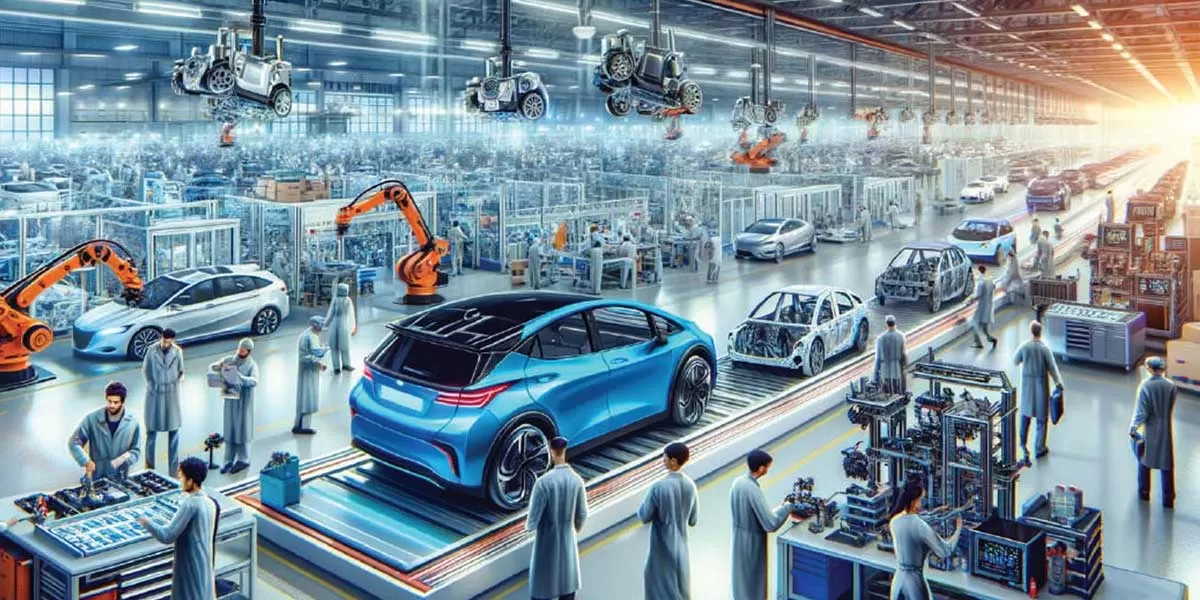
Indian automotive companies are increasing localisation for EV parts
ECONOMY & POLICY

Indian automotive companies are increasing localisation for EV parts

In response to India's push for reduced reliance on imported EV components, JSW MG Motor India is ramping up local sourcing. The government's production-linked incentive schemes for electric vehicles and parts have prompted these efforts.

Rajeev Chaba, CEO Emeritus, JSW MG Motor India, highlighted that while the company initially imported batteries for its EVs, it now assembles them at its Hallol plant. Future plans include local production of battery cells, with JSW Group aiming to start manufacturing them. Currently, all EV manufacturers import these cells, mostly from China. Chaba announced that localisation levels are increasing across their range. The Comet EV is already 60% localised, the ZS EV is 30-40% localised, and the new MG Windsor CUV, set to launch in a few weeks, will eventually reach 80% localisation.

The Windsor CUV is anticipated to be priced below Rs 2 million, between the existing Comet and ZS EV models. Chaba noted that with just two EV models, the company holds a 17% share of the EV market and aims to grow 250% this year. Currently, 40% of their sales are electric vehicles.

To support the growing EV ecosystem, MG Motor India has launched eHUB, a unified charging platform in partnership with Adani Total Energies, BPCL, Chargezone, Glida, and HPCL. eHUB allows users to reserve, navigate, and pay for charging slots, and is accessible to vehicles from any OEM.

Additionally, the company introduced project REVIVE with TERI, Lohum, and BatX, focusing on repurposing EV batteries for renewable energy storage, promoting a circular economy.

MG Motor also announced that all upcoming models will feature the MG-Jio Innovative Connectivity Platform (MG-Jio ICP), which includes an in-car app store for gaming, entertainment, and learning.

(ET)

In response to India's push for reduced reliance on imported EV components, JSW MG Motor India is ramping up local sourcing. The government's production-linked incentive schemes for electric vehicles and parts have prompted these efforts. Rajeev Chaba, CEO Emeritus, JSW MG Motor India, highlighted that while the company initially imported batteries for its EVs, it now assembles them at its Hallol plant. Future plans include local production of battery cells, with JSW Group aiming to start manufacturing them. Currently, all EV manufacturers import these cells, mostly from China. Chaba announced that localisation levels are increasing across their range. The Comet EV is already 60% localised, the ZS EV is 30-40% localised, and the new MG Windsor CUV, set to launch in a few weeks, will eventually reach 80% localisation. The Windsor CUV is anticipated to be priced below Rs 2 million, between the existing Comet and ZS EV models. Chaba noted that with just two EV models, the company holds a 17% share of the EV market and aims to grow 250% this year. Currently, 40% of their sales are electric vehicles. To support the growing EV ecosystem, MG Motor India has launched eHUB, a unified charging platform in partnership with Adani Total Energies, BPCL, Chargezone, Glida, and HPCL. eHUB allows users to reserve, navigate, and pay for charging slots, and is accessible to vehicles from any OEM. Additionally, the company introduced project REVIVE with TERI, Lohum, and BatX, focusing on repurposing EV batteries for renewable energy storage, promoting a circular economy. MG Motor also announced that all upcoming models will feature the MG-Jio Innovative Connectivity Platform (MG-Jio ICP), which includes an in-car app store for gaming, entertainment, and learning. (ET)

Next Story
Infrastructure Urban

Jyoti Structures FY26 profit rises 56.5%

Jyoti Structures (JSL) recently reported strong financial results for the quarter and year ended 31 March 2026, driven by disciplined execution, cost management and steady progress across its order book.For Q4 FY2025-26, total income rose 44.2 per cent to Rs 2.41 billion from Rs 1.67 billion in Q4 FY2024-25. EBITDA increased 58.6 per cent to Rs 237 million, while EBITDA margin improved by 89 basis points to 9.84 per cent. Profit before tax grew 53.3 per cent to Rs 188.5 million, and net profit rose 51.9 per cent to Rs 181.4 million.For FY2025-26, total income grew 53.1 per cent to Rs 7.72 bill..

Next Story
Infrastructure Energy

Cat BEPU to Power Doppstadt Separator at IFAT 2026

Caterpillar’s Cat Battery Electric Power Unit (BEPU) has been selected by Doppstadt to power its SWS 6 Spiral Shaft Separator, which will be showcased for the first time at IFAT 2026 in Munich, Germany, from 4–7 May.The compact plug-and-play BEPU is designed to replace a diesel engine within the same space, using the same mounting locations and relative machine position. It integrates the battery, motor, inverter, onboard charging, cooling and controls, enabling OEMs to electrify existing chassis platforms without extensive redesign.Caterpillar and Cat dealer Zeppelin Power Systems have be..

Next Story
Infrastructure Urban

VECV sales rise 6.9% in April 2026

VE Commercial Vehicles, a joint venture between Volvo Group and Eicher Motors, recorded sales of 7,318 units in April 2026, compared to 6,846 units in April 2025, registering 6.9 per cent growth. The total included 7,159 units under the Eicher brand and 159 units under the Volvo brand.Eicher branded trucks and buses reported sales of 7,159 units during the month, up 6.6 per cent from 6,717 units in April 2025. In the domestic commercial vehicle market, Eicher sales rose 8.6 per cent to 6,797 units from 6,257 units a year earlier.Exports declined 21.3 per cent, with VECV recording 362 units in ..

Advertisement

Subscribe to Our Newsletter

Get daily newsletters around different themes from Construction world.

STAY CONNECTED

Advertisement

Advertisement

Advertisement