India’s Record Crude Imports Shift Balance Between Russia and Gulf
ECONOMY & POLICY

India’s Record Crude Imports Shift Balance Between Russia and Gulf

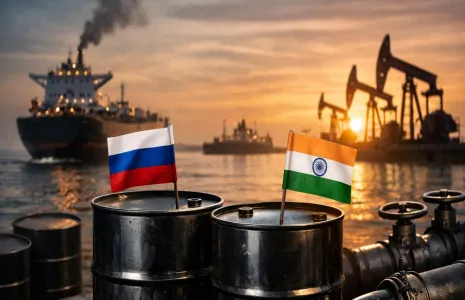
India’s crude oil imports reached a record 5.6 mn barrels per day in October, as refiners increased purchases from both the Middle East and Russia. Data from energy intelligence firm Kpler showed that Middle Eastern supplies accounted for about 2.3 mn barrels per day, while Russian crude flows remained strong at around 2 mn barrels per day.

Higher ship-to-ship transfers supported the movement of additional crude through the Strait of Hormuz during September and October. The recovery in Gulf supplies gave Indian refiners greater flexibility, allowing them to balance Russian and Middle Eastern barrels according to delivered prices, availability and supply security.

Russian shipments could moderate in November and December as attacks in the Black Sea push up freight rates. The resulting increase in landed costs may make Russian crude less competitive, while Gulf suppliers are offering more attractive delivered prices to regain market share in India.

However, any renewed disruption to flows through the Strait of Hormuz could encourage Indian refiners to return to Russian crude, even if transportation costs rise. An October 16 waiver under the Graham Act could also reduce concerns among some Indian buyers about the risks associated with purchasing Russian oil, giving refiners greater procurement flexibility.

India imports nearly 90 per cent of its crude requirements, making the availability and landed cost of alternative supplies critical to refinery economics. Russia became a major supplier after the invasion of Ukraine in February 2022, when Western sanctions, an European Union ban on seaborne Russian crude and the G7 price cap disrupted established trade flows.

Moscow’s discounts drew Indian buyers, with Russian Urals at times trading about USD 30 a barrel below Brent in late 2022 and early 2023. Although those discounts have largely disappeared, Middle Eastern supply disruptions have kept Russian barrels important. India’s sourcing decisions are likely to remain shaped primarily by commercial considerations and supply security rather than geopolitics alone.

India’s crude oil imports reached a record 5.6 mn barrels per day in October, as refiners increased purchases from both the Middle East and Russia. Data from energy intelligence firm Kpler showed that Middle Eastern supplies accounted for about 2.3 mn barrels per day, while Russian crude flows remained strong at around 2 mn barrels per day. Higher ship-to-ship transfers supported the movement of additional crude through the Strait of Hormuz during September and October. The recovery in Gulf supplies gave Indian refiners greater flexibility, allowing them to balance Russian and Middle Eastern barrels according to delivered prices, availability and supply security. Russian shipments could moderate in November and December as attacks in the Black Sea push up freight rates. The resulting increase in landed costs may make Russian crude less competitive, while Gulf suppliers are offering more attractive delivered prices to regain market share in India. However, any renewed disruption to flows through the Strait of Hormuz could encourage Indian refiners to return to Russian crude, even if transportation costs rise. An October 16 waiver under the Graham Act could also reduce concerns among some Indian buyers about the risks associated with purchasing Russian oil, giving refiners greater procurement flexibility. India imports nearly 90 per cent of its crude requirements, making the availability and landed cost of alternative supplies critical to refinery economics. Russia became a major supplier after the invasion of Ukraine in February 2022, when Western sanctions, an European Union ban on seaborne Russian crude and the G7 price cap disrupted established trade flows. Moscow’s discounts drew Indian buyers, with Russian Urals at times trading about USD 30 a barrel below Brent in late 2022 and early 2023. Although those discounts have largely disappeared, Middle Eastern supply disruptions have kept Russian barrels important. India’s sourcing decisions are likely to remain shaped primarily by commercial considerations and supply security rather than geopolitics alone.

Related Stories

Gold Stories

Next Story
Infrastructure Urban

Jupiter Wagons Wins Rs. 3.24 bn ACT2 Wagon Orders from Private Firms

Jupiter Wagons has secured private-sector orders worth more than Rs. 3.24 bn from GATX India and Chetak International for its ACT2 automobile carrier wagons. The company announced the orders on 2 November 2026, saying the contracts would strengthen its business with private wagon-leasing and logistics operators. GATX India has issued a Letter of Intent (LOI) for the manufacture and supply of 10 rakes comprising 270 ACT2 wagons. The LOI is valued at Rs. 2.15 bn and covers the production and delivery of the company’s new-design automobile carrier platform. Chetak International has separately p..

Next Story
Infrastructure Urban

Tata Motors Takes Control of Iveco with 89.42 Per Cent Stake

Tata Motors has taken control of Italian commercial-vehicle maker Iveco after acquiring an 89.42 per cent stake for approximately €3.43 bn, or Rs. 363.87 bn. The transaction gives India’s largest commercial-vehicle manufacturer control of a European business with annual revenue of Rs. 1.42 tn, while shifting attention to integration, cash-flow generation and repayment of acquisition debt. TML CV Holdings B.V., Tata Motors’ indirect wholly owned subsidiary, acquired 238.16 mn common shares at €14.40 apiece. The holding represents 89.42 per cent of Iveco’s common share capital, excludi..

Next Story
Building Material

Ambuja Cements to Invest Rs. 145 bn to Raise Capacity by FY30

Ambuja Cements will invest Rs. 145 bn to expand its cement capacity to 155 mn tonnes per annum by fiscal 2030. The planned investment, equivalent to $1.53 bn, will increase production capacity from the company’s current level of 113.5 MTPA. The company expects capacity to reach 119 MTPA by March 2027, with the wider expansion programme adding facilities across several major cement markets. The investment is intended to support the company’s long-term growth and strengthen its manufacturing network in India. The new capacity will be developed across Assam, Bihar, Jharkhand, Gujarat, Maharas..

Advertisement

Subscribe to Our Newsletter

Get daily newsletters around different themes from Construction world.

STAY CONNECTED

Advertisement

SPECIAL OFFER
QR Code