+
Industry Leaders Debate AI Agents And The Future Of SaaS
ECONOMY & POLICY

Industry Leaders Debate AI Agents And The Future Of SaaS

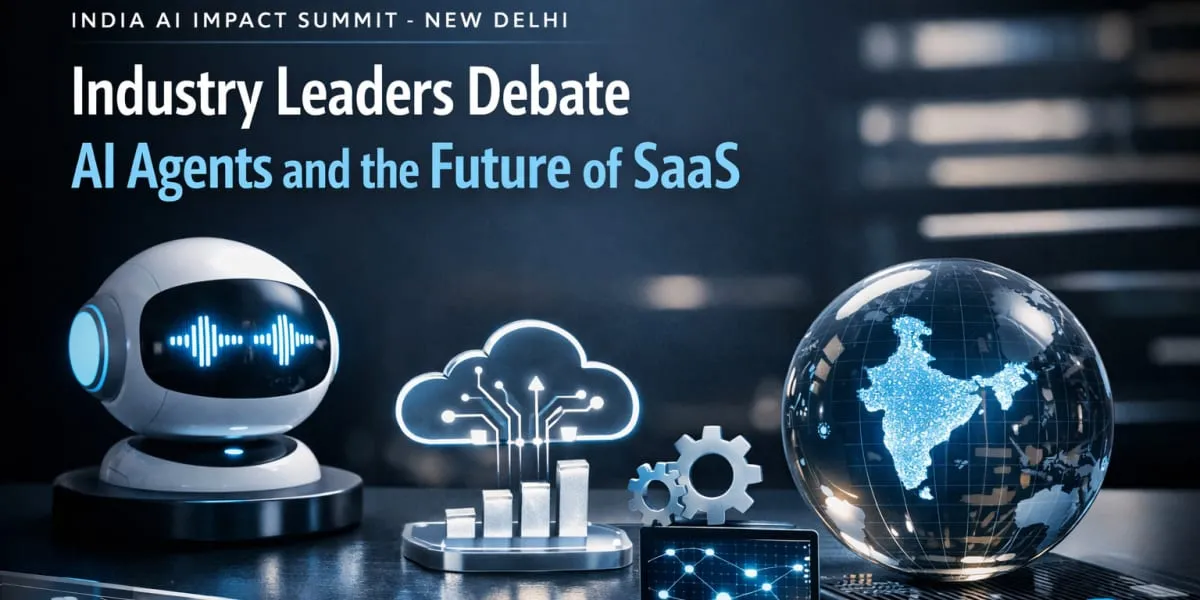
At the India AI Impact Summit in New Delhi, a high-level panel of industry chiefs explored whether AI agents are fundamentally disrupting the traditional Software as a Service model. Panel included Salil Parekh, Chief Executive Officer of Infosys; K. Krithivasan, Chief Executive Officer of Tata Consultancy Services; C Vijayakumar, Chief Executive Officer and Managing Director of HCL Technologies; and Arundhati Bhattacharya, Chairperson and Chief Executive Officer of Salesforce India. The discussion was moderated by Amitabh Kant and focused on enterprise readiness, operational change and customer-centred adoption.

Bhattacharya cautioned against market oversimplification and said that sustainable SaaS outcomes depend on understanding workflows, identifying customer pain points and driving adoption through observability, governance and auditability. She argued that changes in ways of working would not substitute for delivering real customer value and that long term sustainability requires demonstrable outcomes. The panel stressed that application development must be aligned with enterprise processes rather than mere interface or coding trends.

Krithivasan described a shift in the software engineer role towards high level architecture and rigorous validation while noting that enterprise adoption requires significant groundwork from data rationalisation to application modernisation. He predicted expansion in the volume and complexity of what can be produced rather than contraction of the sector. Vijayakumar underlined that large language and foundational models are not yet optimally applicable to many enterprise use cases and explained that his firm is building intellectual property and specialised services, including physical AI and agentic AI, to bridge the gap.

Parekh highlighted the scale of opportunity, saying that AI was creating a 300 billion (bn) dollar services opportunity and pointing to legacy modernisation as an example where orchestration of foundation models with specialised agents can unlock measurable value. The panel concluded that AI agents would reshape business and operating models but would not render them obsolete overnight. Success in the AI era would depend on agility, enterprise readiness, orchestration and the continuous ability to solve real customer problems in complex digital ecosystems.

At the India AI Impact Summit in New Delhi, a high-level panel of industry chiefs explored whether AI agents are fundamentally disrupting the traditional Software as a Service model. Panel included Salil Parekh, Chief Executive Officer of Infosys; K. Krithivasan, Chief Executive Officer of Tata Consultancy Services; C Vijayakumar, Chief Executive Officer and Managing Director of HCL Technologies; and Arundhati Bhattacharya, Chairperson and Chief Executive Officer of Salesforce India. The discussion was moderated by Amitabh Kant and focused on enterprise readiness, operational change and customer-centred adoption. Bhattacharya cautioned against market oversimplification and said that sustainable SaaS outcomes depend on understanding workflows, identifying customer pain points and driving adoption through observability, governance and auditability. She argued that changes in ways of working would not substitute for delivering real customer value and that long term sustainability requires demonstrable outcomes. The panel stressed that application development must be aligned with enterprise processes rather than mere interface or coding trends. Krithivasan described a shift in the software engineer role towards high level architecture and rigorous validation while noting that enterprise adoption requires significant groundwork from data rationalisation to application modernisation. He predicted expansion in the volume and complexity of what can be produced rather than contraction of the sector. Vijayakumar underlined that large language and foundational models are not yet optimally applicable to many enterprise use cases and explained that his firm is building intellectual property and specialised services, including physical AI and agentic AI, to bridge the gap. Parekh highlighted the scale of opportunity, saying that AI was creating a 300 billion (bn) dollar services opportunity and pointing to legacy modernisation as an example where orchestration of foundation models with specialised agents can unlock measurable value. The panel concluded that AI agents would reshape business and operating models but would not render them obsolete overnight. Success in the AI era would depend on agility, enterprise readiness, orchestration and the continuous ability to solve real customer problems in complex digital ecosystems.

Next Story
Equipment

Kabelschlepp India Installs Robotic VMC in Bengaluru

Kabelschlepp India, part of the Tsubaki Group, has installed a state-of-the-art Vertical Machining Center (VMC) integrated with robotic automation at its Bengaluru facility. The inauguration was held in the presence of Henning Preis, President & CEO, Kabelschlepp Group, Jörg Schulz, Vice President – Production, and Srinivas P. Kamisetty, Managing Director, Kabelschlepp India.The high-precision CNC VMC is designed for advanced milling, drilling, tapping and multi-axis machining. Equipped with a vertical spindle orientation, automatic tool changer and intelligent CNC control system, it en..

Next Story
Infrastructure Transport

Highway Delivery Reset!

Project delays and inefficiencies continue to bedevil the progress of India’s National Highways network. A multi-pronged reform agenda is needed to inject greater transparency and accountability at every stage – from planning and procurement to execution, maintenance and oversight. This article offers key recommendations and reform strategies that government stakeholders – from the Ministry of Road Transport & Highways (MoRTH) and the National Highways Authority of India (NHAI) to state agencies and oversight bodies – should pursue to put highway development on a better track.Decen..

Next Story
Infrastructure Transport

MSIDC Executes ₹37,000 Crore Road Programme

With Rs 37,000 crore worth of road projects under execution across Maharashtra, Maharashtra State Infrastructure Development Corporation (MSIDC) is driving one of the state’s largest infrastructure programmes. Dr Brijesh Dixit, Managing Director, discusses the institutional reforms, execution frameworks, financing strategies and technology adoption enabling timely, high-quality delivery, in conversation with PRATAP PADODE, Editor-in-Chief, CW.With over Rs 37,000 crore worth of road projects underway across districts – many under tight timelines – what institutional and executio..

Advertisement

Subscribe to Our Newsletter

Get daily newsletters around different themes from Construction world.

STAY CONNECTED

Advertisement

Advertisement

Advertisement

Open In App