+
INSA And CSIR-NIScPR Sign MoU To Advance Science Policy Research
ECONOMY & POLICY

INSA And CSIR-NIScPR Sign MoU To Advance Science Policy Research

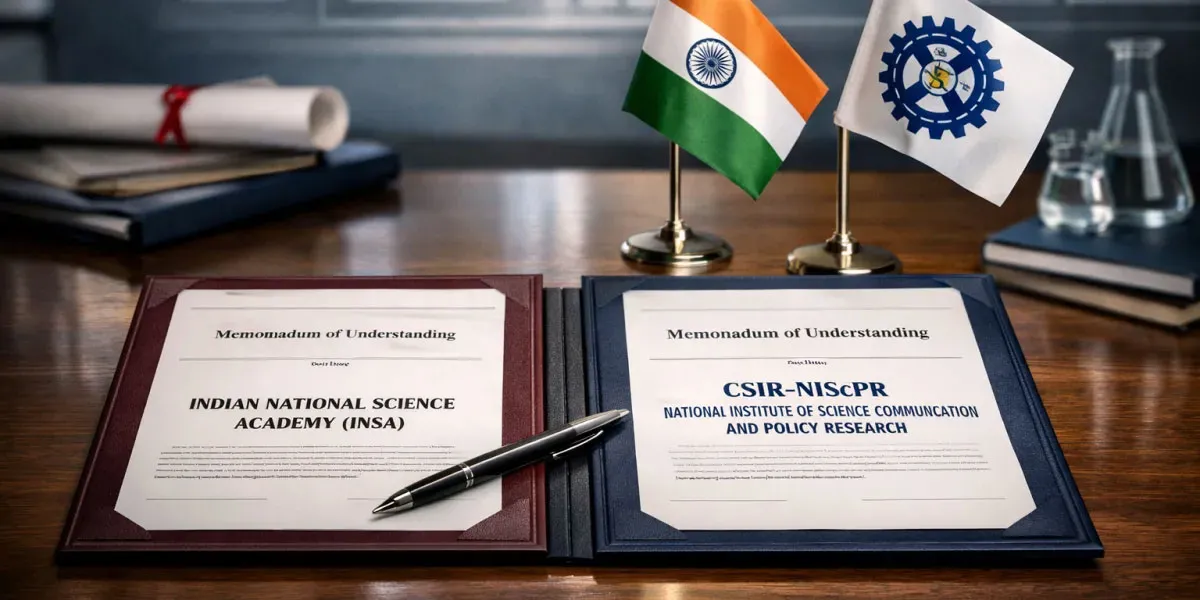
Indian National Science Academy (INSA) and the National Institute of Science Communication and Policy Research (CSIR-NIScPR) signed a memorandum of understanding on 10 February 2026 at INSA in New Delhi to promote collaborative work on science communication and evidence-based science policy research. The agreement aims to strengthen evidence-based policymaking and to advance science, technology and innovation policy research in India. The partnership will support coordinated policy studies, outreach and capacity building.

The programme began with welcome remarks from Dr Brajesh Pandey, executive director of INSA, and a presentation by Dr Akhilesh Gupta, former senior adviser at the Department of Science and Technology (DST), who set out the genesis and rationale of the MoU and emphasised the need for sustained institutional collaboration. Speakers argued for stronger links between research and policy to provide robust evidence for decision making. The initiative was presented as a response to rapid technological change.

Dr Geetha Vani Rayasam, director of CSIR-NIScPR, said the institutions are complementary and that the partnership would enable them to pool strengths in science communication, policy research and academic engagement. Prof Anurag Agrawal, vice president for policy at INSA, highlighted the importance of designing effective policies to guide India towards a sustainable and future ready science and innovation ecosystem. Prof Shekhar C. Mande, president of INSA, reflected on the shared legacy and the significance of collaboration amid fast scientific transformation.

Dr V. K. Saraswat, member of NITI Aayog, congratulated both institutions and stressed the need for policy frameworks that support responsible and human centric adoption of disruptive technologies, noting the value of pilot studies and digital twins for assessing policy measures. The MoU sets out collaborative policy research, joint publications, pilot projects, capacity building initiatives, outreach programmes and stakeholder consultations. It will also facilitate engagement with government bodies, international organisations, think tanks, researchers and young scholars to strengthen India's science, technology and innovation policy ecosystem.

Indian National Science Academy (INSA) and the National Institute of Science Communication and Policy Research (CSIR-NIScPR) signed a memorandum of understanding on 10 February 2026 at INSA in New Delhi to promote collaborative work on science communication and evidence-based science policy research. The agreement aims to strengthen evidence-based policymaking and to advance science, technology and innovation policy research in India. The partnership will support coordinated policy studies, outreach and capacity building. The programme began with welcome remarks from Dr Brajesh Pandey, executive director of INSA, and a presentation by Dr Akhilesh Gupta, former senior adviser at the Department of Science and Technology (DST), who set out the genesis and rationale of the MoU and emphasised the need for sustained institutional collaboration. Speakers argued for stronger links between research and policy to provide robust evidence for decision making. The initiative was presented as a response to rapid technological change. Dr Geetha Vani Rayasam, director of CSIR-NIScPR, said the institutions are complementary and that the partnership would enable them to pool strengths in science communication, policy research and academic engagement. Prof Anurag Agrawal, vice president for policy at INSA, highlighted the importance of designing effective policies to guide India towards a sustainable and future ready science and innovation ecosystem. Prof Shekhar C. Mande, president of INSA, reflected on the shared legacy and the significance of collaboration amid fast scientific transformation. Dr V. K. Saraswat, member of NITI Aayog, congratulated both institutions and stressed the need for policy frameworks that support responsible and human centric adoption of disruptive technologies, noting the value of pilot studies and digital twins for assessing policy measures. The MoU sets out collaborative policy research, joint publications, pilot projects, capacity building initiatives, outreach programmes and stakeholder consultations. It will also facilitate engagement with government bodies, international organisations, think tanks, researchers and young scholars to strengthen India's science, technology and innovation policy ecosystem.

Next Story
Real Estate

Casagrand Launches Keystone In Tiruppur

Casagrand has launched Casagrand Keystone, a gated residential development at Rakkiyapalayam, off Avinashi Road, in Tiruppur. Spread across 2.2 acres, the B+G+5 structure comprises 142 units of 2 and 3 BHK homes, supported by 48 indoor and outdoor amenities. The project is introduced at a starting price of Rs 5,199 per sq. ft. The development allocates 1.3 acres to open space, including a central park of about 24,500 sq. ft. A 6,800 sq. ft. clubhouse includes a multipurpose hall, mini theatre and indoor recreation facilities. Other amenities include a 5,100 sq. ft. swimming pool, poolside par..

Next Story
Real Estate

Premium homes account for half of India’s housing sales in 2025

Knight Frank India, in its latest report on India’s office and residential property market, has highlighted a significant shift in housing demand, with homes priced above Rs 10 million accounting for 50 per cent of total residential sales across the top eight cities in 2025. The findings underscore the growing dominance of premium housing in the country’s real estate landscape.Out of 348,247 residential units sold during the year, approximately 175,091 units were in the Rs 10 million-plus category, marking a 14 per cent year-on-year increase. The data reflects changing buyer preferences, w..

Next Story
Infrastructure Energy

Xbattery launches XB-5K energy storage system for homes, offices

Xbattery, a Hyderabad-based deep-tech company specialising in next-generation energy storage and battery management technologies, has introduced its flagship XB-5K, a scalable 5kWh energy storage system designed for homes and offices in India.The XB-5K is built on the company’s indigenously developed BharatBMS platform, described as India’s first universal high-voltage battery management system architecture aimed at reducing import dependence and improving after-sales service capabilities. The launch comes as India seeks to strengthen domestic manufacturing and address reliance on imported..

Advertisement

Subscribe to Our Newsletter

Get daily newsletters around different themes from Construction world.

STAY CONNECTED

Advertisement

Advertisement

Advertisement

Open In App