IRB Sees 21 Per Cent Toll Revenue Rise In March 2026
ECONOMY & POLICY

IRB Sees 21 Per Cent Toll Revenue Rise In March 2026

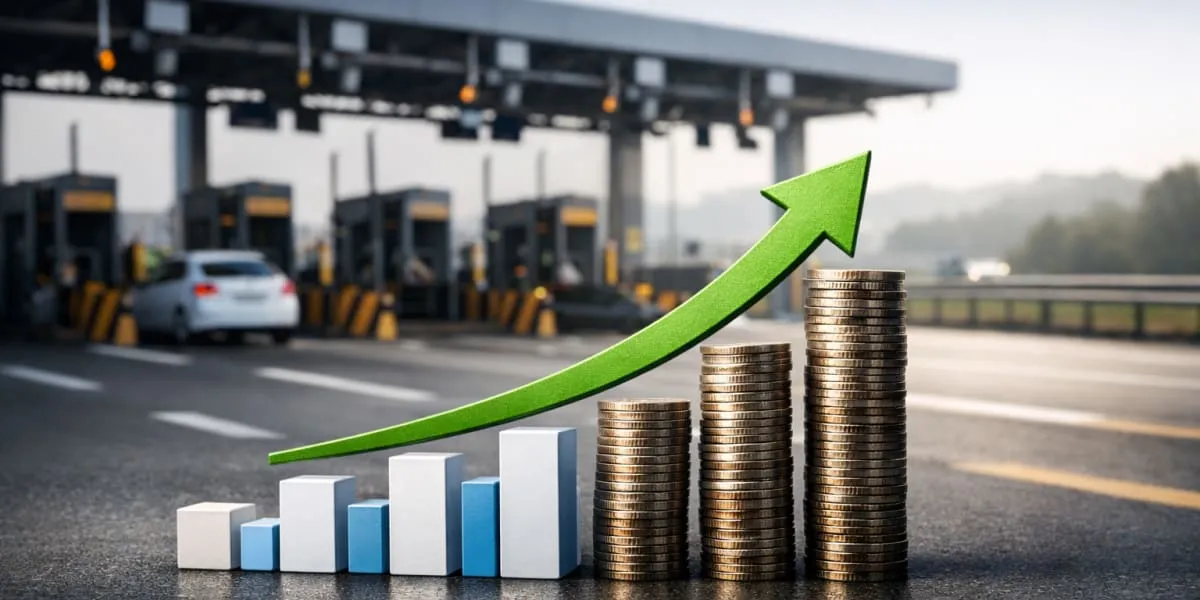
IRB Infrastructure Developers Ltd reported toll revenue of Rs 7,835 mn in March 2026, representing a 21 per cent year-on-year increase from Rs 6,489 mn in March 2025, according to a stock exchange filing on April 9, 2026. The rise reflected stronger traffic momentum across key corridors and the impact of newly operational toll-generating assets. The company attributed the improvement to a combination of higher vehicle volumes and operational measures to optimise tolling efficiency.

Among the top contributors, IRB MP Expressway led with Rs 1,651 mn, followed by IRB Ahmedabad Vadodara Super Express Tollway at Rs 810 mn and IRB Golconda Expressway at Rs 801 mn. Newly commissioned assets also bolstered collections, with IRB Harihara Corridors contributing Rs 536 mn after tolling commenced on January 23, 2026. Assets acquired in November 2025, including Kaithal and Kishangarh Gulabpura tollways, continued to strengthen overall monthly receipts. The mix of mature corridors and recently added stretches produced a balanced uplift across the network.

Deputy CEO Amitabh Murarka indicated that the monthly growth was supported by recently commissioned assets, including a TOT project in Odisha, and that upcoming concessions such as the Ganga Expressway were expected to further accelerate revenue. He also noted that tariff revisions across existing assets provided an additional lever supporting near-term performance. Management emphasised ongoing focus on traffic management and maintenance to preserve service levels while realising revenue gains.

For the financial year 2026, the IRB Group reported total toll revenue of Rs 83.23 bn, representing roughly ten per cent of India's total toll collections of Rs 829 bn. The company's diversified portfolio of operational highways and continued expansion through new concessions underpinned its dominant position in the sector and supported expectations of continued growth into FY27. Analysts expect the platform of concessions to provide resilient cash flows as new projects stabilise traffic patterns.

IRB Infrastructure Developers Ltd reported toll revenue of Rs 7,835 mn in March 2026, representing a 21 per cent year-on-year increase from Rs 6,489 mn in March 2025, according to a stock exchange filing on April 9, 2026. The rise reflected stronger traffic momentum across key corridors and the impact of newly operational toll-generating assets. The company attributed the improvement to a combination of higher vehicle volumes and operational measures to optimise tolling efficiency. Among the top contributors, IRB MP Expressway led with Rs 1,651 mn, followed by IRB Ahmedabad Vadodara Super Express Tollway at Rs 810 mn and IRB Golconda Expressway at Rs 801 mn. Newly commissioned assets also bolstered collections, with IRB Harihara Corridors contributing Rs 536 mn after tolling commenced on January 23, 2026. Assets acquired in November 2025, including Kaithal and Kishangarh Gulabpura tollways, continued to strengthen overall monthly receipts. The mix of mature corridors and recently added stretches produced a balanced uplift across the network. Deputy CEO Amitabh Murarka indicated that the monthly growth was supported by recently commissioned assets, including a TOT project in Odisha, and that upcoming concessions such as the Ganga Expressway were expected to further accelerate revenue. He also noted that tariff revisions across existing assets provided an additional lever supporting near-term performance. Management emphasised ongoing focus on traffic management and maintenance to preserve service levels while realising revenue gains. For the financial year 2026, the IRB Group reported total toll revenue of Rs 83.23 bn, representing roughly ten per cent of India's total toll collections of Rs 829 bn. The company's diversified portfolio of operational highways and continued expansion through new concessions underpinned its dominant position in the sector and supported expectations of continued growth into FY27. Analysts expect the platform of concessions to provide resilient cash flows as new projects stabilise traffic patterns.

Next Story
Technology

India Data Centre Market to Cross USD 22 Bn by 2030: Vestian

India’s data centre market is projected to more than double from around USD 10 billion in 2025 to USD 22 billion by 2030, according to a latest report by Vestian. The growth is expected to be driven by rising cloud adoption, expanding AI workloads and increasing demand for data-intensive digital services.Vestian noted that the global data centre sector is witnessing rapid expansion, with current installed capacity estimated at 40–50 GW and projections exceeding 100 GW by 2030. Within this evolving landscape, India is emerging as a strategic hub in the Asia-Pacific region, supported by its ..

Next Story
Real Estate

Retail Leasing Hits 4.3 Mn Sq Ft in H2 2025: ANAROCK RELEAP 2026

India’s retail real estate market recorded a total retail absorption of around 4.3 million sq ft across the top seven cities in H2 2025, reflecting steady leasing activity despite a dynamic market environment, according to ANAROCK Retail’s flagship report, RELEAP 2026.The report highlights a structural shift in the sector as organised retail moves beyond transactional formats toward experience-led spaces that combine shopping, entertainment and dining. Apparel emerged as the leading category driving leasing demand during the period, followed by entertainment, hypermarkets/supermarkets, and..

Next Story
Building Material

Berger Paints Launches ‘Garmi Gone, Thandak On’ Cooling Range

Berger Paints India has launched its Home Cooling Paints Range along with a nationwide campaign titled ‘Garmi Gone, Thandak On’, as rising temperatures continue to pose growing challenges for households across India.The company said the campaign promotes smarter and energy-efficient cooling solutions by focusing on preventing heat from entering homes rather than relying solely on air conditioning. Berger Paints stated that a significant amount of heat enters homes through walls, rooftops and structural openings, making surface protection an important factor in reducing indoor discomfort du..

Advertisement

Subscribe to Our Newsletter

Get daily newsletters around different themes from Construction world.

STAY CONNECTED

Advertisement

Advertisement

Advertisement