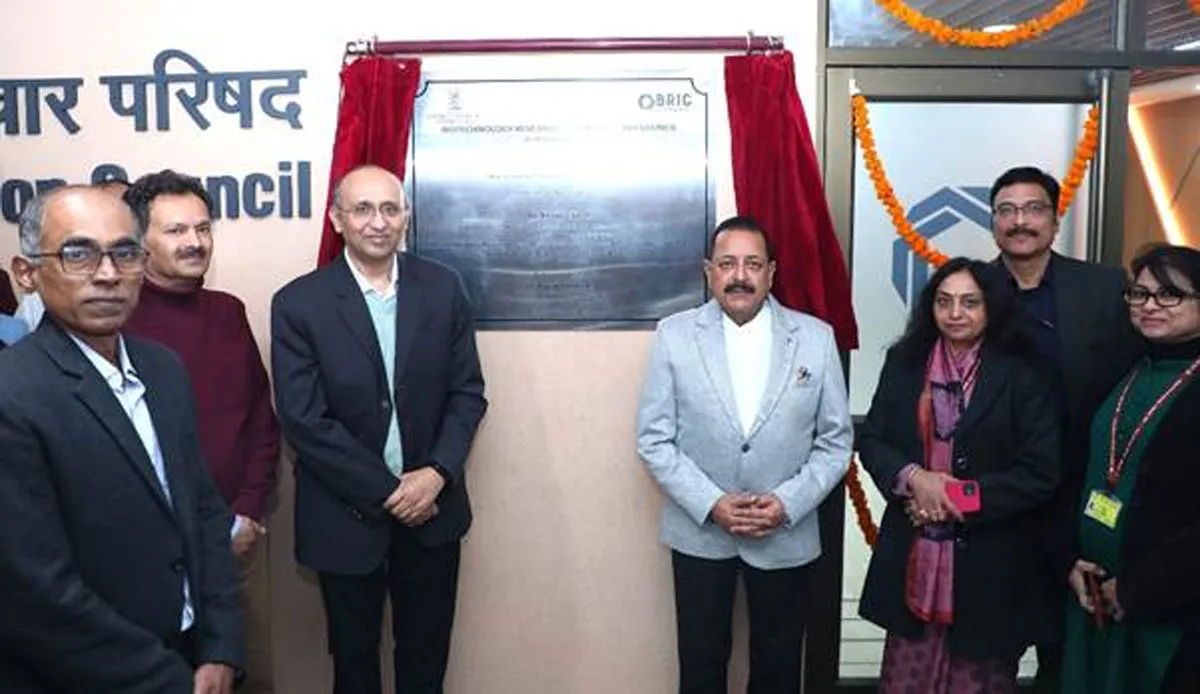
Jitendra Singh Inaugurates BRIC Secretariat In New Delhi
ECONOMY & POLICY

Jitendra Singh Inaugurates BRIC Secretariat In New Delhi

Ahead of the New Year, Union Minister of State (Independent Charge) for Science and Technology and Earth Sciences, and Minister of State in the PMO, Personnel, Public Grievances, Pensions, Atomic Energy and Space, Dr Jitendra Singh inaugurated the new Secretariat complex of the Biotechnology Research and Innovation Council (BRIC), calling it a key milestone for strengthening India’s future bioeconomy.

The BRIC Secretariat office complex is located on the fourth floor of the NSIC Business Park in New Delhi. It will function as a lean coordinating mechanism to enhance collaboration among BRIC’s 14 autonomous institutions, while preserving their independence and reinforcing linkages with the Department of Biotechnology (DBT), other research and development institutions, and industry.

Following the inauguration, the Minister chaired a detailed review meeting of BRIC’s initiatives. Secretary, DBT and Director-General, BRIC, Dr Rajesh S. Gokhale presented an overview of the Council’s achievements since inception and the progress of ongoing programmes. He highlighted BRIC’s role in advancing the Department’s biomanufacturing agenda under the BioE3 Policy, including plans to develop BioE3 Parks. These parks are envisioned as integrated ecosystems where BRIC institutions’ R&D hubs, start-ups, MSMEs and large industries can co-locate, enabling a smoother transition from research to pilot-scale manufacturing and commercialisation.

Commending the progress made, Dr Jitendra Singh said BRIC institutions are poised to play a defining role in national development through biomanufacturing and biosciences, in line with the vision of Viksit Bharat 2047. He stressed the importance of a collaborative, whole-of-government and whole-of-society approach to address structural challenges, break institutional silos and accelerate India’s global standing in biotechnology research and innovation.

The Minister also interacted with senior officers and representatives from various departments and State Governments during a round-table discussion. He noted that the government’s reform philosophy over the past decade has focused on simplifying systems by removing redundant rules rather than adding new ones, supported by large-scale rationalisation of service rules, abolition of outdated practices and the use of technology to enhance transparency.

Dr Jitendra Singh acknowledged the proactive role played by the Department of Biotechnology, with support from its industry arm, the Biotechnology Industry Research Assistance Council (BIRAC), in dismantling silos and fostering collaboration among stakeholders to promote innovative research, optimise resources and build future-ready human capital.

Directors of BRIC institutions reiterated the transformative potential of biology-led and biology-inspired technologies, underlining the need for indigenous biological data, robust biosecurity frameworks and sustained investment in human resource development. They reaffirmed their commitment to advancing BRIC’s collective vision and positioning India as a global hub for biotechnology and biomanufacturing, with continued support from BIRAC.

Ahead of the New Year, Union Minister of State (Independent Charge) for Science and Technology and Earth Sciences, and Minister of State in the PMO, Personnel, Public Grievances, Pensions, Atomic Energy and Space, Dr Jitendra Singh inaugurated the new Secretariat complex of the Biotechnology Research and Innovation Council (BRIC), calling it a key milestone for strengthening India’s future bioeconomy. The BRIC Secretariat office complex is located on the fourth floor of the NSIC Business Park in New Delhi. It will function as a lean coordinating mechanism to enhance collaboration among BRIC’s 14 autonomous institutions, while preserving their independence and reinforcing linkages with the Department of Biotechnology (DBT), other research and development institutions, and industry. Following the inauguration, the Minister chaired a detailed review meeting of BRIC’s initiatives. Secretary, DBT and Director-General, BRIC, Dr Rajesh S. Gokhale presented an overview of the Council’s achievements since inception and the progress of ongoing programmes. He highlighted BRIC’s role in advancing the Department’s biomanufacturing agenda under the BioE3 Policy, including plans to develop BioE3 Parks. These parks are envisioned as integrated ecosystems where BRIC institutions’ R&D hubs, start-ups, MSMEs and large industries can co-locate, enabling a smoother transition from research to pilot-scale manufacturing and commercialisation. Commending the progress made, Dr Jitendra Singh said BRIC institutions are poised to play a defining role in national development through biomanufacturing and biosciences, in line with the vision of Viksit Bharat 2047. He stressed the importance of a collaborative, whole-of-government and whole-of-society approach to address structural challenges, break institutional silos and accelerate India’s global standing in biotechnology research and innovation. The Minister also interacted with senior officers and representatives from various departments and State Governments during a round-table discussion. He noted that the government’s reform philosophy over the past decade has focused on simplifying systems by removing redundant rules rather than adding new ones, supported by large-scale rationalisation of service rules, abolition of outdated practices and the use of technology to enhance transparency. Dr Jitendra Singh acknowledged the proactive role played by the Department of Biotechnology, with support from its industry arm, the Biotechnology Industry Research Assistance Council (BIRAC), in dismantling silos and fostering collaboration among stakeholders to promote innovative research, optimise resources and build future-ready human capital. Directors of BRIC institutions reiterated the transformative potential of biology-led and biology-inspired technologies, underlining the need for indigenous biological data, robust biosecurity frameworks and sustained investment in human resource development. They reaffirmed their commitment to advancing BRIC’s collective vision and positioning India as a global hub for biotechnology and biomanufacturing, with continued support from BIRAC.

Next Story
Infrastructure Urban

Rosatom Delivers Nuclear Fuel for Kudankulam Unit 3

Rosatom has recently supplied nuclear fuel for the initial loading of the VVER-1000 reactor core at Unit 3 of the Kudankulam Nuclear Power Plant, marking a key milestone in the second stage of the Russian-designed nuclear power project in southern India.The fuel was supplied by Rosatom’s Nuclear Fuel Division, managed by TVEL, and manufactured at the Novosibirsk Chemical Concentrates Plant. The delivery includes the initial reactor load along with reserve fuel assemblies and is part of a long-term contract covering the entire operational life of Units 3 and 4.Building on operational experien..

Next Story
Infrastructure Transport

CBL International Enables First LNG Bunkering at Xiaomo Port

CBL International recently completed the first-ever LNG bunkering operation at Xiaomo Port, supplying liquefied natural gas to vessels operated by BYD in support of its maritime decarbonisation strategy. The operation was facilitated through a physical supplier in collaboration with China National Offshore Oil Corporation (CNOOC), which supported the port’s inaugural LNG bunkering activity. The milestone represents a strategic expansion of CBL International's sustainable fuel offerings beyond biofuels, while also diversifying revenue streams. As global shipping intensifies efforts to cut em..

Next Story
Infrastructure Urban

Aimtron, Aurassure Partner for IoT Weather Systems

Aimtron Electronics has recently entered into an OEM manufacturing engagement with Aurassure to produce new-age, IoT-enabled weather and environmental monitoring systems in India. The collaboration supports the growing demand for real-time environmental intelligence across urban, industrial and infrastructure applications. The engagement comes as global focus on climate-risk management and data-driven planning accelerates. The global weather monitoring systems market, valued at around USD 2.1 billion in 2024, is projected to reach nearly USD 4.8 billion by 2034, driven by the rapid adoption o..

Advertisement

Subscribe to Our Newsletter

Get daily newsletters around different themes from Construction world.

STAY CONNECTED

Advertisement

Advertisement

Advertisement

Advertisement

Open In App