
KP Group First In India To Install 4.2 MW Turbine
ECONOMY & POLICY

KP Group First In India To Install 4.2 MW Turbine

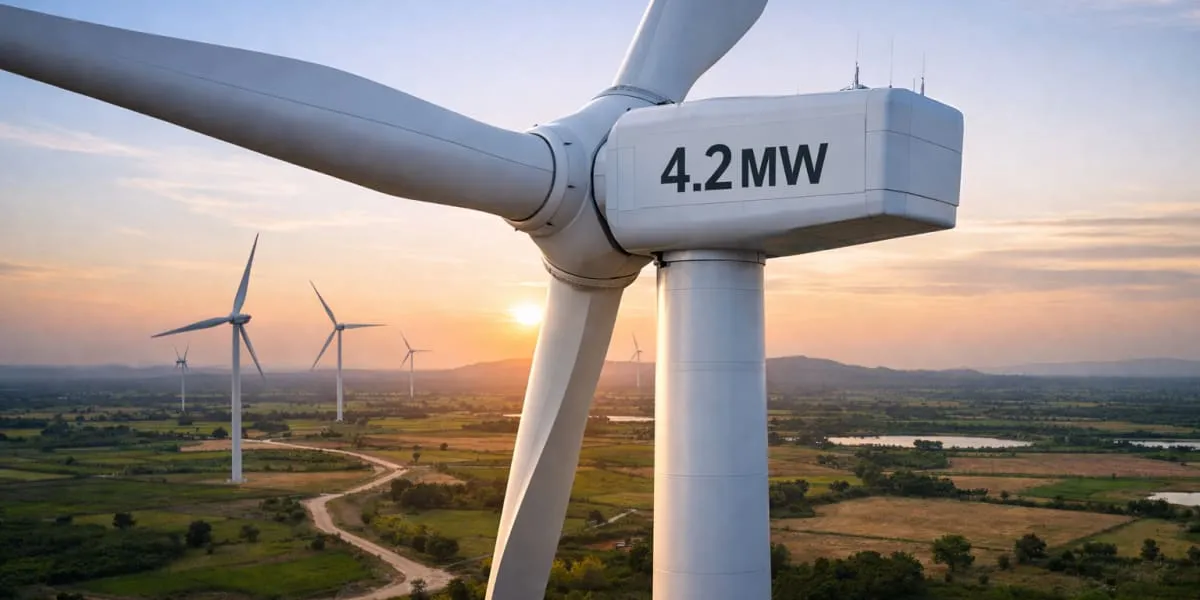
KP Group has become the first company in India to install the Make in India 4.2 megawatt (MW) wind turbine generator model 4.2M160 manufactured by Senvion India, marking a milestone in the adoption of next-generation wind technology. The turbine was installed at a site in south Gujarat, and the company said the deployment demonstrates its focus on larger, more efficient renewable solutions. The installation forms part of a broader strategy to upgrade existing assets and integrate higher-capacity machines across the group portfolio. The company said the milestone strengthens its credentials as a partner for scalable renewable projects.

The 4.2M160 has a rated capacity of four point two MW, a 160-metre rotor diameter and a 140-metre hub height, and is engineered to maximise energy capture in low-to-medium wind regimes. Its larger swept area and advanced control systems are intended to improve generation output and operational efficiency while optimising lifecycle performance for utility-scale projects. Design features also allow improved performance under variable wind speeds and reduced levelised cost of energy over the asset life. The machine’s site-optimised design is aimed at delivering a higher annual energy yield at comparable sites.

The 4XM platform features a modular architecture that enables efficient transportation, faster installation and streamlined commissioning, improving serviceability and operational reliability. The platform is engineered and manufactured in India with over 85 per cent localisation and was included in the Approved List of Models and Manufacturers in December 2025, the company said. Local manufacturing is expected to support domestic supply chains and reduce logistical complexity for large components.

KP Group traces its origins to 1994, when Dr Faruk G. Patel established the group, and over the past three decades it has expanded into renewable energy, infrastructure and innovation. The company said the installation reinforces its commitment to adopting advanced technologies that enhance generation efficiency and deliver long-term value and that operations and maintenance experience will inform future rollouts. The group intends to continue executing scalable renewable projects that contribute to India’s energy transition and national sustainability objectives.

KP Group has become the first company in India to install the Make in India 4.2 megawatt (MW) wind turbine generator model 4.2M160 manufactured by Senvion India, marking a milestone in the adoption of next-generation wind technology. The turbine was installed at a site in south Gujarat, and the company said the deployment demonstrates its focus on larger, more efficient renewable solutions. The installation forms part of a broader strategy to upgrade existing assets and integrate higher-capacity machines across the group portfolio. The company said the milestone strengthens its credentials as a partner for scalable renewable projects. The 4.2M160 has a rated capacity of four point two MW, a 160-metre rotor diameter and a 140-metre hub height, and is engineered to maximise energy capture in low-to-medium wind regimes. Its larger swept area and advanced control systems are intended to improve generation output and operational efficiency while optimising lifecycle performance for utility-scale projects. Design features also allow improved performance under variable wind speeds and reduced levelised cost of energy over the asset life. The machine’s site-optimised design is aimed at delivering a higher annual energy yield at comparable sites. The 4XM platform features a modular architecture that enables efficient transportation, faster installation and streamlined commissioning, improving serviceability and operational reliability. The platform is engineered and manufactured in India with over 85 per cent localisation and was included in the Approved List of Models and Manufacturers in December 2025, the company said. Local manufacturing is expected to support domestic supply chains and reduce logistical complexity for large components. KP Group traces its origins to 1994, when Dr Faruk G. Patel established the group, and over the past three decades it has expanded into renewable energy, infrastructure and innovation. The company said the installation reinforces its commitment to adopting advanced technologies that enhance generation efficiency and deliver long-term value and that operations and maintenance experience will inform future rollouts. The group intends to continue executing scalable renewable projects that contribute to India’s energy transition and national sustainability objectives.

Next Story
Building Material

Enlight Metals to Expand Raipur Plant Capacity

Enlight Metals has announced plans to expand the production capacity of its Raipur manufacturing facility from around 1,200 tonnes to nearly 4,000 tonnes.The expansion is aimed at strengthening the company’s ability to serve rising demand across industrial, infrastructure and contract manufacturing requirements.Located in Raipur, Chhattisgarh, the facility serves as a key manufacturing hub for Enlight Metals. The planned capacity enhancement is expected to improve supply capabilities, operational efficiency and the company’s ability to handle larger project requirements.The facility includ..

Next Story
Infrastructure Urban

Hindustan Zinc Partners Sulfozyme for Zinc Park Project

Hindustan Zinc has signed a Memorandum of Understanding with Sulfozyme Agro India under its Zinc Industrial Park initiative at Khankhala in Bhilwara district, Rajasthan. The partnership aims to strengthen India’s downstream zinc sector through sustainable metal recovery, resource efficiency and industrial development.Under the agreement, Sulfozyme Agro will establish proposed operations at the Zinc Industrial Park to process zinc-based materials into value-added products for industrial and downstream applications.Hindustan Zinc will support the venture through assured raw material linkage an..

Next Story
Infrastructure Urban

Cortec MCI Technology Restores Croatia Monuments

Cortec’s Migrating Corrosion Inhibitor technology has been used in restoration works for historic monuments in Croatia, including the Church of St Donatus in Zadar and the medieval city walls of Ilok.The Church of St Donatus, one of the most significant pre-Romanesque churches in Europe, is listed in the Register of Cultural Goods of the Republic of Croatia and is under UNESCO protection. The monument required urgent rehabilitation after 3D scanning analysis identified critical issues in the church walls, main structure and roof.The reinforced concrete support structure beneath the roof, ins..

Advertisement

Subscribe to Our Newsletter

Get daily newsletters around different themes from Construction world.

STAY CONNECTED

Advertisement

Advertisement

Advertisement