
Ludhiana Floats Tender for 50 EV Charging Stations
ECONOMY & POLICY

Ludhiana Floats Tender for 50 EV Charging Stations

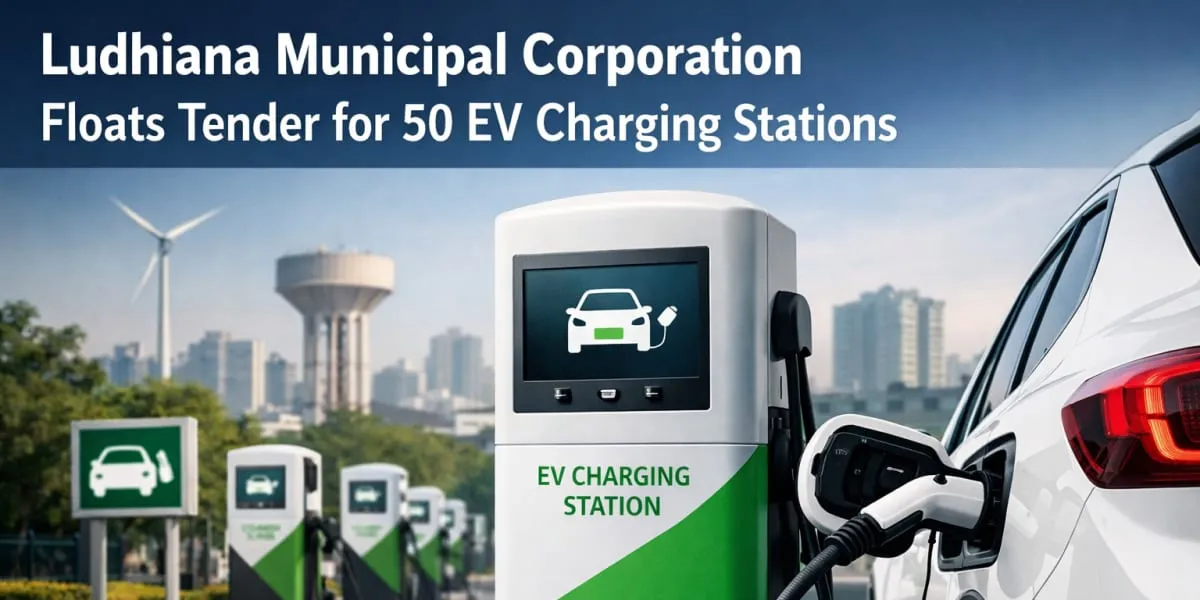
The Ludhiana Municipal Corporation has issued a tender to establish 50 electric vehicle charging stations under a 10-year public-private partnership to strengthen the city’s green mobility infrastructure. Electric vehicles now account for six per cent of the city’s vehicle registrations and the corporation has adopted a user-pays revenue model intended to make the project self-sustaining. The scheme is presented as part of a strategy to transition Ludhiana towards a low-carbon transport hub.

The tender is open only to central and state public-sector undertakings and the selected organisation will deliver the project. Work includes installation of AC and DC chargers, modular battery swapping points, digital integration with mobile applications, QR and RFID authentication and online payment systems. Stations must incorporate safety measures such as fire provisions, CCTV, weatherproof enclosures and drainage. The civic body will provide land and coordinate with power distribution companies for a stable energy supply.

Under the commercial model the municipal corporation will receive a minimum of Rs 1 per kilowatt-hour dispensed. Additional revenue is expected from advertising and space premiums, with a 50-50 split between the concessionaire and the corporation. The user-pays structure and mixed income streams are intended to support financial viability and reduce capital burden on municipal finances. Planned hubs will include IoT-enabled battery lockers and solar-integrated roofs where feasible, aligning with central government incentives to encourage electric mobility.

Officials described Ludhiana as a high-traffic strategic hub where existing infrastructure trails growing demand from cars, two-wheelers and commercial vehicles. The tender is intended to address that gap and to accommodate rising adoption of electric vehicles while supporting services for fleets and individual owners. Delivery by a public sector undertaking is expected to streamline coordination with state agencies and strengthen the charging and battery services ecosystem.

The Ludhiana Municipal Corporation has issued a tender to establish 50 electric vehicle charging stations under a 10-year public-private partnership to strengthen the city’s green mobility infrastructure. Electric vehicles now account for six per cent of the city’s vehicle registrations and the corporation has adopted a user-pays revenue model intended to make the project self-sustaining. The scheme is presented as part of a strategy to transition Ludhiana towards a low-carbon transport hub. The tender is open only to central and state public-sector undertakings and the selected organisation will deliver the project. Work includes installation of AC and DC chargers, modular battery swapping points, digital integration with mobile applications, QR and RFID authentication and online payment systems. Stations must incorporate safety measures such as fire provisions, CCTV, weatherproof enclosures and drainage. The civic body will provide land and coordinate with power distribution companies for a stable energy supply. Under the commercial model the municipal corporation will receive a minimum of Rs 1 per kilowatt-hour dispensed. Additional revenue is expected from advertising and space premiums, with a 50-50 split between the concessionaire and the corporation. The user-pays structure and mixed income streams are intended to support financial viability and reduce capital burden on municipal finances. Planned hubs will include IoT-enabled battery lockers and solar-integrated roofs where feasible, aligning with central government incentives to encourage electric mobility. Officials described Ludhiana as a high-traffic strategic hub where existing infrastructure trails growing demand from cars, two-wheelers and commercial vehicles. The tender is intended to address that gap and to accommodate rising adoption of electric vehicles while supporting services for fleets and individual owners. Delivery by a public sector undertaking is expected to streamline coordination with state agencies and strengthen the charging and battery services ecosystem.

Next Story
Equipment

Sanjay Saxena Passes Away, Leaving Behind a Powerful Industry Legacy

The construction equipment industry mourns the untimely demise of Sanjay Saxena, Chief Operating Officer (Sales, Marketing & Customer Support) at Sany India and South Asia, a respected leader whose vision and dedication left a lasting imprint on the sector. He was a seasoned professional with decades of experience across construction, material handling, port, and mining equipment industries. At Sany India, he played a pivotal role in steering the company’s growth, overseeing business operations across all six key verticals—Hoisting, Foundation, Port, Excavators, Road, and Mining. His strat..

Next Story
Infrastructure Urban

The Gateway of Guwahati

The Brahmaputra does not behave like an ordinary river. It shifts, swells and retreats with extraordinary force, carrying immense sediment loads from the Himalayas while constantly reshaping its own channel. In Guwahati, seasonal water levels can swing by nearly 10-11 m, transforming calm winter waters into a roaring monsoon current.Building permanent infrastructure in such conditions is notoriously difficult. Conventional river terminals – fixed jetties anchored to the riverbed – struggle to survive in an environment where currents intensify, sediment accumulates rapidly and the river’s..

Next Story
Building Material

Cement Excellence Redefined!

Operational excellence in cement is no longer about producing more – it is about producing smarter, cleaner and more reliably, where cost per tonne meets carbon per tonne.Operational excellence in cement has moved far beyond the old pursuit of ‘more tonne’. The new benchmark is smarter, cleaner, more reliable production, delivered with discipline across process, people and data. In an industry where energy can account for nearly 30 per cent of manufacturing cost, even marginal gains translate into meaningful value. As Dr SB Hegde, Professor, Jain College of Engineering & Technol..

Advertisement

Subscribe to Our Newsletter

Get daily newsletters around different themes from Construction world.

STAY CONNECTED

Advertisement

Advertisement

Advertisement