MeitY Clears Rs 418.6 Billion Electronics Component Projects
ECONOMY & POLICY

MeitY Clears Rs 418.6 Billion Electronics Component Projects

The Ministry of Electronics and Information Technology has approved 22 additional proposals under the Electronics Components Manufacturing Scheme (ECMS), with a projected investment of Rs 418.63 billion and expected production of Rs 2,581.52 billion. The latest approvals are estimated to generate 33,791 direct jobs, further strengthening India’s domestic electronics manufacturing ecosystem.

The new approvals follow an earlier clearance of 24 applications involving Rs 127.04 billion in investment. With the latest tranche, a total of 46 applications have now been approved under ECMS across 11 states, entailing cumulative investment of Rs 545.67 billion and direct employment for around 51,000 people.

The approved projects span 11 target segment products with cross-sector applications across mobile manufacturing, telecom, consumer electronics, strategic electronics, automotive and IT hardware. These include five bare components—printed circuit boards, capacitors, connectors, enclosures and lithium-ion cells—three sub-assemblies comprising camera modules, display modules and optical transceivers, and three supply chain items covering aluminium extrusion, anode material and copper-clad laminates.

Approvals for PCB manufacturing, including high-density interconnect boards, have been granted to nine applicants, while capacitor manufacturing approvals have been awarded to Deki Electronics Limited and TDK India Private Limited. High-speed connector manufacturing has been approved for Amphenol High Speed Technology India Private Limited, while enclosure manufacturing for mobile and IT hardware products has been cleared for Yuzhan Technology (India) Private Limited, Motherson Electronic Components Private Limited and Tata Electronics Private Limited. An application for lithium-ion cell manufacturing for digital applications has been approved for ATLbattery Technology (India) Private Limited.

In the sub-assembly segment, approvals include optical transceiver manufacturing by Dixon Electroconnect Private Limited, camera module sub-assembly by Kunshan Q Tech Microelectronics (India) Private Limited, and display module sub-assembly by Samsung Display Noida Private Limited.

To deepen the domestic electronics supply chain, approvals have also been granted to NPSPL Advanced Materials Private Limited for anode material manufacturing, Wipro Global Engineering and Electronic Materials Private Limited for copper-clad laminates, and Hindalco Industries Limited for aluminium extrusion used in mobile phone enclosures, which are currently fully imported.

The approved units are spread across eight states—Andhra Pradesh, Haryana, Karnataka, Madhya Pradesh, Maharashtra, Tamil Nadu, Uttar Pradesh and Rajasthan—underscoring the government’s emphasis on geographically balanced industrial growth.

Speaking on the approvals, Electronics and Information Technology Minister Ashwini Vaishnaw said the programme has strengthened India’s electronics manufacturing ecosystem and enabled a larger share of domestic demand to be met indigenously. Minister of State Jitin Prasada noted that India is increasingly being viewed as a reliable global electronics manufacturing destination amid geopolitical uncertainty.

MeitY Secretary S. Krishnan said the current tranche of approvals is critical to achieving the objectives of ECMS by strengthening domestic supply chains and reducing import dependence. The ministry added that the approvals align with the government’s broader vision of positioning India as a global hub for electronics manufacturing.

The Ministry of Electronics and Information Technology has approved 22 additional proposals under the Electronics Components Manufacturing Scheme (ECMS), with a projected investment of Rs 418.63 billion and expected production of Rs 2,581.52 billion. The latest approvals are estimated to generate 33,791 direct jobs, further strengthening India’s domestic electronics manufacturing ecosystem. The new approvals follow an earlier clearance of 24 applications involving Rs 127.04 billion in investment. With the latest tranche, a total of 46 applications have now been approved under ECMS across 11 states, entailing cumulative investment of Rs 545.67 billion and direct employment for around 51,000 people. The approved projects span 11 target segment products with cross-sector applications across mobile manufacturing, telecom, consumer electronics, strategic electronics, automotive and IT hardware. These include five bare components—printed circuit boards, capacitors, connectors, enclosures and lithium-ion cells—three sub-assemblies comprising camera modules, display modules and optical transceivers, and three supply chain items covering aluminium extrusion, anode material and copper-clad laminates. Approvals for PCB manufacturing, including high-density interconnect boards, have been granted to nine applicants, while capacitor manufacturing approvals have been awarded to Deki Electronics Limited and TDK India Private Limited. High-speed connector manufacturing has been approved for Amphenol High Speed Technology India Private Limited, while enclosure manufacturing for mobile and IT hardware products has been cleared for Yuzhan Technology (India) Private Limited, Motherson Electronic Components Private Limited and Tata Electronics Private Limited. An application for lithium-ion cell manufacturing for digital applications has been approved for ATLbattery Technology (India) Private Limited. In the sub-assembly segment, approvals include optical transceiver manufacturing by Dixon Electroconnect Private Limited, camera module sub-assembly by Kunshan Q Tech Microelectronics (India) Private Limited, and display module sub-assembly by Samsung Display Noida Private Limited. To deepen the domestic electronics supply chain, approvals have also been granted to NPSPL Advanced Materials Private Limited for anode material manufacturing, Wipro Global Engineering and Electronic Materials Private Limited for copper-clad laminates, and Hindalco Industries Limited for aluminium extrusion used in mobile phone enclosures, which are currently fully imported. The approved units are spread across eight states—Andhra Pradesh, Haryana, Karnataka, Madhya Pradesh, Maharashtra, Tamil Nadu, Uttar Pradesh and Rajasthan—underscoring the government’s emphasis on geographically balanced industrial growth. Speaking on the approvals, Electronics and Information Technology Minister Ashwini Vaishnaw said the programme has strengthened India’s electronics manufacturing ecosystem and enabled a larger share of domestic demand to be met indigenously. Minister of State Jitin Prasada noted that India is increasingly being viewed as a reliable global electronics manufacturing destination amid geopolitical uncertainty. MeitY Secretary S. Krishnan said the current tranche of approvals is critical to achieving the objectives of ECMS by strengthening domestic supply chains and reducing import dependence. The ministry added that the approvals align with the government’s broader vision of positioning India as a global hub for electronics manufacturing.

Related Stories

Gold Stories

Next Story
Infrastructure Urban

KONE Opens India's First Digital Experience Centre in Pune

KONE, a global elevator and escalator manufacturer, has inaugurated its first Digital Experience Centre (DEC) in India, located in Pune. The facility aims to showcase how artificial intelligence (AI), connectivity and data-driven technologies can enhance customer experiences and improve building operations.The centre was inaugurated by Jussi Herlin, Executive Vice Chair, KONE Corporation; Philippe Delorme, President and CEO, KONE; and Nandan Nilekani, Co-founder and Chairman of the Board, Infosys.Designed as an interactive customer environment, the facility demonstrates digital solutions cover..

Next Story
Infrastructure Urban

CII GreenCo Launches Circularity Guidelines for Indian Industry

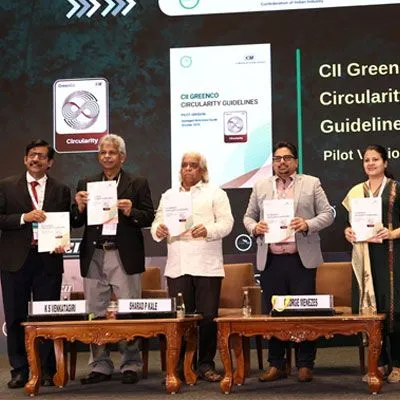
The Confederation of Indian Industry (CII) GreenCo Council has launched the CII GreenCo Circularity Guidelines – Pilot Version at the 17th CII GreenCo Waste & Resource Management Summit 2026 in Chennai. The initiative aims to strengthen resource efficiency, waste reduction and circular economy practices across Indian manufacturing and process industries.The guidelines introduce a structured framework with circularity indices covering raw materials, consumables, packaging and other resource inputs. These indicators will help industries assess existing practices, identify opportunities to ..

Next Story
Infrastructure Energy

Global Electronics Association Launches IPC-1783-CO2E Standard

The Global Electronics Association has introduced IPC-1783-CO2E, a new international standard aimed at improving consistency, transparency and comparability in product carbon footprint reporting across the electronics manufacturing industry.The standard, titled International Standard for Data Collection and Reporting of CO2 Equivalent (CO2e) Emissions for the Electronics Manufacturing Supply Chain, provides industry-specific guidance for collecting, estimating and reporting carbon emissions data.With increasing regulatory requirements and customer expectations, electronics manufacturers face c..

Advertisement

Subscribe to Our Newsletter

Get daily newsletters around different themes from Construction world.

STAY CONNECTED

Advertisement

SPECIAL OFFER
QR Code