Ministry Invites Global Bids For Sintered Rare Earth Magnets
ECONOMY & POLICY

Ministry Invites Global Bids For Sintered Rare Earth Magnets

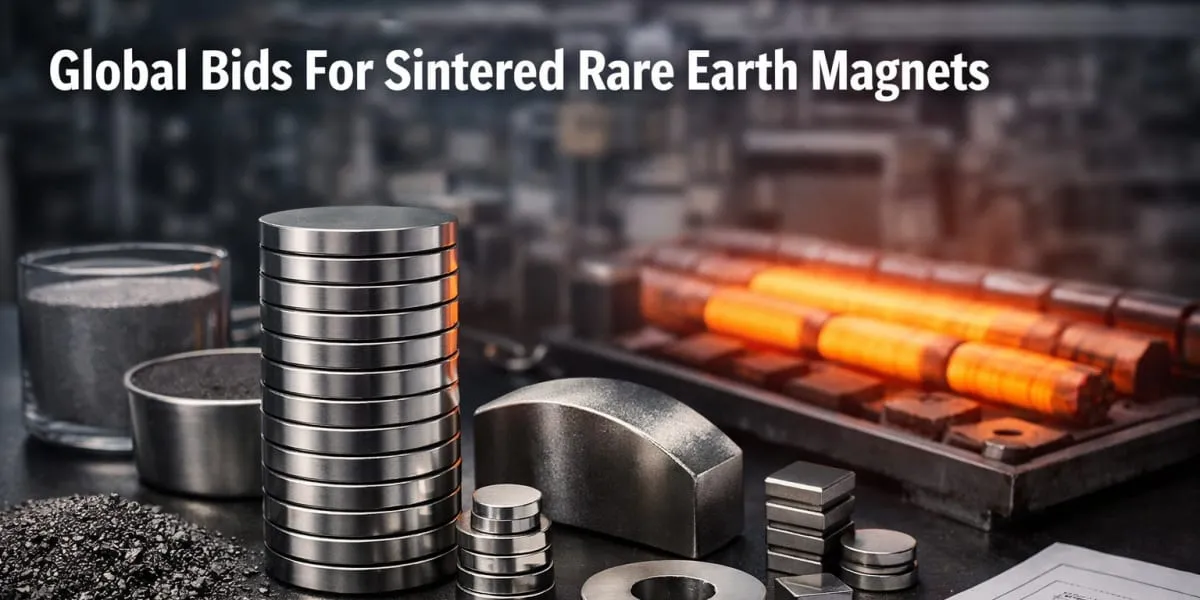
The Ministry of Heavy Industries has issued a request for proposal to select beneficiaries to establish integrated sintered rare earth permanent magnet manufacturing facilities with capacity of 6,000 Metric tonnes per annum (MTPA). The global tender invites bids for projects eligible for capital subsidy and sales-linked incentives under the Scheme to Promote Manufacturing of Sintered Rare Earth Permanent Magnet. The bidding will be conducted online through a transparent least cost system in a two-stage technical and financial process on the Central Public Procurement portal.

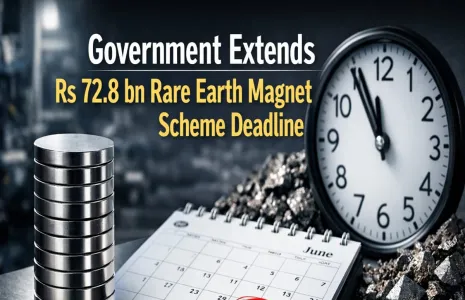
Tender documents were published on 20 March 2026 and a pre-bid conference has been scheduled for seven April 2026, with bids due on 28 May 2026 and technical bids to be opened on 29 May 2026. The Union Cabinet approved the scheme on 26 November 2025 with a financial outlay of Rs 72.8 billion (bn). The initiative aims to establish a total integrated manufacturing capacity of 6,000 MTPA to enhance self-reliance and position India within the global rare earth permanent magnet market.

Under the scheme each beneficiary will be allocated capacity between 600 MTPA and 1,200 MTPA in multiples of 100 MTPA. The scheme provides a capital subsidy of Rs 7.5 bn and a sales-linked incentive of Rs 64.5 bn. The programme includes limited assured supply of neodymium-praseodymium oxide (NdPr oxide) from IREL (India) Limited for the three lowest bidders to support initial feedstock requirements. Applicants will be assessed against technical and financial criteria in the two-stage process.

Rare earth permanent magnets are widely used in electric vehicles, wind turbines, high-end electronics, aerospace and defence systems and demand is expected to rise as these sectors expand. By developing the full value chain from NdPr oxide to finished magnets in India the scheme is expected to reduce import dependence and strengthen domestic industrial capacity. Prospective applicants are invited to submit bids through the Central Public Procurement portal in accordance with the tender documents and the least cost system.

The Ministry of Heavy Industries has issued a request for proposal to select beneficiaries to establish integrated sintered rare earth permanent magnet manufacturing facilities with capacity of 6,000 Metric tonnes per annum (MTPA). The global tender invites bids for projects eligible for capital subsidy and sales-linked incentives under the Scheme to Promote Manufacturing of Sintered Rare Earth Permanent Magnet. The bidding will be conducted online through a transparent least cost system in a two-stage technical and financial process on the Central Public Procurement portal. Tender documents were published on 20 March 2026 and a pre-bid conference has been scheduled for seven April 2026, with bids due on 28 May 2026 and technical bids to be opened on 29 May 2026. The Union Cabinet approved the scheme on 26 November 2025 with a financial outlay of Rs 72.8 billion (bn). The initiative aims to establish a total integrated manufacturing capacity of 6,000 MTPA to enhance self-reliance and position India within the global rare earth permanent magnet market. Under the scheme each beneficiary will be allocated capacity between 600 MTPA and 1,200 MTPA in multiples of 100 MTPA. The scheme provides a capital subsidy of Rs 7.5 bn and a sales-linked incentive of Rs 64.5 bn. The programme includes limited assured supply of neodymium-praseodymium oxide (NdPr oxide) from IREL (India) Limited for the three lowest bidders to support initial feedstock requirements. Applicants will be assessed against technical and financial criteria in the two-stage process. Rare earth permanent magnets are widely used in electric vehicles, wind turbines, high-end electronics, aerospace and defence systems and demand is expected to rise as these sectors expand. By developing the full value chain from NdPr oxide to finished magnets in India the scheme is expected to reduce import dependence and strengthen domestic industrial capacity. Prospective applicants are invited to submit bids through the Central Public Procurement portal in accordance with the tender documents and the least cost system.

Next Story
Infrastructure Transport

AFCONS & Navayuga set world records with Missing Link Expressway

Maharashtra’s most ambitious greenfield bypass — a 13.3-km alignment carrying twin record-setting tunnels and India’s tallest cable-stayed road bridge — was thrown open to traffic on Maharashtra Day, finally completing the Mumbai–Pune Expressway after a 23-year wait. CW reports…The 650-m cable-stayed bridge over Tiger Valley at sunset — the package executed by Afcons Infrastructure Ltd carries 182-m pylons, the tallest on any Indian road bridge.On 1 May 2026, Chief Minister Devendra Fadnavis, flanked by Deputy Chief Ministers Eknath Shinde and Sunetra Pawar (representing the late..

Next Story
Infrastructure Transport

Mumbai–Pune Missing Link boosts realty prospects

The recently opened ‘missing link’ on the Mumbai–Pune Expressway is set to significantly transform connectivity between the two cities by reducing travel time and bypassing the challenging ghat section. The new alignment, featuring tunnels and viaducts, is designed to improve safety, ease congestion and ensure a smoother, faster commute for both passenger and commercial traffic.With improved travel efficiency, the corridor is expected to strengthen intercity movement, encouraging more frequent travel for work, leisure and logistics. This enhanced accessibility is likely to benefit real e..

Next Story
Infrastructure Urban

How Hormuz is Hijacking Indian Highways

At the recently held RAHSTA Round Table on 29th April in Pune, and earlier during our webinars for Cement Expo by Indian Cement Review and by FIRST Construction Council on manufacturing construction equipment for the world, one thread lay common: the industry is being subjected to a cost-push chain reaction moving from crude oil → freight/insurance → steel, cement fuel, bitumen, polymers, packaging, logistics and finally project margins. Indeed, the West Asia crisis caused by the war and the Hormuz Strait blockade, which does not directly concern us, has turned around and hit us. If the wa..

Advertisement

Subscribe to Our Newsletter

Get daily newsletters around different themes from Construction world.

STAY CONNECTED

Advertisement

Advertisement

Advertisement