Moro Hub Inks Pact with OpenText to Boost UAE’s Digital Shift
ECONOMY & POLICY

Moro Hub Inks Pact with OpenText to Boost UAE’s Digital Shift

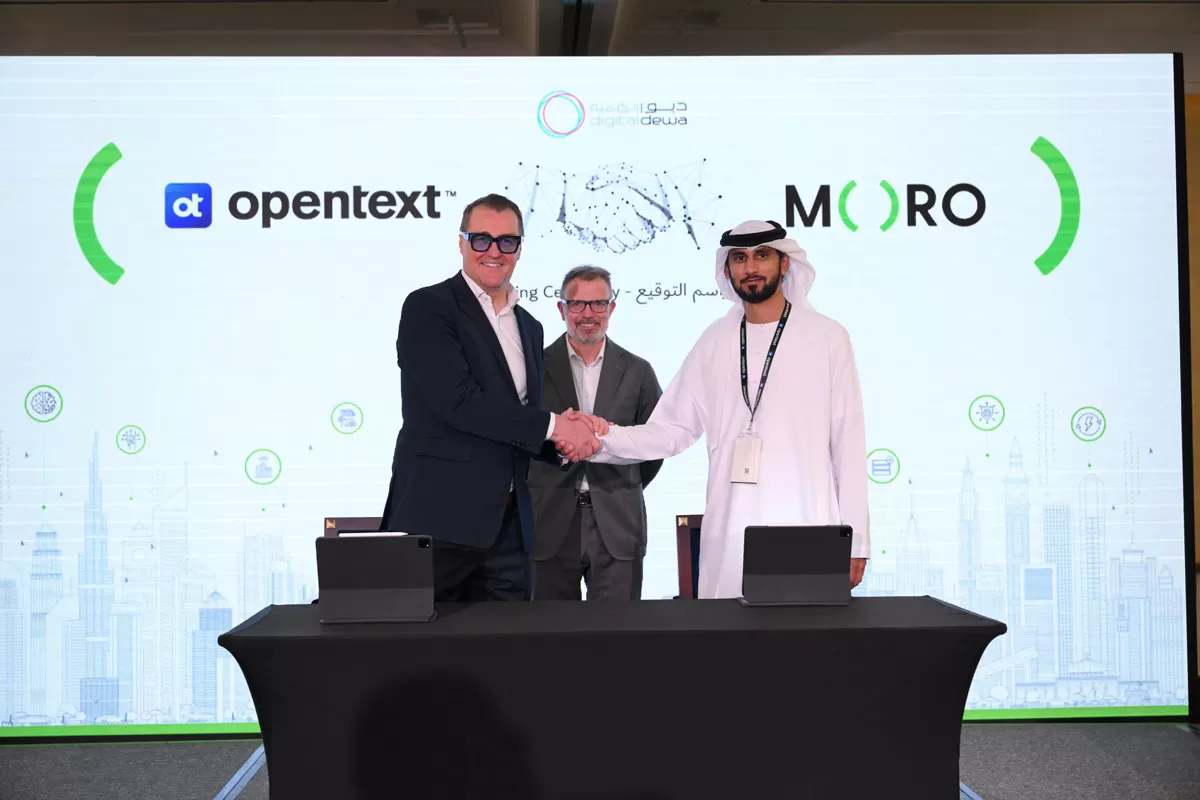
Moro Hub, a subsidiary of Digital DEWA—the digital arm of Dubai Electricity and Water Authority (PJSC)—has signed a strategic agreement with OpenText, a global leader in Information Management, to accelerate digital transformation initiatives across the UAE.

Under the agreement, Moro Hub will offer OpenText’s full portfolio of AI-enabled services and solutions across both public and private sectors in the UAE. These include offerings in content services, digital experience, cybersecurity, and advanced analytics, supporting organisations to optimise operations and make better data-driven decisions.

“This agreement not only strengthens our service offering but also contributes directly to the UAE’s smart infrastructure development, setting new benchmarks in efficiency, security, and sustainability,” said Mohammed bin Sulaiman, CEO of Moro Hub.

The partnership supports the 'We the UAE 2031' vision and comes at a time when AI adoption in the Middle East is projected to add over USD 320 billion to the regional economy by 2030, according to PwC. It positions both Moro Hub and OpenText as key enablers in advancing secure, intelligent, and scalable digital services for enterprises and government bodies.

“Together, we aim to support national digital transformation efforts and deliver secure, intelligent solutions that enable future-ready operations,” said Harald Adams, Sales Vice President of Emerging Markets at OpenText.

Moro Hub’s solar-powered data centres align with the UAE’s sustainability goals and will play a pivotal role in delivering OpenText’s technologies to businesses seeking to modernise and enhance digital resilience.

Moro Hub, a subsidiary of Digital DEWA—the digital arm of Dubai Electricity and Water Authority (PJSC)—has signed a strategic agreement with OpenText, a global leader in Information Management, to accelerate digital transformation initiatives across the UAE.Under the agreement, Moro Hub will offer OpenText’s full portfolio of AI-enabled services and solutions across both public and private sectors in the UAE. These include offerings in content services, digital experience, cybersecurity, and advanced analytics, supporting organisations to optimise operations and make better data-driven decisions.“This agreement not only strengthens our service offering but also contributes directly to the UAE’s smart infrastructure development, setting new benchmarks in efficiency, security, and sustainability,” said Mohammed bin Sulaiman, CEO of Moro Hub.The partnership supports the 'We the UAE 2031' vision and comes at a time when AI adoption in the Middle East is projected to add over USD 320 billion to the regional economy by 2030, according to PwC. It positions both Moro Hub and OpenText as key enablers in advancing secure, intelligent, and scalable digital services for enterprises and government bodies.“Together, we aim to support national digital transformation efforts and deliver secure, intelligent solutions that enable future-ready operations,” said Harald Adams, Sales Vice President of Emerging Markets at OpenText.Moro Hub’s solar-powered data centres align with the UAE’s sustainability goals and will play a pivotal role in delivering OpenText’s technologies to businesses seeking to modernise and enhance digital resilience.

Next Story
Infrastructure Urban

Implementation Status of Jal Jeevan Mission

Since August 2019 the Government has implemented Jal Jeevan Mission to provide assured potable water through household tap connections in rural India. At the start of the mission only 32.3 million (mn) rural households, representing 16.7 per cent, were reported to have tap water connections. States and union territories have reported that 125.8 mn additional rural households have since been provided with tap connections. As a result, of about 193.6 mn rural households roughly 158.2 mn, or 81.71 per cent, are reported to have tap water supply at home.\n\nThe State, district and village level st..

Next Story
Infrastructure Urban

Jal Jeevan Mission Reaches Eighty One Per Cent Rural Coverage

The Government reported substantial progress under the Jal Jeevan Mission, launched in August 2019 to provide tap water to every rural household. At launch only 32.3 million (mn) rural households had tap connections and states and Union territories reported provision of 125.8 mn additional households by March 2026. Consequently, out of about 193.6 mn rural households around 158.2 mn, or 81.71 per cent, are reported to have tap water at home. The Finance Minister announced extension of the mission until 2028 in the 2025-26 budget speech. The Swachh Bharat Mission Grameen, launched in October 20..

Next Story
Infrastructure Urban

Empowering Local Governance for Sustainable Rural Water Supply

The Ministry of Jal Shakti has aligned the Jal Jeevan Mission (JJM) with the 73rd Amendment to strengthen village level planning and community ownership of water supply. Gram Panchayats, village water and sanitation committees and Pani Samitis are to plan, implement, manage and maintain piped water systems, with gram sabha processes formalising handover and oversight. Implementation support agencies including non government organisations, community based organisations and self help groups have been empanelled to train local committees and promote women participation. Under JJM, the department ..

Advertisement

Subscribe to Our Newsletter

Get daily newsletters around different themes from Construction world.

STAY CONNECTED

Advertisement

Advertisement

Advertisement