MP Manish Tewari Chairs Meeting to Tackle Urban Mobility Challenges
ECONOMY & POLICY

MP Manish Tewari Chairs Meeting to Tackle Urban Mobility Challenges

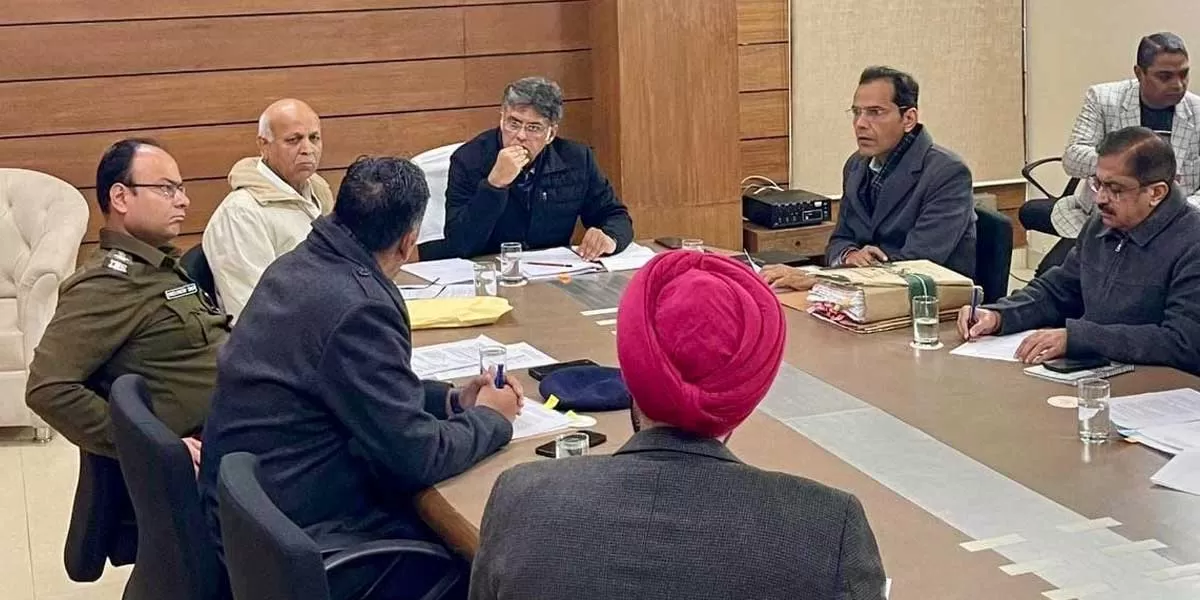
Chandigarh MP Manish Tewari led a transport sub-committee meeting, focusing on urban mobility issues, particularly paid parking in commercial and residential areas. The committee reviewed a pilot parking project in Sector 35 and discussed the potential for updating building bylaws to allow stilt parking, along with other transport-related matters. 

The committee also addressed the registration of auto-rickshaws, with 5,000 new registrations each in Punjab and Haryana. In addition, concerns about the city’s Electric Vehicle (EV) charging infrastructure were raised, particularly regarding vandalised and non-functional charging stations. The MP stressed the need for reliable and affordable EV infrastructure to support the transition to green transport. 

While considering various proposals, the chairman rejected the idea of a congestion tax on external vehicles, deeming it unsuitable for Indian conditions, in contrast to the model used in Central London. 

For public transport, the committee called for an immediate review of the tri-city grid system and ordered a feasibility study for its revival. The President of the Chandigarh Transportation Association highlighted the necessity for modernising transport areas. The chairman requested a site visit with key officials, including the UT SSP (Traffic) and chief engineers of both UT and MC. 

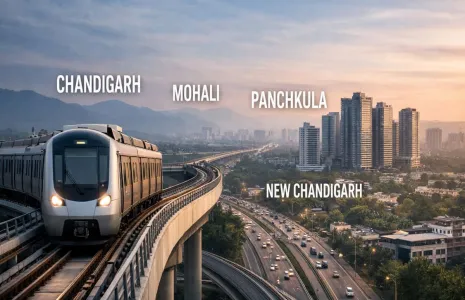
The committee also discussed the Mass Rapid Transit System (MRTS), with the Urban Mobility Transport Authority (UMTA) planning to study metro systems in cities like Ahmedabad, Kochi, Jaipur, and Noida. The chairman emphasised the importance of long-term planning for the Tricity region and suggested that a metro system connecting Chandigarh, Mohali, New Chandigarh, and Panchkula would be crucial for economic growth. He recommended seeking grant-based funding from the Government of India for the Four City Metro project. 

(ET)        

Chandigarh MP Manish Tewari led a transport sub-committee meeting, focusing on urban mobility issues, particularly paid parking in commercial and residential areas. The committee reviewed a pilot parking project in Sector 35 and discussed the potential for updating building bylaws to allow stilt parking, along with other transport-related matters. The committee also addressed the registration of auto-rickshaws, with 5,000 new registrations each in Punjab and Haryana. In addition, concerns about the city’s Electric Vehicle (EV) charging infrastructure were raised, particularly regarding vandalised and non-functional charging stations. The MP stressed the need for reliable and affordable EV infrastructure to support the transition to green transport. While considering various proposals, the chairman rejected the idea of a congestion tax on external vehicles, deeming it unsuitable for Indian conditions, in contrast to the model used in Central London. For public transport, the committee called for an immediate review of the tri-city grid system and ordered a feasibility study for its revival. The President of the Chandigarh Transportation Association highlighted the necessity for modernising transport areas. The chairman requested a site visit with key officials, including the UT SSP (Traffic) and chief engineers of both UT and MC. The committee also discussed the Mass Rapid Transit System (MRTS), with the Urban Mobility Transport Authority (UMTA) planning to study metro systems in cities like Ahmedabad, Kochi, Jaipur, and Noida. The chairman emphasised the importance of long-term planning for the Tricity region and suggested that a metro system connecting Chandigarh, Mohali, New Chandigarh, and Panchkula would be crucial for economic growth. He recommended seeking grant-based funding from the Government of India for the Four City Metro project. (ET)        

Next Story
Infrastructure Urban

Implementation Status of Jal Jeevan Mission

Since August 2019 the Government has implemented Jal Jeevan Mission to provide assured potable water through household tap connections in rural India. At the start of the mission only 32.3 million (mn) rural households, representing 16.7 per cent, were reported to have tap water connections. States and union territories have reported that 125.8 mn additional rural households have since been provided with tap connections. As a result, of about 193.6 mn rural households roughly 158.2 mn, or 81.71 per cent, are reported to have tap water supply at home.\n\nThe State, district and village level st..

Next Story
Infrastructure Urban

Jal Jeevan Mission Reaches Eighty One Per Cent Rural Coverage

The Government reported substantial progress under the Jal Jeevan Mission, launched in August 2019 to provide tap water to every rural household. At launch only 32.3 million (mn) rural households had tap connections and states and Union territories reported provision of 125.8 mn additional households by March 2026. Consequently, out of about 193.6 mn rural households around 158.2 mn, or 81.71 per cent, are reported to have tap water at home. The Finance Minister announced extension of the mission until 2028 in the 2025-26 budget speech. The Swachh Bharat Mission Grameen, launched in October 20..

Next Story
Infrastructure Urban

Empowering Local Governance for Sustainable Rural Water Supply

The Ministry of Jal Shakti has aligned the Jal Jeevan Mission (JJM) with the 73rd Amendment to strengthen village level planning and community ownership of water supply. Gram Panchayats, village water and sanitation committees and Pani Samitis are to plan, implement, manage and maintain piped water systems, with gram sabha processes formalising handover and oversight. Implementation support agencies including non government organisations, community based organisations and self help groups have been empanelled to train local committees and promote women participation. Under JJM, the department ..

Advertisement

Subscribe to Our Newsletter

Get daily newsletters around different themes from Construction world.

STAY CONNECTED

Advertisement

Advertisement

Advertisement