+
NITI Aayog Panel Urges Public Private Push For Critical Minerals
ECONOMY & POLICY

NITI Aayog Panel Urges Public Private Push For Critical Minerals

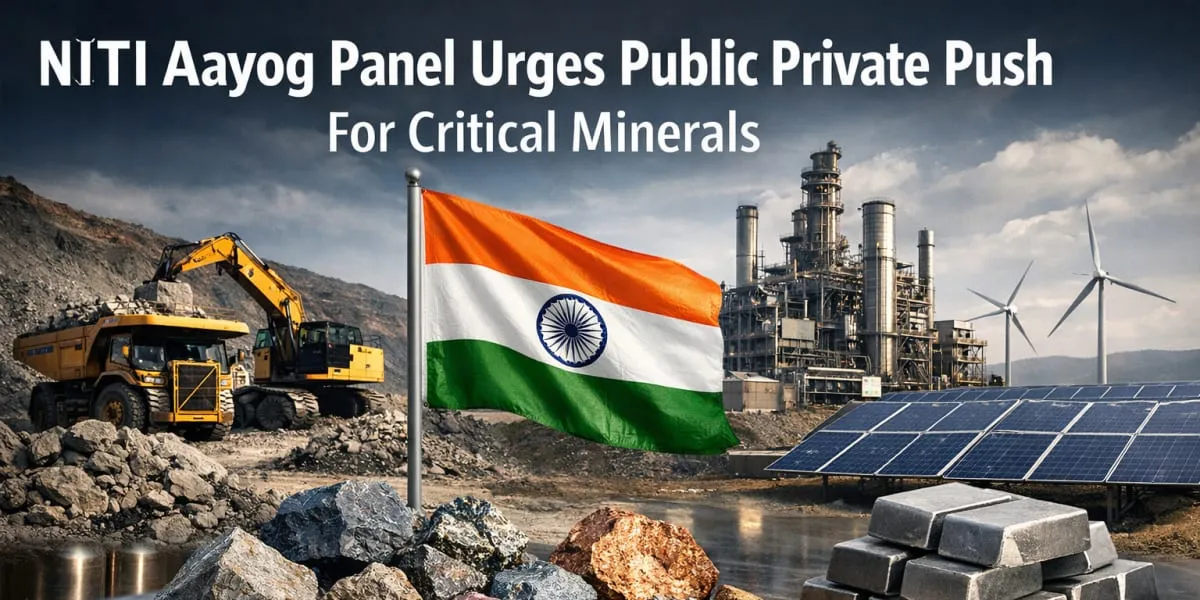
A high level panel convened by NITI Aayog (National Institution for Transforming India) has recommended a stepped up public private push to bolster domestic capability in critical minerals. The panel set out the strategic imperative of reducing import dependence for minerals that underpin the energy transition and advanced manufacturing. It underscored the need for a comprehensive policy framework that aligns exploration, processing and recycling across central and state agencies. The recommendations aim to create an integrated value chain from resource discovery to end use.

The panel advised rapid geological mapping and incentivised exploration to identify economically extractable deposits, coupled with targeted support for downstream processing and refining. It proposed fostering public private partnerships to mobilise capital and technology, and to develop strategic reserves and domestic smelting capacity. The report recommended measures to promote sustainable mining practices and to scale up recycling and urban mining for secondary feedstocks. It also called for closer engagement with research institutions to develop mineral specific processing technologies.

To attract private investment the panel suggested regulatory clarity, time bound approvals and calibrated fiscal incentives that balance national security and commercial viability. It noted that integrated industrial clusters and shared infrastructure could lower costs and accelerate project execution. The recommendations envisaged active role for state governments to streamline land and environmental clearances and to facilitate local employment. The emphasis on supply chain resilience included encouraging diversification of import routes and partner countries.

Implementation would require a coherent governance mechanism to coordinate policy design, licensing and monitoring across ministries and states. The panel envisaged periodic review of strategic priorities and adaptive policy tools to respond to changing technology and market dynamics. It envisaged that domestic capacity building and private sector mobilisation would over time reduce vulnerability to external shocks and support the country's strategic autonomy. The report set out a roadmap intended to position India as a competitive player in critical minerals.

A high level panel convened by NITI Aayog (National Institution for Transforming India) has recommended a stepped up public private push to bolster domestic capability in critical minerals. The panel set out the strategic imperative of reducing import dependence for minerals that underpin the energy transition and advanced manufacturing. It underscored the need for a comprehensive policy framework that aligns exploration, processing and recycling across central and state agencies. The recommendations aim to create an integrated value chain from resource discovery to end use. The panel advised rapid geological mapping and incentivised exploration to identify economically extractable deposits, coupled with targeted support for downstream processing and refining. It proposed fostering public private partnerships to mobilise capital and technology, and to develop strategic reserves and domestic smelting capacity. The report recommended measures to promote sustainable mining practices and to scale up recycling and urban mining for secondary feedstocks. It also called for closer engagement with research institutions to develop mineral specific processing technologies. To attract private investment the panel suggested regulatory clarity, time bound approvals and calibrated fiscal incentives that balance national security and commercial viability. It noted that integrated industrial clusters and shared infrastructure could lower costs and accelerate project execution. The recommendations envisaged active role for state governments to streamline land and environmental clearances and to facilitate local employment. The emphasis on supply chain resilience included encouraging diversification of import routes and partner countries. Implementation would require a coherent governance mechanism to coordinate policy design, licensing and monitoring across ministries and states. The panel envisaged periodic review of strategic priorities and adaptive policy tools to respond to changing technology and market dynamics. It envisaged that domestic capacity building and private sector mobilisation would over time reduce vulnerability to external shocks and support the country's strategic autonomy. The report set out a roadmap intended to position India as a competitive player in critical minerals.

Next Story
Building Material

Operational Excellence Redefined!

Operational excellence in cement has moved far beyond the old pursuit of ‘more tonne’. The new benchmark is smarter, cleaner, more reliable production—delivered with discipline across process, people and data. In an industry where energy can account for nearly 30 per cent of manufacturing cost, even marginal gains translate into meaningful value. As Dr SB Hegde, Professor, Jain College of Engineering & Technology, Hubli and Visiting Professor, Pennsylvania State University, USA, puts it, “Operational excellence… is no longer about producing more. It is about producing smarter, cleane..

Next Story
Infrastructure Urban

CMC Reviews State Progress on Polluted Rivers and Sewage Management

The 21st meeting of the Central Monitoring Committee (CMC) on river rejuvenation was held under the chairpersonship of Shri V. L. Kantha Rao, Secretary of the Department of Water Resources, River Development and Ganga Rejuvenation in the Ministry of Jal Shakti. The meeting was attended by senior officials including the Director General of the National Mission for Clean Ganga (NMCG) and representatives of state governments and state pollution control boards. The committee reviewed the latest status of polluted river stretches based on the Central Pollution Control Board (CPCB) 2025 report and e..

Next Story
Infrastructure Urban

India Proposes Biomanufacturing Working Group With Delaware

Union Minister for Science and Technology Dr Jitendra Singh proposed a small India–Delaware biomanufacturing working group to convert discussions into collaborations in research, manufacturing and startup ecosystems. The proposal was made during his meeting with a visiting US delegation led by Delaware Governor Matt Meyer at Seva Teerth. Both sides focused on bilateral collaboration in pharma, biotechnology, clean energy and innovation-led industrial growth. The minister said science, technology and biotechnology are a key pillar of the India–US strategic partnership and that India seeks d..

Advertisement

Subscribe to Our Newsletter

Get daily newsletters around different themes from Construction world.

STAY CONNECTED

Advertisement

Advertisement

Advertisement

Open In App