+
NITI Aayog Releases Reports on Viksit Bharat and Net Zero
ECONOMY & POLICY

NITI Aayog Releases Reports on Viksit Bharat and Net Zero

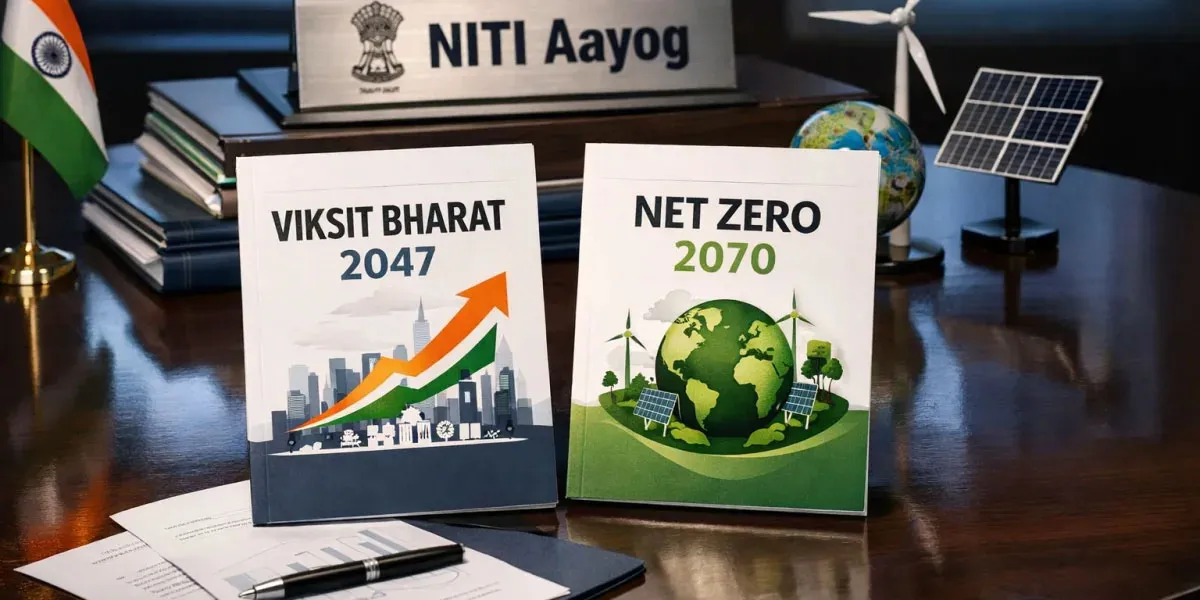
NITI Aayog (NITI) released 11 study reports on scenarios towards Viksit Bharat and net zero at an event at the Ambedkar International Centre in New Delhi on the tenth of February 2026. The final set of four reports formed part of a series that examines long-term development pathways to deliver the Prime Minister’s vision of Viksit Bharat 2047 while achieving net zero greenhouse gas emissions by 2070. The releases were attended by senior officials including Ramesh Chand, B.V.R. Subrahmanyam and Mangi Lal Jat, and included a virtual address by V. K. Paul.

The reports include sectoral volumes on buildings, agriculture and waste, and a volume on social implications. The buildings volume noted that roughly 86 per cent of the floor space that will exist in 2070 is yet to be built and that air-conditioning ownership is projected to increase from 10 per cent today to more than 80 per cent by 2070, emphasising the need for passive design, super-efficient appliances and low-carbon materials. The agriculture volume advocates strategic sequencing with resource efficiency measures such as micro-irrigation and fertiliser optimisation to boost farmer incomes and soil health before large-scale energy substitution.

The waste volume highlights structural gaps and recommends universal collection, 100 per cent door-to-door segregation and large-scale adoption of bio-methanation to convert waste into resources such as Bio-CNG, compost and treated wastewater that support soil health and circular urban economies. The social implications volume frames the transition as a human-centric development project that will reshape land use, employment and migration patterns while delivering health co-benefits through reduced air pollution and climate-ready health systems.

NITI explained that the study is a scenario-based analytic modelling exercise that integrates economic growth, development priorities and climate commitments and was informed by 10 inter-ministerial working groups examining power, transport, industry, buildings, agriculture, finance, critical minerals, research and development, manufacturing and social implications. The reports are intended to inform long-term policy planning, and the full volumes are available on the NITI website.

NITI Aayog (NITI) released 11 study reports on scenarios towards Viksit Bharat and net zero at an event at the Ambedkar International Centre in New Delhi on the tenth of February 2026. The final set of four reports formed part of a series that examines long-term development pathways to deliver the Prime Minister’s vision of Viksit Bharat 2047 while achieving net zero greenhouse gas emissions by 2070. The releases were attended by senior officials including Ramesh Chand, B.V.R. Subrahmanyam and Mangi Lal Jat, and included a virtual address by V. K. Paul. The reports include sectoral volumes on buildings, agriculture and waste, and a volume on social implications. The buildings volume noted that roughly 86 per cent of the floor space that will exist in 2070 is yet to be built and that air-conditioning ownership is projected to increase from 10 per cent today to more than 80 per cent by 2070, emphasising the need for passive design, super-efficient appliances and low-carbon materials. The agriculture volume advocates strategic sequencing with resource efficiency measures such as micro-irrigation and fertiliser optimisation to boost farmer incomes and soil health before large-scale energy substitution. The waste volume highlights structural gaps and recommends universal collection, 100 per cent door-to-door segregation and large-scale adoption of bio-methanation to convert waste into resources such as Bio-CNG, compost and treated wastewater that support soil health and circular urban economies. The social implications volume frames the transition as a human-centric development project that will reshape land use, employment and migration patterns while delivering health co-benefits through reduced air pollution and climate-ready health systems. NITI explained that the study is a scenario-based analytic modelling exercise that integrates economic growth, development priorities and climate commitments and was informed by 10 inter-ministerial working groups examining power, transport, industry, buildings, agriculture, finance, critical minerals, research and development, manufacturing and social implications. The reports are intended to inform long-term policy planning, and the full volumes are available on the NITI website.

Next Story
Real Estate

Casagrand Launches Keystone In Tiruppur

Casagrand has launched Casagrand Keystone, a gated residential development at Rakkiyapalayam, off Avinashi Road, in Tiruppur. Spread across 2.2 acres, the B+G+5 structure comprises 142 units of 2 and 3 BHK homes, supported by 48 indoor and outdoor amenities. The project is introduced at a starting price of Rs 5,199 per sq. ft. The development allocates 1.3 acres to open space, including a central park of about 24,500 sq. ft. A 6,800 sq. ft. clubhouse includes a multipurpose hall, mini theatre and indoor recreation facilities. Other amenities include a 5,100 sq. ft. swimming pool, poolside par..

Next Story
Real Estate

Premium homes account for half of India’s housing sales in 2025

Knight Frank India, in its latest report on India’s office and residential property market, has highlighted a significant shift in housing demand, with homes priced above Rs 10 million accounting for 50 per cent of total residential sales across the top eight cities in 2025. The findings underscore the growing dominance of premium housing in the country’s real estate landscape.Out of 348,247 residential units sold during the year, approximately 175,091 units were in the Rs 10 million-plus category, marking a 14 per cent year-on-year increase. The data reflects changing buyer preferences, w..

Next Story
Infrastructure Energy

Xbattery launches XB-5K energy storage system for homes, offices

Xbattery, a Hyderabad-based deep-tech company specialising in next-generation energy storage and battery management technologies, has introduced its flagship XB-5K, a scalable 5kWh energy storage system designed for homes and offices in India.The XB-5K is built on the company’s indigenously developed BharatBMS platform, described as India’s first universal high-voltage battery management system architecture aimed at reducing import dependence and improving after-sales service capabilities. The launch comes as India seeks to strengthen domestic manufacturing and address reliance on imported..

Advertisement

Subscribe to Our Newsletter

Get daily newsletters around different themes from Construction world.

STAY CONNECTED

Advertisement

Advertisement

Advertisement

Open In App