



+
Norton Scan Flags Multiple High Risk Threats
ECONOMY & POLICY

Norton Scan Flags Multiple High Risk Threats

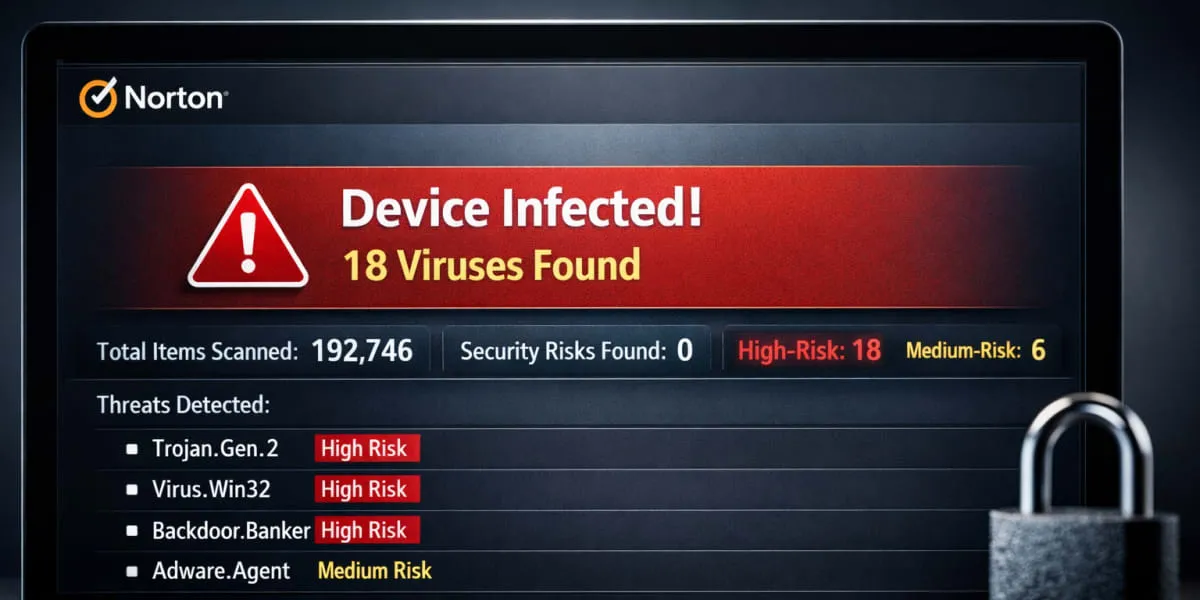
A quick scan by Norton Antivirus (Norton) run in a system interface that identified commonly infected areas and startup files reported that total items scanned numbered 192746. The report simultaneously indicated total security risks detected zero and displayed a prominent alert stating the device was infected with 18 viruses, creating a contradictory result on the same interface. The scan identified multiple entries labelled high risk among virus detections and medium risk for adware and other malicious software. The interface also listed that total security risks resolved were zero and total security risks requiring attention were zero.

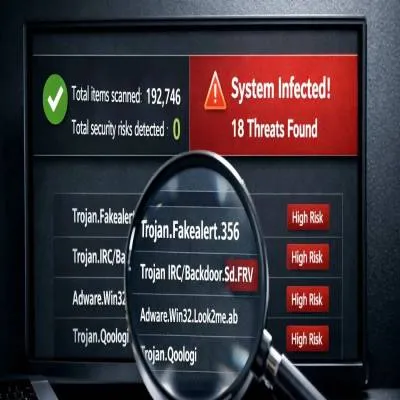
The report enumerated specific threats including Trojan.Fakealert.356, Trojan IRC/Backdor.Sd.FRV, Adware.Win32.Look2me.ab and Trojan.Qoologic, described as a key logger, each presented as high risk and with origin not available. Several instances of the same Trojan.Fakealert.356 were listed repeatedly, alongside other entries categorised as adware, scareware and general malware. Activity fields on the report noted threat actions performed as one for many entries. The repeated appearance of identical threat names contributed to the impression of an extensive infection.

Prominent warnings within the interface urged immediate action and encouraged renewal of the Norton subscription, noting that unprotected devices were 93 per cent more vulnerable to malware. The scan display also included calls to renew subscription to keep devices protected and links that suggested purchase or renewal paths. At the same time the report's summary counters recorded zero resolved risks and zero requiring attention, which contrasted with the urgent renewal prompts and high risk labels. The mixed indicators raised questions about the reliability of the presented results.

Cybersecurity observers said users should verify such alerts through official programme dashboards and software updates rather than responding to in-scan prompts, and assess scan logs directly within the security application for consistency. The report exemplifies a pattern where scare language and repeated entries can create pressure to act quickly, and underscores the need for measured verification when confronted with conflicting scan outputs. Users were advised to consult authorised support channels if uncertainty persisted.

A quick scan by Norton Antivirus (Norton) run in a system interface that identified commonly infected areas and startup files reported that total items scanned numbered 192746. The report simultaneously indicated total security risks detected zero and displayed a prominent alert stating the device was infected with 18 viruses, creating a contradictory result on the same interface. The scan identified multiple entries labelled high risk among virus detections and medium risk for adware and other malicious software. The interface also listed that total security risks resolved were zero and total security risks requiring attention were zero. The report enumerated specific threats including Trojan.Fakealert.356, Trojan IRC/Backdor.Sd.FRV, Adware.Win32.Look2me.ab and Trojan.Qoologic, described as a key logger, each presented as high risk and with origin not available. Several instances of the same Trojan.Fakealert.356 were listed repeatedly, alongside other entries categorised as adware, scareware and general malware. Activity fields on the report noted threat actions performed as one for many entries. The repeated appearance of identical threat names contributed to the impression of an extensive infection. Prominent warnings within the interface urged immediate action and encouraged renewal of the Norton subscription, noting that unprotected devices were 93 per cent more vulnerable to malware. The scan display also included calls to renew subscription to keep devices protected and links that suggested purchase or renewal paths. At the same time the report's summary counters recorded zero resolved risks and zero requiring attention, which contrasted with the urgent renewal prompts and high risk labels. The mixed indicators raised questions about the reliability of the presented results. Cybersecurity observers said users should verify such alerts through official programme dashboards and software updates rather than responding to in-scan prompts, and assess scan logs directly within the security application for consistency. The report exemplifies a pattern where scare language and repeated entries can create pressure to act quickly, and underscores the need for measured verification when confronted with conflicting scan outputs. Users were advised to consult authorised support channels if uncertainty persisted.

Next Story
Equipment

Kabelschlepp India Installs Robotic VMC in Bengaluru

Kabelschlepp India, part of the Tsubaki Group, has installed a state-of-the-art Vertical Machining Center (VMC) integrated with robotic automation at its Bengaluru facility. The inauguration was held in the presence of Henning Preis, President & CEO, Kabelschlepp Group, Jörg Schulz, Vice President – Production, and Srinivas P. Kamisetty, Managing Director, Kabelschlepp India.The high-precision CNC VMC is designed for advanced milling, drilling, tapping and multi-axis machining. Equipped with a vertical spindle orientation, automatic tool changer and intelligent CNC control system, it en..

Next Story
Infrastructure Transport

Highway Delivery Reset!

Project delays and inefficiencies continue to bedevil the progress of India’s National Highways network. A multi-pronged reform agenda is needed to inject greater transparency and accountability at every stage – from planning and procurement to execution, maintenance and oversight. This article offers key recommendations and reform strategies that government stakeholders – from the Ministry of Road Transport & Highways (MoRTH) and the National Highways Authority of India (NHAI) to state agencies and oversight bodies – should pursue to put highway development on a better track.Decen..

Next Story
Infrastructure Transport

MSIDC Executes ₹37,000 Crore Road Programme

With Rs 37,000 crore worth of road projects under execution across Maharashtra, Maharashtra State Infrastructure Development Corporation (MSIDC) is driving one of the state’s largest infrastructure programmes. Dr Brijesh Dixit, Managing Director, discusses the institutional reforms, execution frameworks, financing strategies and technology adoption enabling timely, high-quality delivery, in conversation with PRATAP PADODE, Editor-in-Chief, CW.With over Rs 37,000 crore worth of road projects underway across districts – many under tight timelines – what institutional and executio..

Advertisement

Subscribe to Our Newsletter

Get daily newsletters around different themes from Construction world.

STAY CONNECTED

Advertisement

Advertisement

Advertisement

Open In App














