Odisha Targets 100 Million Tonnes Steel Capacity By 2030
ECONOMY & POLICY

Odisha Targets 100 Million Tonnes Steel Capacity By 2030

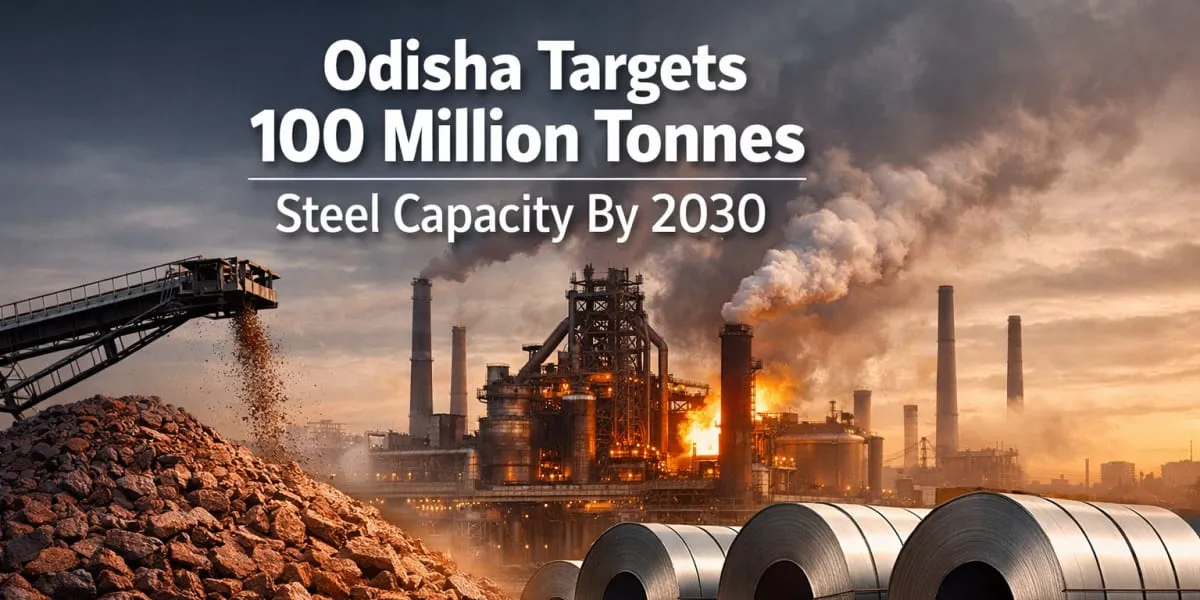
Odisha has set a target to scale its steel production capacity to 100 million tonnes (100 mn t) by 2030, and Chief Minister Mohan Charan Majhi has urged steel companies to prepare a clear roadmap to meet the objective. At a high-level meeting in Bhubaneswar with industry and mining stakeholders, the Chief Minister said the state will facilitate clearances and policy support to enable higher iron ore production and seamless dispatch of the raw material.

Officials said iron ore output must be increased in line with the Mine Development and Production Agreement minimum dispatch obligations while remaining within regulatory limits. The government is preparing a comprehensive database of land acquired for compensatory afforestation to assist investors in assessing district-wise availability and has drawn up an annual auction calendar for 2026-27 to expedite allocation of mining blocks and improve predictability for industry planning.

The delegation included the president of the Indian Steel Association, Naveen Jindal, and senior executives from Tata Steel, JSW Steel and AMNS India. Industry representatives praised Odisha's mining policy and transparent auction system as supportive of revenue generation and investment, and they urged prioritisation of operational steel plants in ore allocation by the Odisha Mining Corporation. Jindal conveyed that sustained raw material security was critical to realising the capacity target and outlined practical inputs from companies.

Majhi highlighted regional imbalances and noted that mineral-rich districts continue to have a relatively low industrial presence, urging companies to expand into these areas to boost production and generate local employment. He asked firms to prioritise the basic needs and welfare of local communities as part of their investment plans. Senior officials including Chief Secretary Anu Garg, Development Commissioner Deo Ranjan Kumar Singh and leaders of the Odisha Mining Corporation were present and the state signalled readiness to combine policy incentives with administrative support.

Odisha has set a target to scale its steel production capacity to 100 million tonnes (100 mn t) by 2030, and Chief Minister Mohan Charan Majhi has urged steel companies to prepare a clear roadmap to meet the objective. At a high-level meeting in Bhubaneswar with industry and mining stakeholders, the Chief Minister said the state will facilitate clearances and policy support to enable higher iron ore production and seamless dispatch of the raw material. Officials said iron ore output must be increased in line with the Mine Development and Production Agreement minimum dispatch obligations while remaining within regulatory limits. The government is preparing a comprehensive database of land acquired for compensatory afforestation to assist investors in assessing district-wise availability and has drawn up an annual auction calendar for 2026-27 to expedite allocation of mining blocks and improve predictability for industry planning. The delegation included the president of the Indian Steel Association, Naveen Jindal, and senior executives from Tata Steel, JSW Steel and AMNS India. Industry representatives praised Odisha's mining policy and transparent auction system as supportive of revenue generation and investment, and they urged prioritisation of operational steel plants in ore allocation by the Odisha Mining Corporation. Jindal conveyed that sustained raw material security was critical to realising the capacity target and outlined practical inputs from companies. Majhi highlighted regional imbalances and noted that mineral-rich districts continue to have a relatively low industrial presence, urging companies to expand into these areas to boost production and generate local employment. He asked firms to prioritise the basic needs and welfare of local communities as part of their investment plans. Senior officials including Chief Secretary Anu Garg, Development Commissioner Deo Ranjan Kumar Singh and leaders of the Odisha Mining Corporation were present and the state signalled readiness to combine policy incentives with administrative support.

Next Story
Infrastructure Transport

AFCONS & Navayuga set world records with Missing Link Expressway

Maharashtra’s most ambitious greenfield bypass — a 13.3-km alignment carrying twin record-setting tunnels and India’s tallest cable-stayed road bridge — was thrown open to traffic on Maharashtra Day, finally completing the Mumbai–Pune Expressway after a 23-year wait. CW reports…The 650-m cable-stayed bridge over Tiger Valley at sunset — the package executed by Afcons Infrastructure Ltd carries 182-m pylons, the tallest on any Indian road bridge.On 1 May 2026, Chief Minister Devendra Fadnavis, flanked by Deputy Chief Ministers Eknath Shinde and Sunetra Pawar (representing the late..

Next Story
Infrastructure Transport

Mumbai–Pune Missing Link boosts realty prospects

The recently opened ‘missing link’ on the Mumbai–Pune Expressway is set to significantly transform connectivity between the two cities by reducing travel time and bypassing the challenging ghat section. The new alignment, featuring tunnels and viaducts, is designed to improve safety, ease congestion and ensure a smoother, faster commute for both passenger and commercial traffic.With improved travel efficiency, the corridor is expected to strengthen intercity movement, encouraging more frequent travel for work, leisure and logistics. This enhanced accessibility is likely to benefit real e..

Next Story
Infrastructure Urban

How Hormuz is Hijacking Indian Highways

At the recently held RAHSTA Round Table on 29th April in Pune, and earlier during our webinars for Cement Expo by Indian Cement Review and by FIRST Construction Council on manufacturing construction equipment for the world, one thread lay common: the industry is being subjected to a cost-push chain reaction moving from crude oil → freight/insurance → steel, cement fuel, bitumen, polymers, packaging, logistics and finally project margins. Indeed, the West Asia crisis caused by the war and the Hormuz Strait blockade, which does not directly concern us, has turned around and hit us. If the wa..

Advertisement

Subscribe to Our Newsletter

Get daily newsletters around different themes from Construction world.

STAY CONNECTED

Advertisement

Advertisement

Advertisement