PLI Scheme to Expand Domestic Advanced Chemistry Cell Capacity
ECONOMY & POLICY

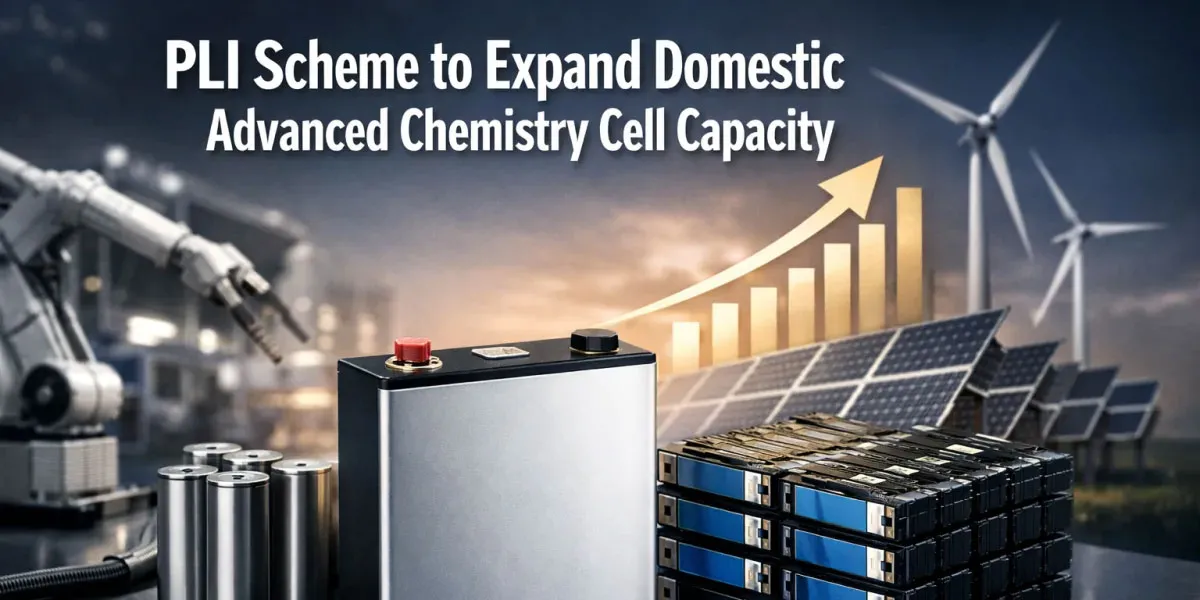
PLI Scheme to Expand Domestic Advanced Chemistry Cell Capacity

The Ministry of Heavy Industries (MHI) is administering the Production Linked Incentive (PLI) scheme, the National Programme on Advanced Chemistry Cell (ACC) Battery Storage, approved in May 2021 with a total outlay of Rs 181 billion (Rs 181 bn) to establish 50 GWh of domestic Advanced Chemistry Cell manufacturing capacity. The scheme aims to build domestic scale and resilience in battery storage supply chains while encouraging investment in the latest cell technologies. The PLI is designed to attract large domestic and international manufacturers through structured incentives linked to production and value addition.

Under Round-two bidding, one beneficiary, Reliance New Energy Battery Ltd, signed the programme agreement with MHI on 17 February 2025 to establish an ACC manufacturing facility of 10 GWh capacity. The scheme period for Round-two is seven years from the appointed date of 01.07.2025, with the first two years designated as a gestation period. The agreement reflects a phased approach to capacity building and commercial production timelines.

The scheme provides incentives based on quoted subsidy per kWh and on the percentage of value addition achieved on actual sales by manufacturers. Beneficiaries must achieve at least 25 per cent value addition within two years at the mother unit level and raise value addition to 60 per cent within five years from the appointed date. The policy is technologically agnostic and allocates higher support to superior technologies while allowing qualifying research and development expenditure to count towards investment criteria.

The programme is intended to reduce dependence on imported advanced chemistry cells by enhancing domestic manufacturing capabilities and competitiveness across the supply chain. The ministry conveyed these details in a written reply to the Rajya Sabha, setting out compliance timelines and incentive mechanisms for participating firms. Implementation will be monitored against value addition milestones and production targets to support orderly domestic capacity expansion.

The Ministry of Heavy Industries (MHI) is administering the Production Linked Incentive (PLI) scheme, the National Programme on Advanced Chemistry Cell (ACC) Battery Storage, approved in May 2021 with a total outlay of Rs 181 billion (Rs 181 bn) to establish 50 GWh of domestic Advanced Chemistry Cell manufacturing capacity. The scheme aims to build domestic scale and resilience in battery storage supply chains while encouraging investment in the latest cell technologies. The PLI is designed to attract large domestic and international manufacturers through structured incentives linked to production and value addition. Under Round-two bidding, one beneficiary, Reliance New Energy Battery Ltd, signed the programme agreement with MHI on 17 February 2025 to establish an ACC manufacturing facility of 10 GWh capacity. The scheme period for Round-two is seven years from the appointed date of 01.07.2025, with the first two years designated as a gestation period. The agreement reflects a phased approach to capacity building and commercial production timelines. The scheme provides incentives based on quoted subsidy per kWh and on the percentage of value addition achieved on actual sales by manufacturers. Beneficiaries must achieve at least 25 per cent value addition within two years at the mother unit level and raise value addition to 60 per cent within five years from the appointed date. The policy is technologically agnostic and allocates higher support to superior technologies while allowing qualifying research and development expenditure to count towards investment criteria. The programme is intended to reduce dependence on imported advanced chemistry cells by enhancing domestic manufacturing capabilities and competitiveness across the supply chain. The ministry conveyed these details in a written reply to the Rajya Sabha, setting out compliance timelines and incentive mechanisms for participating firms. Implementation will be monitored against value addition milestones and production targets to support orderly domestic capacity expansion.

Next Story
Resources

RR Kabel Appoints Kamaljeet Kaur as CHRO

RR Kabel has appointed Kamaljeet Kaur as Chief Human Resources Officer (CHRO), reinforcing its focus on strategic talent management, organisational effectiveness, and HR transformation. In her new role, Kaur will lead the company’s HR function, focusing on leadership development, employee engagement, and building a high-performance, people-centric culture aligned with the company’s growth ambitions. With over 22 years of experience, she brings expertise across industrial relations, talent management, learning and development, performance management, compensation and benefits, compliance,..

Next Story
Infrastructure Energy

Repos Energy Signs MoU with DPIIT to Boost Fuel-Tech Innovation

Repos Energy has signed a non-binding Memorandum of Understanding (MoU) with the Department for Promotion of Industry and Internal Trade (DPIIT), Government of India, to advance the country’s technology and innovation ecosystem. The agreement was formalised on 25 March 2026 in the presence of senior DPIIT officials.Amid rising geopolitical tensions and supply chain disruptions, the partnership highlights the growing importance of efficient last-mile fuel distribution. The collaboration aims to support startups, innovators and entrepreneurs, while promoting technology-led solutions in critica..

Next Story
Infrastructure Energy

CALB Reports 60% Revenue Growth in 2025

CALB Group reported strong financial performance for the year ended 31 December 2025, with revenue reaching RMB 44,400.07 million, up 60 per cent year-on-year. Profit surged over 140 per cent to RMB 2,095.22 million, reflecting significant improvement in profitability.The company strengthened its position across power batteries and energy storage, with market share gains in both segments. In October 2025, its power battery installations ranked among the global top three on a monthly basis, while the commercial EV segment recorded 630 per cent year-on-year growth in early 2026.CALB expanded its..

Advertisement

Subscribe to Our Newsletter

Get daily newsletters around different themes from Construction world.

STAY CONNECTED

Advertisement

Advertisement

Advertisement