- Home
- Infrastructure Energy
- ECONOMY & POLICY
- PM Modi Launches Rs 134 Billion Projects In Andhra Pradesh
PM Modi Launches Rs 134 Billion Projects In Andhra Pradesh
Addressing the gathering, the Prime Minister invoked blessings from Lord Narasimha Swamy of Ahobilam, Shri Mahanandishwara Swamy of Mahanandi, and Guru Raghavendra Swamy of Mantralayam, expressing gratitude for Andhra Pradesh’s cultural and spiritual richness.
He remarked that Andhra Pradesh is a “land of pride, science, and innovation” and highlighted the limitless potential of its youth. He said the state now benefits from visionary leadership under Chief Minister N. Chandrababu Naidu and Pawan Kalyan, supported by the Central Government, which together are propelling rapid development.
Over the past sixteen months, Andhra Pradesh has witnessed “unprecedented progress,” Modi said, with Delhi and Amaravati working in tandem to accelerate growth. He reiterated that India’s goal is to become a developed nation by 2047, with the 21st century belonging to India and its 1.4 billion citizens.
The Prime Minister announced a Rs 30 billion transmission project in the power sector to enhance India’s energy security and capacity. Recalling conditions from a decade ago, when per capita electricity use was below 1,000 units and villages lacked basic infrastructure, he said per capita consumption now stands at 1,400 units, and India is achieving record output across clean and conventional energy sectors.
Highlighting Andhra Pradesh’s role in the national energy revolution, Modi launched the Natural Gas Pipeline Project from Srikakulam to Angul, which will supply gas to about 1.5 million households, and inaugurated an LPG bottling plant in Chittoor with a capacity of 20,000 cylinders per day, generating jobs in logistics and storage.
The Prime Minister also unveiled new highway and railway projects, including the Sabbavaram–Sheelanagar highway, aimed at improving freight and passenger connectivity and boosting regional industry.
Modi further announced Google’s major investment in Andhra Pradesh to establish India’s first Artificial Intelligence Hub at Visakhapatnam. The AI Hub will include data centres, energy infrastructure, and a new International Subsea Gateway, positioning Visakhapatnam as a global AI and digital connectivity hub.
On the defence front, the Prime Minister inaugurated the Advanced Night Vision Factory at Nimmaluru, part of the government’s drive toward Aatmanirbharta (self-reliance) in defence. The facility will produce night vision equipment, missile sensors, and drone guard systems, boosting India’s defence exports. He noted that the success of indigenous weapon systems during Operation Sindoor had demonstrated India’s growing technological prowess.
Expressing satisfaction that the state is developing Kurnool as India’s drone hub, Modi said the industry will spur new technology-driven sectors across Andhra Pradesh. He predicted that Kurnool will soon emerge as a national centre for drone innovation.
The Prime Minister also highlighted citizen-focused reforms, stating that income up to Rs 1.2 million is now tax-free, while affordable healthcare, medicines, and Ayushman cards for senior citizens have improved living standards.
He announced that the next-generation GST reforms will yield savings of over Rs 80 billion for Andhra Pradesh’s people, praising the launch of the “Super GST – Super Savings” campaign led by Nara Lokesh. Modi encouraged citizens to celebrate the GST Savings Festival in alignment with the ‘Vocal for Local’ initiative.
He concluded by affirming that a developed Andhra Pradesh is essential for a developed India, and congratulated the state for its achievements and forthcoming projects.
The event was attended by Governor Syed Abdul Nazeer, Chief Minister N. Chandrababu Naidu, Union Ministers Rammohan Naidu Kinjarapu, Dr. Chandra Sekhar Pemmasani, and Bhupathi Raju Srinivasa Varma, along with several dignitaries.
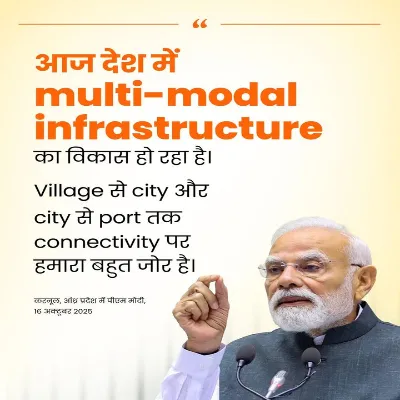
Prime Minister Narendra Modi laid the foundation stone, inaugurated, and dedicated to the nation development projects worth about Rs 134.3 billion in Kurnool, Andhra Pradesh, on 16 October 2025. The initiatives span roads, railways, energy, trade, and defence, aiming to boost connectivity, industry, and employment across the state. Addressing the gathering, the Prime Minister invoked blessings from Lord Narasimha Swamy of Ahobilam, Shri Mahanandishwara Swamy of Mahanandi, and Guru Raghavendra Swamy of Mantralayam, expressing gratitude for Andhra Pradesh’s cultural and spiritual richness. He remarked that Andhra Pradesh is a “land of pride, science, and innovation” and highlighted the limitless potential of its youth. He said the state now benefits from visionary leadership under Chief Minister N. Chandrababu Naidu and Pawan Kalyan, supported by the Central Government, which together are propelling rapid development. Over the past sixteen months, Andhra Pradesh has witnessed “unprecedented progress,” Modi said, with Delhi and Amaravati working in tandem to accelerate growth. He reiterated that India’s goal is to become a developed nation by 2047, with the 21st century belonging to India and its 1.4 billion citizens. The Prime Minister announced a Rs 30 billion transmission project in the power sector to enhance India’s energy security and capacity. Recalling conditions from a decade ago, when per capita electricity use was below 1,000 units and villages lacked basic infrastructure, he said per capita consumption now stands at 1,400 units, and India is achieving record output across clean and conventional energy sectors. Highlighting Andhra Pradesh’s role in the national energy revolution, Modi launched the Natural Gas Pipeline Project from Srikakulam to Angul, which will supply gas to about 1.5 million households, and inaugurated an LPG bottling plant in Chittoor with a capacity of 20,000 cylinders per day, generating jobs in logistics and storage. The Prime Minister also unveiled new highway and railway projects, including the Sabbavaram–Sheelanagar highway, aimed at improving freight and passenger connectivity and boosting regional industry. Modi further announced Google’s major investment in Andhra Pradesh to establish India’s first Artificial Intelligence Hub at Visakhapatnam. The AI Hub will include data centres, energy infrastructure, and a new International Subsea Gateway, positioning Visakhapatnam as a global AI and digital connectivity hub. On the defence front, the Prime Minister inaugurated the Advanced Night Vision Factory at Nimmaluru, part of the government’s drive toward Aatmanirbharta (self-reliance) in defence. The facility will produce night vision equipment, missile sensors, and drone guard systems, boosting India’s defence exports. He noted that the success of indigenous weapon systems during Operation Sindoor had demonstrated India’s growing technological prowess. Expressing satisfaction that the state is developing Kurnool as India’s drone hub, Modi said the industry will spur new technology-driven sectors across Andhra Pradesh. He predicted that Kurnool will soon emerge as a national centre for drone innovation. The Prime Minister also highlighted citizen-focused reforms, stating that income up to Rs 1.2 million is now tax-free, while affordable healthcare, medicines, and Ayushman cards for senior citizens have improved living standards. He announced that the next-generation GST reforms will yield savings of over Rs 80 billion for Andhra Pradesh’s people, praising the launch of the “Super GST – Super Savings” campaign led by Nara Lokesh. Modi encouraged citizens to celebrate the GST Savings Festival in alignment with the ‘Vocal for Local’ initiative. He concluded by affirming that a developed Andhra Pradesh is essential for a developed India, and congratulated the state for its achievements and forthcoming projects. The event was attended by Governor Syed Abdul Nazeer, Chief Minister N. Chandrababu Naidu, Union Ministers Rammohan Naidu Kinjarapu, Dr. Chandra Sekhar Pemmasani, and Bhupathi Raju Srinivasa Varma, along with several dignitaries.
Related Stories
Gold Stories
Infrastructure Opportunity Outlook by IMPACCT.Info
India’s infrastructure pipeline is witnessing dynamic activity across stages — from immediate bidding to future planning. IMPACCT segments these into three categories: Immediate, 3–6 Month, and Future Opportunities, enabling businesses to identify, prepare, and participate in high-value tenders and projects across sectors.To read full article Click Here ..
Glass, Reframed!
Glass façades, quintessential aesthetic building envelopes globally, have been widely adopted in India as well. But when the focus is high-performance building systems that deliver energy efficiency, comfort and architectural identity, glass isn’t the only preference. Combination solutions, involving glass and some other material, improve façade outcomes. Some combinations come at comparable prices, some at a higher price. Here is a selection of performance-oriented solutions...To read the full story Click Here ..
Beyond Building Faster
India’s cities are expanding at an unprecedented pace, bringing new infrastructure and development opportunities while also intensifying challenges around mobility, public spaces, liveability and supporting infrastructure. The question, therefore, is not simply whether India can build faster, but whether it can build cities that work better.At a CW webinar, Are We Designing Better Cities – or Just Building Faster?, moderator Ar. Samir Shaikh, Founding Principal, AR&UD Studio, brought together perspectives from design, development, master planning and technology...To read the full artic..
Related Articles
Latest Updates

Recommended for you
Advertisement
Subscribe to Our Newsletter
Get daily newsletters around different themes from Construction world.
subscribe to the newsletter
Don't miss out on valuable insights and opportunities
to connect with like minded professionals