+
Quasi Two-Dimensional Tellurium Nanosheets Boost Hydrogen Production
ECONOMY & POLICY

Quasi Two-Dimensional Tellurium Nanosheets Boost Hydrogen Production

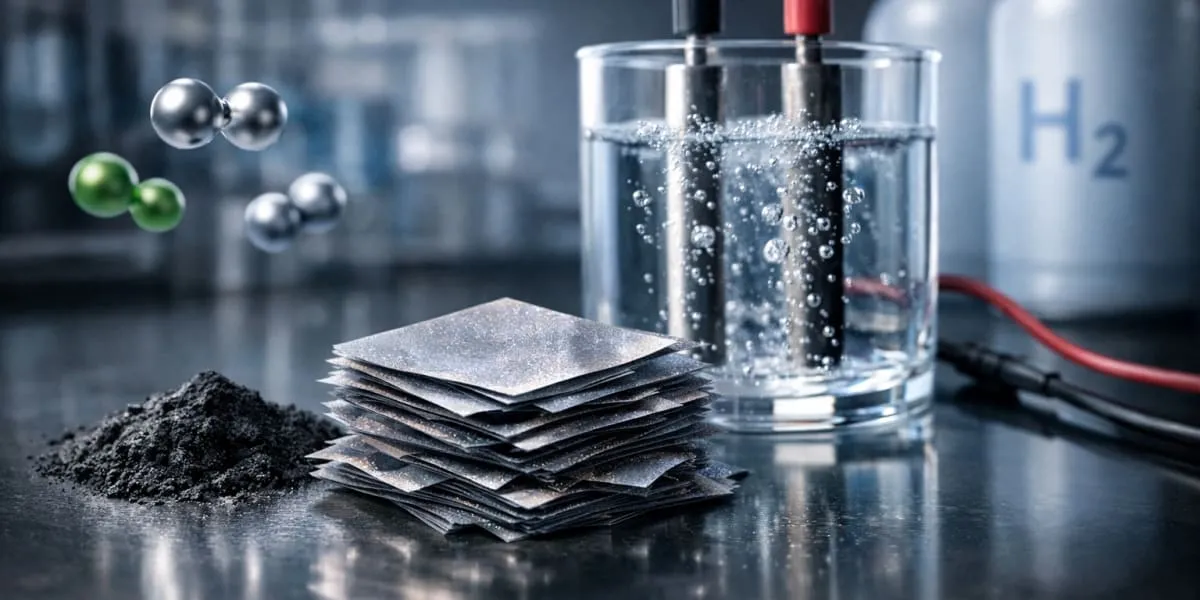
A team at the Institute of Nano Science and Technology (INST), Mohali, has developed quasi-two-dimensional alpha-tellurium (alpha-Te) nanosheets that exhibit an emergent ferromagnetic state and can make hydrogen-producing electrolysers more energy-efficient. The researchers combined scalable liquid-phase exfoliation with strain-engineered lattice distortions and advanced spin-sensitive probes to create and study few-layer alpha-Te. The approach targets indigenous solutions for sustainable hydrogen production by integrating magnetism and catalysis in a single elemental material.

The team found that exfoliating bulk tellurium into quasi-two-dimensional alpha-Te nanosheets released unpaired five-p electron spins that are otherwise quenched in bulk material, producing surface ferromagnetism tied to strain and broken inversion symmetry. This surface magnetism couples with ferroelectric and strong piezoelectric responses in the same few-layer platform, yielding a giant magnetoelectric response that can be actively manipulated by strain and electric fields. Spin-sensitive measurements traced how unpaired surface spins emerge and how magnetoelectric control can be applied.

The magnetoelectric control lowers the voltage required for the hydrogen evolution reaction and accelerates the reaction kinetics, thereby reducing electricity consumption for green hydrogen production. The researchers demonstrated enhanced hydrogen evolution under applied magnetic fields on the alpha-Te nanosheets, indicating that magnetoelectric coupling can directly boost electrocatalytic performance. The work has been published in Advanced Materials.

The discovery connects spintronics, multiferroic nanoelectronics and green hydrogen technologies and points to applications in low-power memory, smart sensors and magnetoelectric-driven water electrolysers. The stability and flexibility of the quasi-two-dimensional alpha-Te nanosheets suggest promise for flexible, portable and wearable energy and sensing technologies that could improve access to clean energy and real-time health or environmental monitoring. Further research will aim to scale the materials and integrate them into practical devices.

A team at the Institute of Nano Science and Technology (INST), Mohali, has developed quasi-two-dimensional alpha-tellurium (alpha-Te) nanosheets that exhibit an emergent ferromagnetic state and can make hydrogen-producing electrolysers more energy-efficient. The researchers combined scalable liquid-phase exfoliation with strain-engineered lattice distortions and advanced spin-sensitive probes to create and study few-layer alpha-Te. The approach targets indigenous solutions for sustainable hydrogen production by integrating magnetism and catalysis in a single elemental material. The team found that exfoliating bulk tellurium into quasi-two-dimensional alpha-Te nanosheets released unpaired five-p electron spins that are otherwise quenched in bulk material, producing surface ferromagnetism tied to strain and broken inversion symmetry. This surface magnetism couples with ferroelectric and strong piezoelectric responses in the same few-layer platform, yielding a giant magnetoelectric response that can be actively manipulated by strain and electric fields. Spin-sensitive measurements traced how unpaired surface spins emerge and how magnetoelectric control can be applied. The magnetoelectric control lowers the voltage required for the hydrogen evolution reaction and accelerates the reaction kinetics, thereby reducing electricity consumption for green hydrogen production. The researchers demonstrated enhanced hydrogen evolution under applied magnetic fields on the alpha-Te nanosheets, indicating that magnetoelectric coupling can directly boost electrocatalytic performance. The work has been published in Advanced Materials. The discovery connects spintronics, multiferroic nanoelectronics and green hydrogen technologies and points to applications in low-power memory, smart sensors and magnetoelectric-driven water electrolysers. The stability and flexibility of the quasi-two-dimensional alpha-Te nanosheets suggest promise for flexible, portable and wearable energy and sensing technologies that could improve access to clean energy and real-time health or environmental monitoring. Further research will aim to scale the materials and integrate them into practical devices.

Next Story
Infrastructure Urban

Implementation Status of Jal Jeevan Mission

Since August 2019 the Government has implemented Jal Jeevan Mission to provide assured potable water through household tap connections in rural India. At the start of the mission only 32.3 million (mn) rural households, representing 16.7 per cent, were reported to have tap water connections. States and union territories have reported that 125.8 mn additional rural households have since been provided with tap connections. As a result, of about 193.6 mn rural households roughly 158.2 mn, or 81.71 per cent, are reported to have tap water supply at home.\n\nThe State, district and village level st..

Next Story
Infrastructure Urban

Jal Jeevan Mission Reaches Eighty One Per Cent Rural Coverage

The Government reported substantial progress under the Jal Jeevan Mission, launched in August 2019 to provide tap water to every rural household. At launch only 32.3 million (mn) rural households had tap connections and states and Union territories reported provision of 125.8 mn additional households by March 2026. Consequently, out of about 193.6 mn rural households around 158.2 mn, or 81.71 per cent, are reported to have tap water at home. The Finance Minister announced extension of the mission until 2028 in the 2025-26 budget speech. The Swachh Bharat Mission Grameen, launched in October 20..

Next Story
Infrastructure Urban

Empowering Local Governance for Sustainable Rural Water Supply

The Ministry of Jal Shakti has aligned the Jal Jeevan Mission (JJM) with the 73rd Amendment to strengthen village level planning and community ownership of water supply. Gram Panchayats, village water and sanitation committees and Pani Samitis are to plan, implement, manage and maintain piped water systems, with gram sabha processes formalising handover and oversight. Implementation support agencies including non government organisations, community based organisations and self help groups have been empanelled to train local committees and promote women participation. Under JJM, the department ..

Advertisement

Subscribe to Our Newsletter

Get daily newsletters around different themes from Construction world.

STAY CONNECTED

Advertisement

Advertisement

Advertisement