+
Rajasthan Government Decentralises Approval Process for MSME and ODOP
ECONOMY & POLICY

Rajasthan Government Decentralises Approval Process for MSME and ODOP

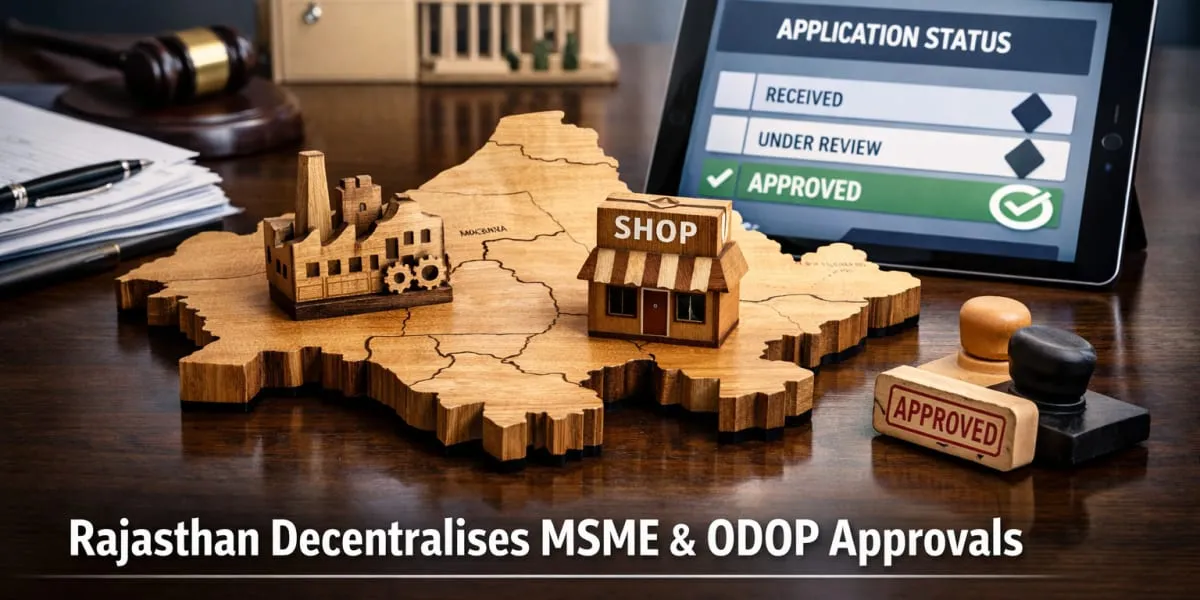
The Rajasthan government has decentralised the approval process for Micro, Small and Medium Enterprises (MSME) and One District One Product (ODOP) proposals to speed up clearances and support local entrepreneurship. The move transfers authority to district-level committees and nodal officers to ensure faster decision making and reduce bottlenecks at the state headquarters. Officials have been directed to streamline procedures and deploy digital tracking to monitor application progress. The change is intended to cut administrative layers and bring decision making closer to applicants.

The revised framework establishes single-window facilitation at the district level to handle registrations, licences and subsidy claims and to co-ordinate with line departments. Timelines for processing applications are to be standardised and communicated to applicants to improve transparency and predictability. The government expects that clearer processes will reduce delays that previously deterred small enterprises from expanding. Applicants will be advised on documentation requirements and assisted in meeting compliance norms.

The decentralisation is intended to strengthen the ODOP programme and to make it easier for artisans and producers to access support, testing and market linkages. It is also aimed at promoting the growth of MSME by reducing procedural friction and improving access to incentives. Training and capacity building for district officials are planned to ensure consistent implementation. Stakeholders will be consulted during roll-out to refine procedures based on feedback.

The state administration will institute regular reviews and performance monitoring to assess the impact of the new process and to make corrective adjustments as required. Departments will share data and integrate existing portals to enable applicants to track status and upload documents electronically. The measure is designed to enhance local investment, create employment opportunities and accelerate the delivery of benefits to entrepreneurs. Outcomes will be reviewed periodically to ensure the intended benefits reach local businesses and artisans in nearby communities.

The Rajasthan government has decentralised the approval process for Micro, Small and Medium Enterprises (MSME) and One District One Product (ODOP) proposals to speed up clearances and support local entrepreneurship. The move transfers authority to district-level committees and nodal officers to ensure faster decision making and reduce bottlenecks at the state headquarters. Officials have been directed to streamline procedures and deploy digital tracking to monitor application progress. The change is intended to cut administrative layers and bring decision making closer to applicants. The revised framework establishes single-window facilitation at the district level to handle registrations, licences and subsidy claims and to co-ordinate with line departments. Timelines for processing applications are to be standardised and communicated to applicants to improve transparency and predictability. The government expects that clearer processes will reduce delays that previously deterred small enterprises from expanding. Applicants will be advised on documentation requirements and assisted in meeting compliance norms. The decentralisation is intended to strengthen the ODOP programme and to make it easier for artisans and producers to access support, testing and market linkages. It is also aimed at promoting the growth of MSME by reducing procedural friction and improving access to incentives. Training and capacity building for district officials are planned to ensure consistent implementation. Stakeholders will be consulted during roll-out to refine procedures based on feedback. The state administration will institute regular reviews and performance monitoring to assess the impact of the new process and to make corrective adjustments as required. Departments will share data and integrate existing portals to enable applicants to track status and upload documents electronically. The measure is designed to enhance local investment, create employment opportunities and accelerate the delivery of benefits to entrepreneurs. Outcomes will be reviewed periodically to ensure the intended benefits reach local businesses and artisans in nearby communities.

Next Story
Building Material

Operational Excellence Redefined!

Operational excellence in cement has moved far beyond the old pursuit of ‘more tonne’. The new benchmark is smarter, cleaner, more reliable production—delivered with discipline across process, people and data. In an industry where energy can account for nearly 30 per cent of manufacturing cost, even marginal gains translate into meaningful value. As Dr SB Hegde, Professor, Jain College of Engineering & Technology, Hubli and Visiting Professor, Pennsylvania State University, USA, puts it, “Operational excellence… is no longer about producing more. It is about producing smarter, cleane..

Next Story
Infrastructure Urban

CMC Reviews State Progress on Polluted Rivers and Sewage Management

The 21st meeting of the Central Monitoring Committee (CMC) on river rejuvenation was held under the chairpersonship of Shri V. L. Kantha Rao, Secretary of the Department of Water Resources, River Development and Ganga Rejuvenation in the Ministry of Jal Shakti. The meeting was attended by senior officials including the Director General of the National Mission for Clean Ganga (NMCG) and representatives of state governments and state pollution control boards. The committee reviewed the latest status of polluted river stretches based on the Central Pollution Control Board (CPCB) 2025 report and e..

Next Story
Infrastructure Urban

India Proposes Biomanufacturing Working Group With Delaware

Union Minister for Science and Technology Dr Jitendra Singh proposed a small India–Delaware biomanufacturing working group to convert discussions into collaborations in research, manufacturing and startup ecosystems. The proposal was made during his meeting with a visiting US delegation led by Delaware Governor Matt Meyer at Seva Teerth. Both sides focused on bilateral collaboration in pharma, biotechnology, clean energy and innovation-led industrial growth. The minister said science, technology and biotechnology are a key pillar of the India–US strategic partnership and that India seeks d..

Advertisement

Subscribe to Our Newsletter

Get daily newsletters around different themes from Construction world.

STAY CONNECTED

Advertisement

Advertisement

Advertisement

Open In App