+
Raksha Mantri Reviews Indigenous Military Engine Projects at GTRE
ECONOMY & POLICY

Raksha Mantri Reviews Indigenous Military Engine Projects at GTRE

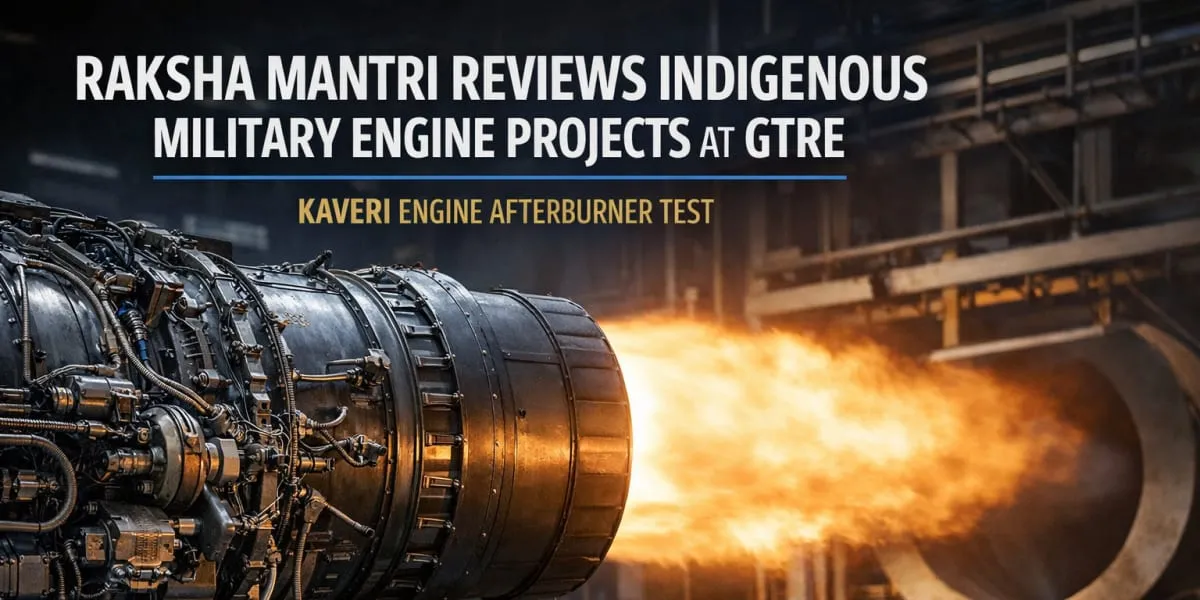
On February 16, 2026, Raksha Mantri Rajnath Singh visited the Defence Research and Development Organisation (DRDO)’s Gas Turbine Research Establishment (GTRE) in Bengaluru to review indigenous military gas turbine engine development. He was briefed on projects, interactions with Indian industry, academia and research institutes and on support to the defence forces, and he inspected an exhibition of indigenous engine parts and witnessed a full afterburner test of the Kaveri. He praised GTRE for bolstering national security through self-reliance and called DRDO the foundation of India’s strategic capability.

He underscored the importance of achieving Aatmanirbharta in aero engine technology amid a rapidly evolving geopolitical landscape and said every effort was being made to prioritise development in India. He observed that supply chains were breaking and new ecosystems were developing and argued that nations with indigenous critical technologies would remain secure. He urged GTRE to focus on next generation engines by building a nationwide robust ecosystem and referenced work on the design of the Advanced Medium Combat Aircraft.

He characterised aero engine development as an extremely complex endeavour integrating thermodynamics, material science, fluid mechanics and advanced mechanical engineering and noted that even developed nations often take 25 to 30 years to develop next generation engines. He urged Indian scientists to compress timelines in view of strategic needs and said that twenty years had effectively passed and India had only five to seven years left. He emphasised the growing role of artificial intelligence, machine learning and new materials in accelerating development.

He said Operation Sindoor had demonstrated India’s growing Aatmanirbharta in defence as communications, surveillance and attack systems had been indigenous, boosting morale and public pride. He welcomed joint studies with the United Kingdom and France under the National Aero Engine Mission as means to learn technologies and the challenges faced over decades. He highlighted the dual use potential of high temperature composites for civil aviation, power generation and space and called for capitalising on trade and strategic opportunities to build capability.

On February 16, 2026, Raksha Mantri Rajnath Singh visited the Defence Research and Development Organisation (DRDO)’s Gas Turbine Research Establishment (GTRE) in Bengaluru to review indigenous military gas turbine engine development. He was briefed on projects, interactions with Indian industry, academia and research institutes and on support to the defence forces, and he inspected an exhibition of indigenous engine parts and witnessed a full afterburner test of the Kaveri. He praised GTRE for bolstering national security through self-reliance and called DRDO the foundation of India’s strategic capability. He underscored the importance of achieving Aatmanirbharta in aero engine technology amid a rapidly evolving geopolitical landscape and said every effort was being made to prioritise development in India. He observed that supply chains were breaking and new ecosystems were developing and argued that nations with indigenous critical technologies would remain secure. He urged GTRE to focus on next generation engines by building a nationwide robust ecosystem and referenced work on the design of the Advanced Medium Combat Aircraft. He characterised aero engine development as an extremely complex endeavour integrating thermodynamics, material science, fluid mechanics and advanced mechanical engineering and noted that even developed nations often take 25 to 30 years to develop next generation engines. He urged Indian scientists to compress timelines in view of strategic needs and said that twenty years had effectively passed and India had only five to seven years left. He emphasised the growing role of artificial intelligence, machine learning and new materials in accelerating development. He said Operation Sindoor had demonstrated India’s growing Aatmanirbharta in defence as communications, surveillance and attack systems had been indigenous, boosting morale and public pride. He welcomed joint studies with the United Kingdom and France under the National Aero Engine Mission as means to learn technologies and the challenges faced over decades. He highlighted the dual use potential of high temperature composites for civil aviation, power generation and space and called for capitalising on trade and strategic opportunities to build capability.

Next Story
Infrastructure Energy

Larsen & Toubro To Divest Nabha Power To Torrent Power

Larsen & Toubro Limited, hereafter L&T, has agreed to divest its entire stake in Nabha Power Limited to Torrent Power Limited, with the companies announcing the transaction. The deal will transfer ownership of the thermal power project and associated assets to Torrent Power as part of L&T's portfolio rationalisation. L&T is a US dollar 30 bn Indian multinational engaged in engineering, procurement and construction projects, hi-tech manufacturing and services across multiple geographies. The company attributes its market position to a strong customer-focused approach and sustained quality over ..

Next Story
Infrastructure Transport

Centre Approves Road Projects Worth Over Rs110 bn

The central government has approved road projects worth over Rs110 bn across Maharashtra, Gujarat and Telangana, according to the Ministry of Road Transport and Highways. The approvals follow a cabinet committee decision and are intended to improve connectivity and reduce travel times on key corridors. The package covers multiple stretches of national highways and involves both construction and widening works. In Gujarat, the ministry approved construction of four-lane sections on the Dhamasiya-Bitada/Movi and Nasarpore-Malotha stretches at a combined capital cost of about Rs45.84 bn. The prin..

Next Story
Infrastructure Urban

Prime Minister Inaugurates India AI Impact Expo 2026

Prime Minister Narendra Modi inaugurated the India AI Impact Expo 2026 at Bharat Mandapam in New Delhi, opening a national platform for Artificial Intelligence (AI) demonstration and dialogue. The event brought together innovators, researchers and technology enthusiasts from across the country and abroad to showcase applications and research. The inauguration underscored the government’s intent to position India as a significant contributor to global AI development. The prime minister noted in a post on X that being among innovators, researchers and tech enthusiasts offered a clear view of t..

Advertisement

Subscribe to Our Newsletter

Get daily newsletters around different themes from Construction world.

STAY CONNECTED

Advertisement

Advertisement

Advertisement

Open In App