


Rishikesh Bypass Approved With Rs 11.06 bn Funding
ECONOMY & POLICY

Rishikesh Bypass Approved With Rs 11.06 bn Funding

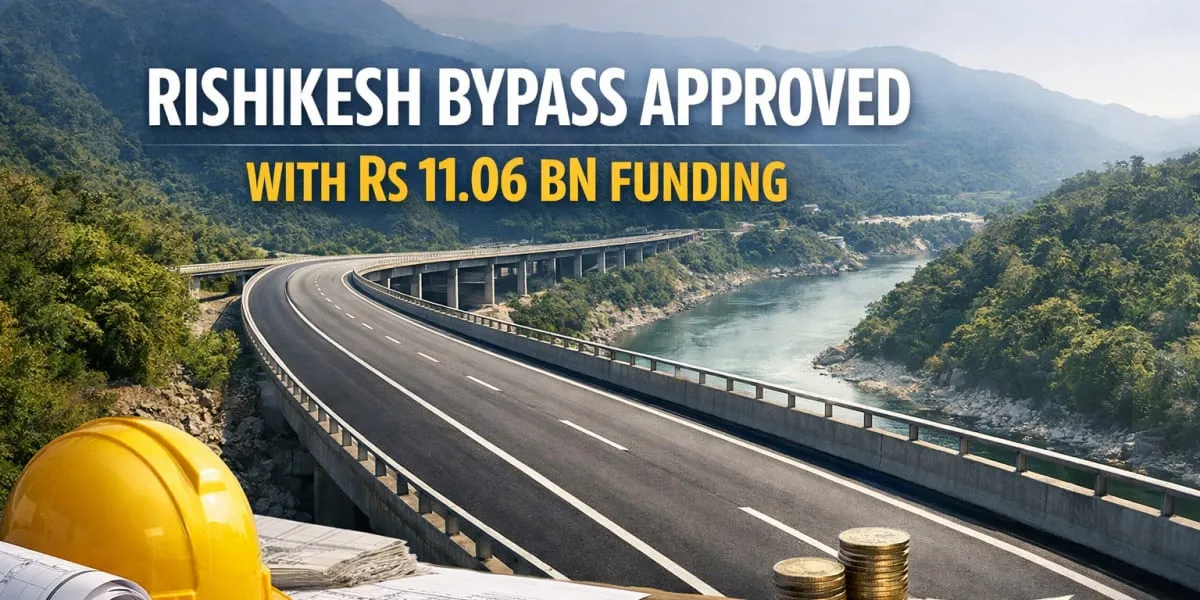
The Ministry of Road Transport and Highways has granted technical, administrative and financial approval for the construction of a four?lane Rishikesh bypass on National Highway seven, following sustained efforts by Uttarakhand Chief Minister Pushkar Singh Dhami. The project has been sanctioned at Rs 11.06 billion (Rs 11,057.9 mn) and will be executed under the Engineering, Procurement and Construction mode. This bypass is slated to extend for 12.67 km from Teenpani Flyover (km 529.750) to Kharasrote Bridge (km 542.420), passing through the villages of Bhattowala and Dhalwala.

The Ministry indicated that the initial estimated cost stood at Rs 11.51 billion, was later revised to Rs 11.39 billion and has finally been approved at Rs 11.06 billion. The project timeline has been set at three years with no provision for cost or time escalation, and tenders will be invited via an e tendering process in accordance with prescribed guidelines. The Regional Officer in Dehradun will act as the Drawing and Disbursing Officer for the initiative.

The state government highlighted that the bypass is intended to ease frequent traffic jams, reduce congestion and provide convenience to local residents, pilgrims undertaking the Char Dham Yatra and visiting tourists. Officials underlined that the development is part of a broader strategy to enhance road connectivity across Uttarakhand and to link remote and urban areas through a robust network.

Funding for the project will be drawn from Government of India budget provisions for the financial year 2025-26 and the Ministry confirmed adherence to standard procurement and construction norms. All work is to follow prescribed technical and environmental guidelines and will be monitored to ensure compliance with the approved scope and schedule.

Once completed, the bypass is expected to improve traffic management in the Rishikesh region substantially and to bolster the state’s economic growth and tourism sector, while providing long term benefits to mobility and local commerce. The authorities have committed to regular updates as the project advances through tendering and construction phases.

The Ministry of Road Transport and Highways has granted technical, administrative and financial approval for the construction of a four?lane Rishikesh bypass on National Highway seven, following sustained efforts by Uttarakhand Chief Minister Pushkar Singh Dhami. The project has been sanctioned at Rs 11.06 billion (Rs 11,057.9 mn) and will be executed under the Engineering, Procurement and Construction mode. This bypass is slated to extend for 12.67 km from Teenpani Flyover (km 529.750) to Kharasrote Bridge (km 542.420), passing through the villages of Bhattowala and Dhalwala. The Ministry indicated that the initial estimated cost stood at Rs 11.51 billion, was later revised to Rs 11.39 billion and has finally been approved at Rs 11.06 billion. The project timeline has been set at three years with no provision for cost or time escalation, and tenders will be invited via an e tendering process in accordance with prescribed guidelines. The Regional Officer in Dehradun will act as the Drawing and Disbursing Officer for the initiative. The state government highlighted that the bypass is intended to ease frequent traffic jams, reduce congestion and provide convenience to local residents, pilgrims undertaking the Char Dham Yatra and visiting tourists. Officials underlined that the development is part of a broader strategy to enhance road connectivity across Uttarakhand and to link remote and urban areas through a robust network. Funding for the project will be drawn from Government of India budget provisions for the financial year 2025-26 and the Ministry confirmed adherence to standard procurement and construction norms. All work is to follow prescribed technical and environmental guidelines and will be monitored to ensure compliance with the approved scope and schedule. Once completed, the bypass is expected to improve traffic management in the Rishikesh region substantially and to bolster the state’s economic growth and tourism sector, while providing long term benefits to mobility and local commerce. The authorities have committed to regular updates as the project advances through tendering and construction phases.

Related Stories

Gold Stories

Next Story
Infrastructure Urban

KONE Opens India's First Digital Experience Centre in Pune

KONE, a global elevator and escalator manufacturer, has inaugurated its first Digital Experience Centre (DEC) in India, located in Pune. The facility aims to showcase how artificial intelligence (AI), connectivity and data-driven technologies can enhance customer experiences and improve building operations.The centre was inaugurated by Jussi Herlin, Executive Vice Chair, KONE Corporation; Philippe Delorme, President and CEO, KONE; and Nandan Nilekani, Co-founder and Chairman of the Board, Infosys.Designed as an interactive customer environment, the facility demonstrates digital solutions cover..

Next Story
Infrastructure Urban

CII GreenCo Launches Circularity Guidelines for Indian Industry

The Confederation of Indian Industry (CII) GreenCo Council has launched the CII GreenCo Circularity Guidelines – Pilot Version at the 17th CII GreenCo Waste & Resource Management Summit 2026 in Chennai. The initiative aims to strengthen resource efficiency, waste reduction and circular economy practices across Indian manufacturing and process industries.The guidelines introduce a structured framework with circularity indices covering raw materials, consumables, packaging and other resource inputs. These indicators will help industries assess existing practices, identify opportunities to ..

Next Story
Infrastructure Energy

Global Electronics Association Launches IPC-1783-CO2E Standard

The Global Electronics Association has introduced IPC-1783-CO2E, a new international standard aimed at improving consistency, transparency and comparability in product carbon footprint reporting across the electronics manufacturing industry.The standard, titled International Standard for Data Collection and Reporting of CO2 Equivalent (CO2e) Emissions for the Electronics Manufacturing Supply Chain, provides industry-specific guidance for collecting, estimating and reporting carbon emissions data.With increasing regulatory requirements and customer expectations, electronics manufacturers face c..

Advertisement

Subscribe to Our Newsletter

Get daily newsletters around different themes from Construction world.

STAY CONNECTED

Advertisement

SPECIAL OFFER
QR Code











