Startup Challenge for Citizen-Centric Blockchain and Web3 Solutions
ECONOMY & POLICY

Startup Challenge for Citizen-Centric Blockchain and Web3 Solutions

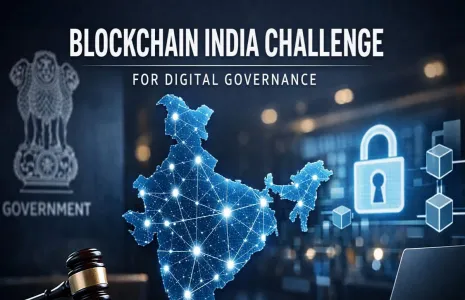
The Ministry of Electronics and Information Technology has launched a Startup Challenge to develop citizen-centric innovative solutions using blockchain and Web3 to support government use cases. The scheme offers financial incentives to blockchain and Web3 start ups and is intended to encourage development on permissioned blockchain infrastructure. Monetary values are expressed in million (mn) and thereafter use the abbreviation mn. The initiative was presented to the Rajya Sabha by the Union Minister of State for Electronics and Information Technology.

The challenge is structured in four evaluation stages and provides graded support as teams progress from concept to deployment. In stage one selected teams move from ideation to proof of concept with up to 40 entries receiving Rs 0.15 mn each. In stage two shortlisted teams advance from proof of concept to minimum viable product with up to 30 entries supported with Rs 0.4 mn each. In stage three up to 20 shortlisted teams receive Rs 1 mn each to take their minimum viable product to deployment and stage four will select up to 10 winning teams to receive Rs 5 mn each to deploy pilot governance solutions.

Existing pilots illustrate potential government applications of blockchain technology. Judiciary Chain records judicial data and documents and has completed pilot implementation at the Supreme Court and the High Court of Karnataka for bail orders and judgement orders. The Aushada system tracks medicine supply chain in Karnataka and is deployed on the National Blockchain Framework infrastructure to record movement and quality check details. Praamaanik stores application origin details from app owners and allows citizens to verify authenticity through a security application and has onboarded 14 citizen-centric applications from a state electronics development corporation.

The ministry expects the challenge to foster scalable public sector solutions and incentivise start ups to align product development with governance needs. Support is intended to reduce barriers to pilot deployment and create precedent use cases that other states and central bodies can adapt. The programme emphasises permissioned blockchain for privacy and governance requirements and aims to accelerate citizen-centric services.

The Ministry of Electronics and Information Technology has launched a Startup Challenge to develop citizen-centric innovative solutions using blockchain and Web3 to support government use cases. The scheme offers financial incentives to blockchain and Web3 start ups and is intended to encourage development on permissioned blockchain infrastructure. Monetary values are expressed in million (mn) and thereafter use the abbreviation mn. The initiative was presented to the Rajya Sabha by the Union Minister of State for Electronics and Information Technology. The challenge is structured in four evaluation stages and provides graded support as teams progress from concept to deployment. In stage one selected teams move from ideation to proof of concept with up to 40 entries receiving Rs 0.15 mn each. In stage two shortlisted teams advance from proof of concept to minimum viable product with up to 30 entries supported with Rs 0.4 mn each. In stage three up to 20 shortlisted teams receive Rs 1 mn each to take their minimum viable product to deployment and stage four will select up to 10 winning teams to receive Rs 5 mn each to deploy pilot governance solutions. Existing pilots illustrate potential government applications of blockchain technology. Judiciary Chain records judicial data and documents and has completed pilot implementation at the Supreme Court and the High Court of Karnataka for bail orders and judgement orders. The Aushada system tracks medicine supply chain in Karnataka and is deployed on the National Blockchain Framework infrastructure to record movement and quality check details. Praamaanik stores application origin details from app owners and allows citizens to verify authenticity through a security application and has onboarded 14 citizen-centric applications from a state electronics development corporation. The ministry expects the challenge to foster scalable public sector solutions and incentivise start ups to align product development with governance needs. Support is intended to reduce barriers to pilot deployment and create precedent use cases that other states and central bodies can adapt. The programme emphasises permissioned blockchain for privacy and governance requirements and aims to accelerate citizen-centric services.

Next Story
Real Estate

Integrated Waterproofing Strategies

Waterproofing buildings used to be an annual pre-monsoon affair but the evolution of real-estate development has changed that approach. In new developments, developers are weaving waterproofing solutions into both the design and construction phases, an approach that Nikhil Madan, Managing Director, Mahima Group, says, “is all about ensuring lasting durability [of the building] and keeping lifecycle risks including water seepage and extensive maintenance to a minimum.”Watertight by designAluminium formwork systems aren’t commonly thought of as a waterproofing tool but at the Mahima Group,..

Next Story
Infrastructure Urban

GROHE Showcases Water-Led Design At Milan

GROHE unveiled its GROHE SPA Aqua Sanctuary at Milan Design Week 2026, transforming Piccolo Teatro Studio Melato into an immersive showcase of water, design and wellbeing. Built on the philosophy of ‘Wellbeing Through Water’, the installation reimagined bathrooms as holistic spaces for relaxation, rejuvenation and self-care.The Aqua Sanctuary was presented through three interconnected sanctums. The first showcased the 3D-printed GROHE SPA AquaTree shower and faucet, highlighting bespoke innovation and biophilic design. The second featured the Atrio Private Collection and GROHE SPA x Buster..

Next Story
Infrastructure Transport

Rahee Group Expands Rail Manufacturing Capacity

Rahee Group has outlined a multi-year investment roadmap to expand its operational footprint and strengthen manufacturing capabilities for India’s growing railway and urban transit sector. The Group is expanding in Odisha with a new Track Component Casting Unit, for which the groundbreaking ceremony was held on 8 April 2026 in the presence of Odisha Chief Minister Mohan Charan Majhi.The Group’s flagship EPC arm, Rahee Infratech Ltd, continues to focus on complex rail infrastructure projects, including track systems, bridges, viaducts and ballastless infrastructure. Its wholly owned subsidi..

Advertisement

Subscribe to Our Newsletter

Get daily newsletters around different themes from Construction world.

STAY CONNECTED

Advertisement

Advertisement

Advertisement