Startups Drive Chip Design Push at Semicon India 2025
ECONOMY & POLICY

Startups Drive Chip Design Push at Semicon India 2025

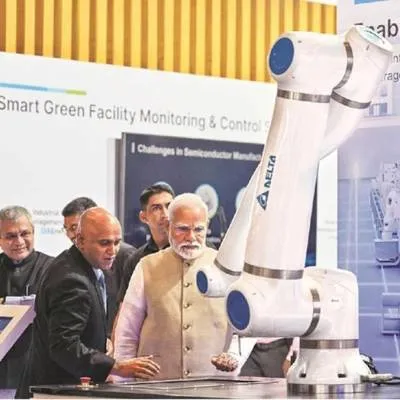
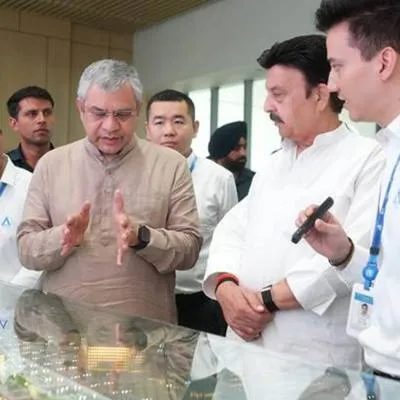
On Day 2 of Semicon India 2025, held at Yashobhoomi in New Delhi, Prime Minister Shri Narendra Modi visited the exhibition pavilions, accompanied by Union Minister Shri Ashwini Vaishnaw and Minister of State Shri Jitin Prasada. During the visit, the Prime Minister underscored the critical role of startups and Indian Intellectual Property (IP) in driving the country’s ambitions in semiconductor self-reliance.
Backed by the Government of India’s Design Linked Incentive (DLI) Scheme, Indian chip design is accelerating across vital domains such as surveillance, networking, energy metering, and motor control. To date, 23 chip design projects have been approved under the scheme, and 72 startups have been granted access to advanced Electronic Design Automation (EDA) tools. Many of these ventures presented their innovations at the event, showcasing India's growing prowess in semiconductor design.

RISC-V SoC Automation Platform by InCore
InCore Semiconductors, founded by the creators of India's SHAKTI processors, unveiled a System-on-Chip (SoC) Generator Platform that reduces frontend chip design time from months to minutes. Their test chip, manufactured on TSMC’s 40nm node, integrates six heterogeneous RISC-V cores, a custom Network-on-Chip, peripherals, and a full software stack including a Real-Time Operating System (RTOS).

InCore’s RISC-V portfolio includes:
  • Azurite: For ultra-low-power motor control and embedded applications
  • Calcite: For mid-tier IoT devices, balancing power and performance
  • Dolomite (in development): For high-performance vector processing and edge AI
Made-in-India Networking SoC – Vihaan
Aheesa Digital Innovations will release its Vihaan SoC, based on the C-DAC VEGA RISC-V processor, by Q1 2026. The chip includes Secure Boot, PCIe 3.0, USB 3.0, and other key interfaces. It will be offered to OEMs and ODMs to create broadband and networking equipment using 100 per cent indigenously developed silicon.

Surveillance SoCs by Indian Firms
Four Indian companies—3rdiTech, Netrasemi, BigEndian Semiconductors, and Mindgrove Technologies—are developing SoCs for surveillance and CCTV applications. Test chips were taped out in 2025, and commercial versions are set for 2026. Collectively, these startups have raised over Rs 3 billion in venture capital, including DLI support, with combined valuations exceeding Rs 10 billion.

Vidyut: Smart Energy Meter Chip by MosChip
MosChip Technologies is working on Vidyut, a fully indigenous smart energy meter chip. Key IPs like the Power Management Unit, LCD Controller, and Clock Management Unit have been validated on a 180nm test chip, with packaging done at SCL Mohali. Full localisation, including fabrication, is targeted by 2026.

Motor Control & Space-Grade ICs by Vervesemi
Vervesemi aims to begin mass production of its custom SoCs by late 2026. These include chips for BLDC motor control, EVs, drones, and weighing systems, as well as ASICs for space-grade data acquisition, developed in collaboration with ISRO to replace imported components.

MBit’s 4G-LTE Modem Chipset
MBit Wireless has indigenously developed a 4G-LTE modem chipset with a complete protocol stack. It has been certified by the Global Certification Forum (GCF) and LG Labs and is undergoing field testing with Indian telecom operators.

From IP creation to fully indigenous system-on-chip (SoC) platforms, startups supported under the DLI Scheme are fast-tracking India's journey toward semiconductor self-reliance. Prime Minister Modi affirmed that India is transitioning from being a backend hub to a full-stack semiconductor nation, with homegrown innovation now powering India’s place in the global chip design ecosystem.
With a strong foundation laid, and indigenous companies now building chips in India, for the world, the vision of a Viksit Bharat through electronics and semiconductor leadership is steadily becoming a reality.

On Day 2 of Semicon India 2025, held at Yashobhoomi in New Delhi, Prime Minister Shri Narendra Modi visited the exhibition pavilions, accompanied by Union Minister Shri Ashwini Vaishnaw and Minister of State Shri Jitin Prasada. During the visit, the Prime Minister underscored the critical role of startups and Indian Intellectual Property (IP) in driving the country’s ambitions in semiconductor self-reliance.Backed by the Government of India’s Design Linked Incentive (DLI) Scheme, Indian chip design is accelerating across vital domains such as surveillance, networking, energy metering, and motor control. To date, 23 chip design projects have been approved under the scheme, and 72 startups have been granted access to advanced Electronic Design Automation (EDA) tools. Many of these ventures presented their innovations at the event, showcasing India's growing prowess in semiconductor design.RISC-V SoC Automation Platform by InCoreInCore Semiconductors, founded by the creators of India's SHAKTI processors, unveiled a System-on-Chip (SoC) Generator Platform that reduces frontend chip design time from months to minutes. Their test chip, manufactured on TSMC’s 40nm node, integrates six heterogeneous RISC-V cores, a custom Network-on-Chip, peripherals, and a full software stack including a Real-Time Operating System (RTOS).InCore’s RISC-V portfolio includes:Azurite: For ultra-low-power motor control and embedded applicationsCalcite: For mid-tier IoT devices, balancing power and performanceDolomite (in development): For high-performance vector processing and edge AIMade-in-India Networking SoC – VihaanAheesa Digital Innovations will release its Vihaan SoC, based on the C-DAC VEGA RISC-V processor, by Q1 2026. The chip includes Secure Boot, PCIe 3.0, USB 3.0, and other key interfaces. It will be offered to OEMs and ODMs to create broadband and networking equipment using 100 per cent indigenously developed silicon.Surveillance SoCs by Indian FirmsFour Indian companies—3rdiTech, Netrasemi, BigEndian Semiconductors, and Mindgrove Technologies—are developing SoCs for surveillance and CCTV applications. Test chips were taped out in 2025, and commercial versions are set for 2026. Collectively, these startups have raised over Rs 3 billion in venture capital, including DLI support, with combined valuations exceeding Rs 10 billion.Vidyut: Smart Energy Meter Chip by MosChipMosChip Technologies is working on Vidyut, a fully indigenous smart energy meter chip. Key IPs like the Power Management Unit, LCD Controller, and Clock Management Unit have been validated on a 180nm test chip, with packaging done at SCL Mohali. Full localisation, including fabrication, is targeted by 2026.Motor Control & Space-Grade ICs by VervesemiVervesemi aims to begin mass production of its custom SoCs by late 2026. These include chips for BLDC motor control, EVs, drones, and weighing systems, as well as ASICs for space-grade data acquisition, developed in collaboration with ISRO to replace imported components.MBit’s 4G-LTE Modem ChipsetMBit Wireless has indigenously developed a 4G-LTE modem chipset with a complete protocol stack. It has been certified by the Global Certification Forum (GCF) and LG Labs and is undergoing field testing with Indian telecom operators.From IP creation to fully indigenous system-on-chip (SoC) platforms, startups supported under the DLI Scheme are fast-tracking India's journey toward semiconductor self-reliance. Prime Minister Modi affirmed that India is transitioning from being a backend hub to a full-stack semiconductor nation, with homegrown innovation now powering India’s place in the global chip design ecosystem.With a strong foundation laid, and indigenous companies now building chips in India, for the world, the vision of a Viksit Bharat through electronics and semiconductor leadership is steadily becoming a reality. 

Next Story
Infrastructure Urban

Mount Expands Tumkur Facility with New Automated Panel, PEB Lines

Mount Roofing & Structures Private Limited, one of India's fastest-growing manufacturers in PUF and a leading solutions provider across pre-engineered building (PEB) and polycarbonate sheets, simultaneously inaugurated its second fully automated continuous sandwich panel manufacturing line and a new PEB manufacturing plant at its integrated campus in Tumkur.The milestone expansion, part of a total investment of Rs 250 crore, marks a significant advancement in the company's commitment to engineered performance, manufacturing scale, and industrial growth. The integrated facility spans approx..

Next Story
Infrastructure Transport

India Becomes First to Produce Bio-Bitumen for Roads

India has become the first country in the world to commercially produce bio-bitumen for use in road construction, according to Road, Transport and Highways Minister Nitin Gadkari. Bitumen, a black and viscous hydrocarbon derived from crude oil, is a key binding material in road building, and the bio-based alternative is expected to significantly improve the sector’s environmental footprint.Addressing the CSIR Technology Transfer Ceremony in New Delhi, Mr Gadkari congratulated Council of Scientific and Industrial Research on achieving the milestone, noting that the initiative would help curb ..

Next Story
Infrastructure Urban

HILT Policy Seen Boosting Telangana Revenue Sharply

The Hyderabad Industrial Land Transformation (HILT) Policy is expected to generate around Rs 1.08 billion in revenue for the Telangana state exchequer, according to Deputy Chief Minister Bhatti Vikramarka Mallu. Speaking in the Telangana Legislative Assembly, he said the policy would be implemented within a six-month timeframe in a transparent manner, with uniform rules applicable to all stakeholders. Mr Vikramarka noted that without the HILT Policy, the state would have earned only about Rs 1.2 million per acre. Under the new framework, however, revenue is projected to rise sharply to Rs 70 ..

Advertisement

Subscribe to Our Newsletter

Get daily newsletters around different themes from Construction world.

STAY CONNECTED

Advertisement

Advertisement

Advertisement

Advertisement

Open In App