Tata.ev Partners With Hopcharge For On-Demand EV Charging Vans
ECONOMY & POLICY

Tata.ev Partners With Hopcharge For On-Demand EV Charging Vans

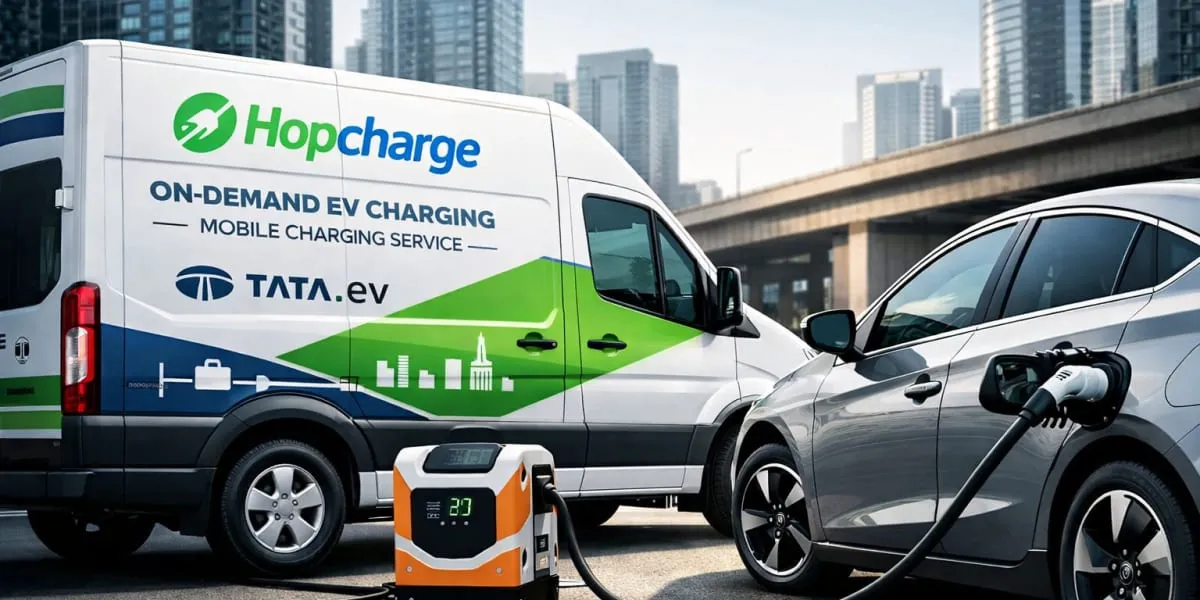
Tata.ev has partnered with Hopcharge to launch an on-demand electric vehicle charging van service in the National Capital Region (NCR). The initiative is intended to provide flexible charging support for private and commercial electric vehicles and to address range anxiety across dense urban corridors. The partners framed the service as complementary to fixed charging infrastructure and as a measure to accelerate electric mobility uptake and to support policymaker objectives for cleaner urban transport.

The mobile vans will be deployed to respond to booking requests through a digital platform and will serve residential neighbourhoods, business districts and fleet depots. The operation is described as on-demand and dynamically routed to match real time requirements, enabling users to request assistance at short notice and to minimise delays caused by queueing at fixed sites. The service model aims to reduce downtime for drivers and to support continuous vehicle operations for last mile and urban delivery fleets.

The partners said the vans will carry modular charging equipment and will coordinate with local power utilities to manage peak loads and ensure safety and reliability. The service is expected to complement public chargers and to address the interim needs of users while fixed infrastructure expands. Operators will focus on rapid response, operational efficiency and data driven optimisation of fleet deployment and to apply predictive analytics for route planning and demand forecasting.

The roll out begins with a pilot phase in the National Capital Region and will be monitored for performance, utilisation and customer experience before any wider expansion. Tata.ev and Hopcharge intend to gather operational insights and refine the service to inform future scaling across other metropolitan markets. The collaboration is positioned as a practical step to broaden access to charging and to support the wider transition to electric mobility and to evaluate environmental and economic outcomes.

Tata.ev has partnered with Hopcharge to launch an on-demand electric vehicle charging van service in the National Capital Region (NCR). The initiative is intended to provide flexible charging support for private and commercial electric vehicles and to address range anxiety across dense urban corridors. The partners framed the service as complementary to fixed charging infrastructure and as a measure to accelerate electric mobility uptake and to support policymaker objectives for cleaner urban transport. The mobile vans will be deployed to respond to booking requests through a digital platform and will serve residential neighbourhoods, business districts and fleet depots. The operation is described as on-demand and dynamically routed to match real time requirements, enabling users to request assistance at short notice and to minimise delays caused by queueing at fixed sites. The service model aims to reduce downtime for drivers and to support continuous vehicle operations for last mile and urban delivery fleets. The partners said the vans will carry modular charging equipment and will coordinate with local power utilities to manage peak loads and ensure safety and reliability. The service is expected to complement public chargers and to address the interim needs of users while fixed infrastructure expands. Operators will focus on rapid response, operational efficiency and data driven optimisation of fleet deployment and to apply predictive analytics for route planning and demand forecasting. The roll out begins with a pilot phase in the National Capital Region and will be monitored for performance, utilisation and customer experience before any wider expansion. Tata.ev and Hopcharge intend to gather operational insights and refine the service to inform future scaling across other metropolitan markets. The collaboration is positioned as a practical step to broaden access to charging and to support the wider transition to electric mobility and to evaluate environmental and economic outcomes.

Next Story
Technology

India Data Centre Market to Cross USD 22 Bn by 2030: Vestian

India’s data centre market is projected to more than double from around USD 10 billion in 2025 to USD 22 billion by 2030, according to a latest report by Vestian. The growth is expected to be driven by rising cloud adoption, expanding AI workloads and increasing demand for data-intensive digital services.Vestian noted that the global data centre sector is witnessing rapid expansion, with current installed capacity estimated at 40–50 GW and projections exceeding 100 GW by 2030. Within this evolving landscape, India is emerging as a strategic hub in the Asia-Pacific region, supported by its ..

Next Story
Real Estate

Retail Leasing Hits 4.3 Mn Sq Ft in H2 2025: ANAROCK RELEAP 2026

India’s retail real estate market recorded a total retail absorption of around 4.3 million sq ft across the top seven cities in H2 2025, reflecting steady leasing activity despite a dynamic market environment, according to ANAROCK Retail’s flagship report, RELEAP 2026.The report highlights a structural shift in the sector as organised retail moves beyond transactional formats toward experience-led spaces that combine shopping, entertainment and dining. Apparel emerged as the leading category driving leasing demand during the period, followed by entertainment, hypermarkets/supermarkets, and..

Next Story
Building Material

Berger Paints Launches ‘Garmi Gone, Thandak On’ Cooling Range

Berger Paints India has launched its Home Cooling Paints Range along with a nationwide campaign titled ‘Garmi Gone, Thandak On’, as rising temperatures continue to pose growing challenges for households across India.The company said the campaign promotes smarter and energy-efficient cooling solutions by focusing on preventing heat from entering homes rather than relying solely on air conditioning. Berger Paints stated that a significant amount of heat enters homes through walls, rooftops and structural openings, making surface protection an important factor in reducing indoor discomfort du..

Advertisement

Subscribe to Our Newsletter

Get daily newsletters around different themes from Construction world.

STAY CONNECTED

Advertisement

Advertisement

Advertisement