TRAI Assesses Mobile Network Quality In Saharanpur And Muzaffarnagar
ECONOMY & POLICY

TRAI Assesses Mobile Network Quality In Saharanpur And Muzaffarnagar

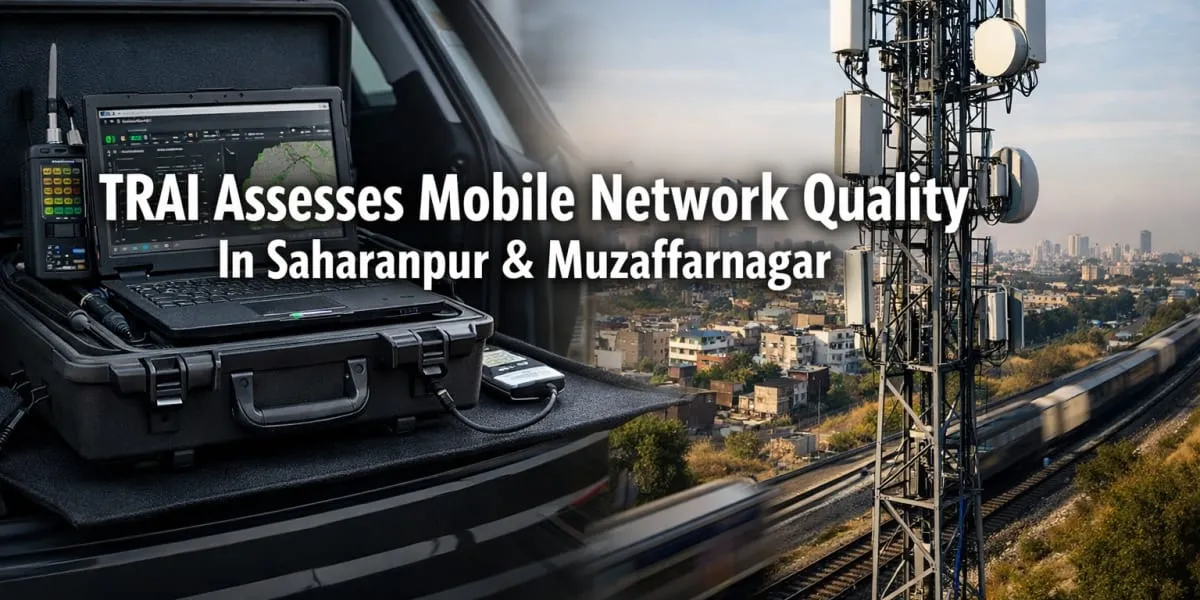
The Telecom Regulatory Authority of India conducted Independent Drive Tests covering Saharanpur and Muzaffarnagar cities and nearby areas of Uttar Pradesh (West) licence service area in January 2026. The appointed agency carried out city drive tests over 338.4 km and three point eight km of walk tests between 20 and 23 January 2026 to capture real?world experience across urban zones, hotspots and public transport hubs. The evaluation covered second?generation (2G), third?generation (3G), fourth?generation (4G) and fifth?generation (5G) technologies to reflect diverse handset capabilities and the findings have been intimated to the telecom service providers for further action.

Key parameters for voice assessment included call setup success rate, drop call rate, call setup time, call silence rate and speech quality measured as mean opinion score together with coverage. Data services were assessed for download and upload throughput, latency, jitter, packet drop rate and video streaming delay. The tests used TRAI calibrated equipment and standardised protocols in real?time environments and the authority indicated that the detailed report is available on the TRAI website.

In auto?selection mode covering 5G, 4G, 3G and 2G voice testing, Airtel recorded a call setup success rate of 99.71 per cent, BSNL 80.56 per cent, RJIL 99.85 per cent and VIL 89.06 per cent. Drop call rates were reported as zero point zero zero per cent for Airtel, one point two one per cent for BSNL, zero point five nine per cent for RJIL and zero point four seven per cent for VIL. Poor signal strength during voice testing on the city route was observed as zero point four two per cent for Airtel, 17.51 per cent for BSNL, zero point three two per cent for RJIL and zero point six eight per cent for VIL.

During data testing in auto?selection mode, poor signal strength on the city route was four point five zero per cent for Airtel, 29.08 per cent for BSNL, two point nine seven per cent for RJIL and two point seven six per cent for VIL. The authority advised that the findings have been communicated to the concerned operators for remedial measures and further necessary action. For clarification, the regional advisor in Bhopal may be contacted through the channels indicated in the detailed report.

The Telecom Regulatory Authority of India conducted Independent Drive Tests covering Saharanpur and Muzaffarnagar cities and nearby areas of Uttar Pradesh (West) licence service area in January 2026. The appointed agency carried out city drive tests over 338.4 km and three point eight km of walk tests between 20 and 23 January 2026 to capture real?world experience across urban zones, hotspots and public transport hubs. The evaluation covered second?generation (2G), third?generation (3G), fourth?generation (4G) and fifth?generation (5G) technologies to reflect diverse handset capabilities and the findings have been intimated to the telecom service providers for further action. Key parameters for voice assessment included call setup success rate, drop call rate, call setup time, call silence rate and speech quality measured as mean opinion score together with coverage. Data services were assessed for download and upload throughput, latency, jitter, packet drop rate and video streaming delay. The tests used TRAI calibrated equipment and standardised protocols in real?time environments and the authority indicated that the detailed report is available on the TRAI website. In auto?selection mode covering 5G, 4G, 3G and 2G voice testing, Airtel recorded a call setup success rate of 99.71 per cent, BSNL 80.56 per cent, RJIL 99.85 per cent and VIL 89.06 per cent. Drop call rates were reported as zero point zero zero per cent for Airtel, one point two one per cent for BSNL, zero point five nine per cent for RJIL and zero point four seven per cent for VIL. Poor signal strength during voice testing on the city route was observed as zero point four two per cent for Airtel, 17.51 per cent for BSNL, zero point three two per cent for RJIL and zero point six eight per cent for VIL. During data testing in auto?selection mode, poor signal strength on the city route was four point five zero per cent for Airtel, 29.08 per cent for BSNL, two point nine seven per cent for RJIL and two point seven six per cent for VIL. The authority advised that the findings have been communicated to the concerned operators for remedial measures and further necessary action. For clarification, the regional advisor in Bhopal may be contacted through the channels indicated in the detailed report.

Next Story
Real Estate

Housing Sales Dip 7 per cent QoQ Across Top Cities

India’s housing market saw a 7 per cent quarter-on-quarter decline in sales across the top seven cities in Q1 2026, with approximately 1,01,675 units sold compared to 1,08,970 units in Q4 2025, according to ANAROCK Group. However, on a yearly basis, sales rose 9 per cent, indicating continued underlying demand.The total sales value stood at around Rs 1.51 trillion, reflecting a 5 per cent quarterly drop but a 6 per cent annual increase. Mumbai Metropolitan Region and Bengaluru together accounted for nearly 48 per cent of total sales, while Chennai recorded the highest quarterly decline at 18..

Next Story
Real Estate

Birla Estates Enters Mumbai Redevelopment

Birla Estates has announced its entry into Mumbai’s redevelopment segment with a luxury residential project in Khar West, developed in partnership with Parinee Real Estate Builders. The project will redevelop Anmol Co-operative Housing Society and Bhartiya Bhavan Co-operative Housing Society, marking the company’s first redevelopment initiative in the Mumbai Metropolitan Region.Spread across 1.3 acres, the development will offer a saleable area of 2.9 lakh sq ft with an estimated revenue potential of Rs 17 billion. Positioned in one of Mumbai’s prime residential micro-markets, the projec..

Next Story
Infrastructure Urban

Hitachi, MUFG Expand EV Financing Model

Hitachi and MUFG Bank have expanded their NextGen business co-creation model to accelerate decarbonised mobility by financing electric vehicles and charging infrastructure. The renewed collaboration aims to address key barriers to electrification, including limited access to capital and the need for integrated energy solutions.Building on earlier partnerships, the expanded model extends beyond battery-focused solutions to include electric mobility assets, charging systems and energy management infrastructure across global markets. The initiative will leverage structured financing through speci..

Advertisement

Subscribe to Our Newsletter

Get daily newsletters around different themes from Construction world.

STAY CONNECTED

Advertisement

Advertisement

Advertisement