+
US Iran Escalation Triggers Regional Strikes And Travel Disruptions
ECONOMY & POLICY

US Iran Escalation Triggers Regional Strikes And Travel Disruptions

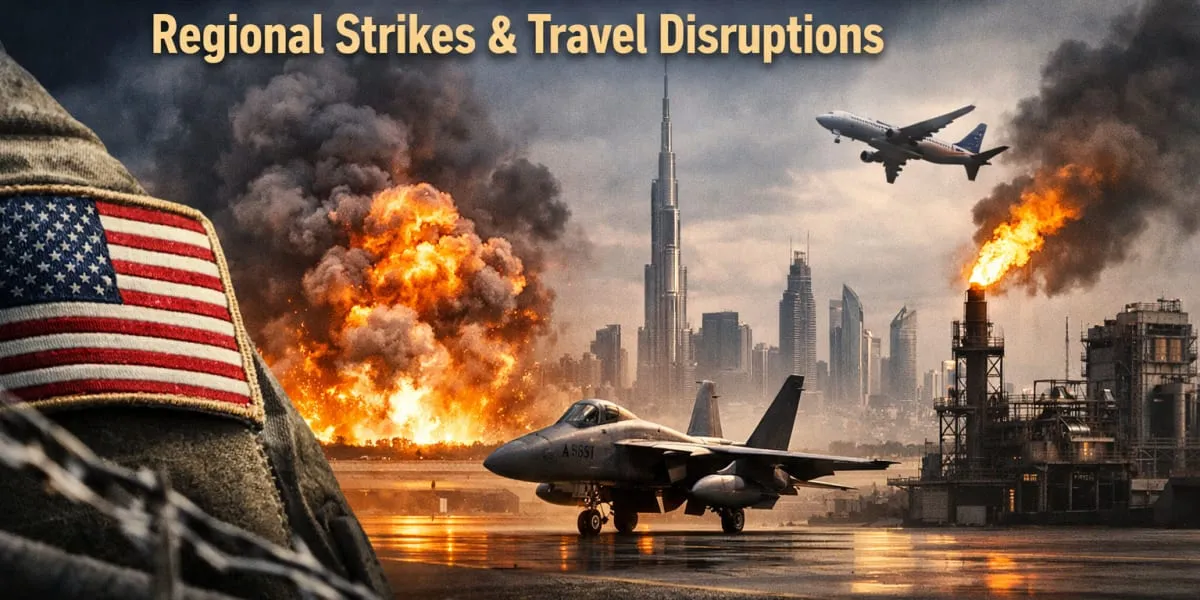
Hostilities between the United States and Iran escalated after former president Donald Trump warned Tehran and signalled the use of force that had never been seen before. Iranian forces responded by striking a United States naval base in Kuwait, an action that regional authorities reported as part of a wider offensive. The exchanges have heightened tensions across the Middle East and prompted intensified international monitoring.

Multiple blasts were reported in Dubai amid the offensive, and Qatar said eight people were injured in separate incidents. Aviation authorities closed parts of Gulf airspace as a precaution, forcing cancellations and route changes by several carriers. Indian carriers were among those affected, with Air India and Indigo cancelling flights on regional sectors.

India issued an advisory for foreigners who may be stranded following the escalation and urged them to register with their diplomatic missions and follow official guidance. Travel disruption compounded by airport closures left many passengers facing delays and missed connections, with reports of ruined holiday plans and additional expenses. Authorities advised travellers to check notices before travelling and to liaise with airlines for rebooking.

Commercial links and supply chains showed signs of strain as carriers rerouted flights and insurers assessed risk exposure in the region. Markets reacted to the uncertainty with heightened volatility in energy and transportation sectors, while shipping and logistics firms adjusted schedules to avoid conflict zones. Governments and companies emphasised contingency planning to limit disruption to commerce and citizens.

International organisations called for restraint and diplomatic engagement to de-escalate the situation, while intelligence agencies continued to monitor developments closely. Travel advisories and operational notices were expected to evolve as events unfolded, and officials urged travellers to allow additional time for journeys and to verify itineraries. The region remained on high alert as responses continued to unfold.

Hostilities between the United States and Iran escalated after former president Donald Trump warned Tehran and signalled the use of force that had never been seen before. Iranian forces responded by striking a United States naval base in Kuwait, an action that regional authorities reported as part of a wider offensive. The exchanges have heightened tensions across the Middle East and prompted intensified international monitoring. Multiple blasts were reported in Dubai amid the offensive, and Qatar said eight people were injured in separate incidents. Aviation authorities closed parts of Gulf airspace as a precaution, forcing cancellations and route changes by several carriers. Indian carriers were among those affected, with Air India and Indigo cancelling flights on regional sectors. India issued an advisory for foreigners who may be stranded following the escalation and urged them to register with their diplomatic missions and follow official guidance. Travel disruption compounded by airport closures left many passengers facing delays and missed connections, with reports of ruined holiday plans and additional expenses. Authorities advised travellers to check notices before travelling and to liaise with airlines for rebooking. Commercial links and supply chains showed signs of strain as carriers rerouted flights and insurers assessed risk exposure in the region. Markets reacted to the uncertainty with heightened volatility in energy and transportation sectors, while shipping and logistics firms adjusted schedules to avoid conflict zones. Governments and companies emphasised contingency planning to limit disruption to commerce and citizens. International organisations called for restraint and diplomatic engagement to de-escalate the situation, while intelligence agencies continued to monitor developments closely. Travel advisories and operational notices were expected to evolve as events unfolded, and officials urged travellers to allow additional time for journeys and to verify itineraries. The region remained on high alert as responses continued to unfold.

Next Story
Infrastructure Urban

Implementation Status of Jal Jeevan Mission

Since August 2019 the Government has implemented Jal Jeevan Mission to provide assured potable water through household tap connections in rural India. At the start of the mission only 32.3 million (mn) rural households, representing 16.7 per cent, were reported to have tap water connections. States and union territories have reported that 125.8 mn additional rural households have since been provided with tap connections. As a result, of about 193.6 mn rural households roughly 158.2 mn, or 81.71 per cent, are reported to have tap water supply at home.\n\nThe State, district and village level st..

Next Story
Infrastructure Urban

Jal Jeevan Mission Reaches Eighty One Per Cent Rural Coverage

The Government reported substantial progress under the Jal Jeevan Mission, launched in August 2019 to provide tap water to every rural household. At launch only 32.3 million (mn) rural households had tap connections and states and Union territories reported provision of 125.8 mn additional households by March 2026. Consequently, out of about 193.6 mn rural households around 158.2 mn, or 81.71 per cent, are reported to have tap water at home. The Finance Minister announced extension of the mission until 2028 in the 2025-26 budget speech. The Swachh Bharat Mission Grameen, launched in October 20..

Next Story
Infrastructure Urban

Empowering Local Governance for Sustainable Rural Water Supply

The Ministry of Jal Shakti has aligned the Jal Jeevan Mission (JJM) with the 73rd Amendment to strengthen village level planning and community ownership of water supply. Gram Panchayats, village water and sanitation committees and Pani Samitis are to plan, implement, manage and maintain piped water systems, with gram sabha processes formalising handover and oversight. Implementation support agencies including non government organisations, community based organisations and self help groups have been empanelled to train local committees and promote women participation. Under JJM, the department ..

Advertisement

Subscribe to Our Newsletter

Get daily newsletters around different themes from Construction world.

STAY CONNECTED

Advertisement

Advertisement

Advertisement