Zingbus Targets Rs 3.50 Bn Revenue on Demand-Led Network Expansion
ECONOMY & POLICY

Zingbus Targets Rs 3.50 Bn Revenue on Demand-Led Network Expansion

Intercity bus aggregator zingbus has set an ambitious revenue target of over Rs 3.50 billion for the current financial year, banking on demand-led network expansion and increased service frequency across key corridors in north and south India. The company said its growth strategy is closely aligned with rising passenger demand for flexible, reliable and premium intercity travel options.

To support this expansion, zingbus has launched 28 new intercity routes under its zingbus Maxx and zingbus Plus offerings. These services are designed to cater to different traveller segments, combining comfort, safety and affordability while addressing the growing preference for organised intercity bus travel.

A significant part of the company’s fleet expansion has been undertaken on existing high-demand routes. By adding more buses on established corridors, zingbus aims to provide passengers with greater flexibility in travel timings and improved seat availability. The approach allows the company to optimise utilisation while enhancing customer convenience, especially during peak travel periods.

The demand-led strategy reflects a broader shift in intercity mobility, with travellers increasingly opting for app-based aggregators that offer transparent pricing, digital ticketing and consistent service standards. zingbus said its network growth is being guided by real-time demand patterns, enabling it to scale operations efficiently while maintaining service quality.

With a stronger presence across northern and southern markets, the company is positioning itself to capture a larger share of India’s fast-growing intercity travel segment. The focus on expanding both routes and frequency is expected to drive higher load factors and repeat usage, contributing to topline growth during the fiscal year.

As competition intensifies in the organised bus travel space, zingbus believes its emphasis on network depth, fleet deployment on proven routes and differentiated service categories will help sustain momentum. The company’s Rs 3.50-billion revenue target underscores confidence in continued demand recovery and the long-term potential of India’s intercity bus market.

News source: Outlook Business

Intercity bus aggregator zingbus has set an ambitious revenue target of over Rs 3.50 billion for the current financial year, banking on demand-led network expansion and increased service frequency across key corridors in north and south India. The company said its growth strategy is closely aligned with rising passenger demand for flexible, reliable and premium intercity travel options.To support this expansion, zingbus has launched 28 new intercity routes under its zingbus Maxx and zingbus Plus offerings. These services are designed to cater to different traveller segments, combining comfort, safety and affordability while addressing the growing preference for organised intercity bus travel.A significant part of the company’s fleet expansion has been undertaken on existing high-demand routes. By adding more buses on established corridors, zingbus aims to provide passengers with greater flexibility in travel timings and improved seat availability. The approach allows the company to optimise utilisation while enhancing customer convenience, especially during peak travel periods.The demand-led strategy reflects a broader shift in intercity mobility, with travellers increasingly opting for app-based aggregators that offer transparent pricing, digital ticketing and consistent service standards. zingbus said its network growth is being guided by real-time demand patterns, enabling it to scale operations efficiently while maintaining service quality.With a stronger presence across northern and southern markets, the company is positioning itself to capture a larger share of India’s fast-growing intercity travel segment. The focus on expanding both routes and frequency is expected to drive higher load factors and repeat usage, contributing to topline growth during the fiscal year.As competition intensifies in the organised bus travel space, zingbus believes its emphasis on network depth, fleet deployment on proven routes and differentiated service categories will help sustain momentum. The company’s Rs 3.50-billion revenue target underscores confidence in continued demand recovery and the long-term potential of India’s intercity bus market.News source: Outlook Business

Related Stories

Gold Stories

Next Story
Infrastructure Urban

KONE Opens India's First Digital Experience Centre in Pune

KONE, a global elevator and escalator manufacturer, has inaugurated its first Digital Experience Centre (DEC) in India, located in Pune. The facility aims to showcase how artificial intelligence (AI), connectivity and data-driven technologies can enhance customer experiences and improve building operations.The centre was inaugurated by Jussi Herlin, Executive Vice Chair, KONE Corporation; Philippe Delorme, President and CEO, KONE; and Nandan Nilekani, Co-founder and Chairman of the Board, Infosys.Designed as an interactive customer environment, the facility demonstrates digital solutions cover..

Next Story
Infrastructure Urban

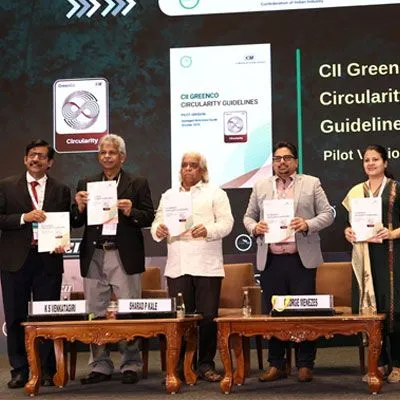
CII GreenCo Launches Circularity Guidelines for Indian Industry

The Confederation of Indian Industry (CII) GreenCo Council has launched the CII GreenCo Circularity Guidelines – Pilot Version at the 17th CII GreenCo Waste & Resource Management Summit 2026 in Chennai. The initiative aims to strengthen resource efficiency, waste reduction and circular economy practices across Indian manufacturing and process industries.The guidelines introduce a structured framework with circularity indices covering raw materials, consumables, packaging and other resource inputs. These indicators will help industries assess existing practices, identify opportunities to ..

Next Story
Infrastructure Energy

Global Electronics Association Launches IPC-1783-CO2E Standard

The Global Electronics Association has introduced IPC-1783-CO2E, a new international standard aimed at improving consistency, transparency and comparability in product carbon footprint reporting across the electronics manufacturing industry.The standard, titled International Standard for Data Collection and Reporting of CO2 Equivalent (CO2e) Emissions for the Electronics Manufacturing Supply Chain, provides industry-specific guidance for collecting, estimating and reporting carbon emissions data.With increasing regulatory requirements and customer expectations, electronics manufacturers face c..

Advertisement

Subscribe to Our Newsletter

Get daily newsletters around different themes from Construction world.

STAY CONNECTED

Advertisement

SPECIAL OFFER
QR Code