Delhi Airport Terminal-1 to close for a month after roof collapse
AVIATION & AIRPORTS

Delhi Airport Terminal-1 to close for a month after roof collapse

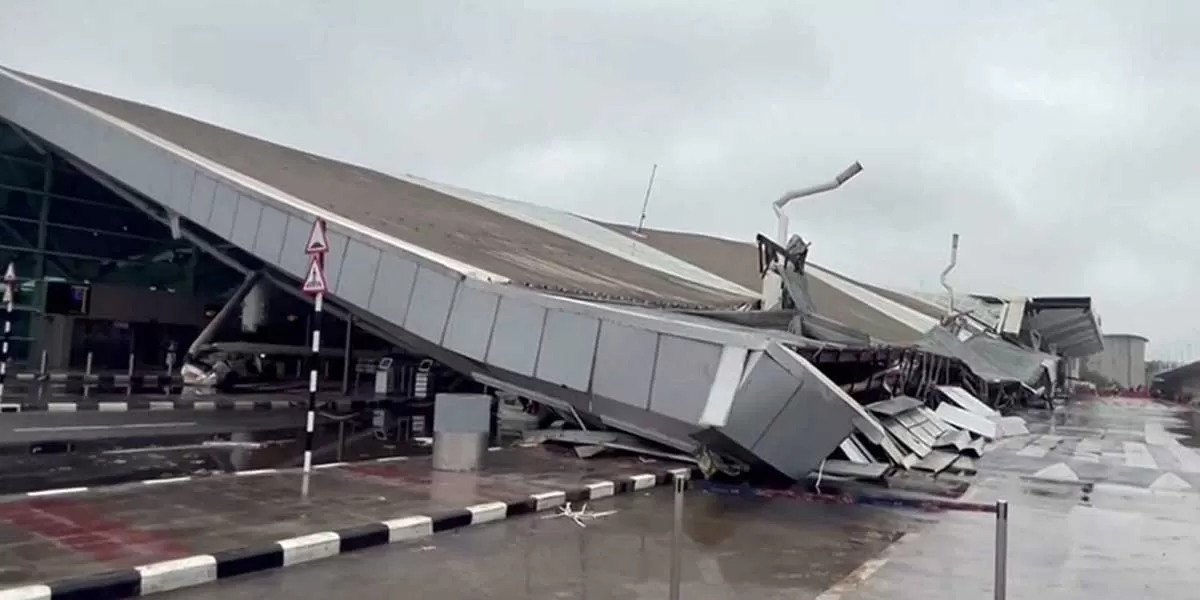
Delhi Airport's revamped Terminal 1 is expected to face more than a month-long delay in starting operations following a roof collapse caused by heavy rain, which resulted in one fatality. Originally set to open by mid-July, the terminal now requires a thorough structural examination before permission can be granted, sources revealed. Meanwhile, all flights have been relocated to Terminals 2 and 3.

A Delhi Airport spokesperson assured that no flights have been delayed or cancelled, and a cross-functional team is actively assessing the situation with various stakeholders to ensure passenger safety and convenience. Terminal 2, the airport's smallest, has taken on the additional flights, but this has led to congestion.

An Indian Institute of Technology (IIT) team is investigating the cause of the incident, which involved the collapse of a portion of the roof, canopy, and several beams. Delhi Airport, the busiest in the country with over 1,100 daily flights, recently completed a Rs 80 billion expansion project, boosting its capacity to handle about 100 million passengers annually. The project aimed to integrate Terminal 1's separate departure and arrival buildings into a single new terminal, doubling its capacity to 40 million passengers annually.

IndiGo has shifted 72 flights from Terminal 1, nearly half to Terminal 2, which can handle around 1,400 passengers per hour but is now experiencing overcrowding. Airline officials likened the situation to winter fog conditions when passenger volumes exceeded planned capacities. Extra manpower and X-ray machines have been deployed, and airlines are rescheduling flights to non-peak hours to manage the increased passenger flow, with potential flight cancellations to reduce the load.

Passengers are advised to arrive at the airport at least three hours before departure to accommodate longer check-in and security processes. Akasa Air, operating from Terminal 2, emphasised this to its passengers. One passenger, Nishant, reported that it took him an hour to complete check-in, citing long queues and limited seating.

"We remain committed to maintaining flight operations at T3 and T2 while operations at T1 are temporarily suspended," the Delhi Airport spokesperson stated. (Source: ET)

Delhi Airport's revamped Terminal 1 is expected to face more than a month-long delay in starting operations following a roof collapse caused by heavy rain, which resulted in one fatality. Originally set to open by mid-July, the terminal now requires a thorough structural examination before permission can be granted, sources revealed. Meanwhile, all flights have been relocated to Terminals 2 and 3. A Delhi Airport spokesperson assured that no flights have been delayed or cancelled, and a cross-functional team is actively assessing the situation with various stakeholders to ensure passenger safety and convenience. Terminal 2, the airport's smallest, has taken on the additional flights, but this has led to congestion. An Indian Institute of Technology (IIT) team is investigating the cause of the incident, which involved the collapse of a portion of the roof, canopy, and several beams. Delhi Airport, the busiest in the country with over 1,100 daily flights, recently completed a Rs 80 billion expansion project, boosting its capacity to handle about 100 million passengers annually. The project aimed to integrate Terminal 1's separate departure and arrival buildings into a single new terminal, doubling its capacity to 40 million passengers annually. IndiGo has shifted 72 flights from Terminal 1, nearly half to Terminal 2, which can handle around 1,400 passengers per hour but is now experiencing overcrowding. Airline officials likened the situation to winter fog conditions when passenger volumes exceeded planned capacities. Extra manpower and X-ray machines have been deployed, and airlines are rescheduling flights to non-peak hours to manage the increased passenger flow, with potential flight cancellations to reduce the load. Passengers are advised to arrive at the airport at least three hours before departure to accommodate longer check-in and security processes. Akasa Air, operating from Terminal 2, emphasised this to its passengers. One passenger, Nishant, reported that it took him an hour to complete check-in, citing long queues and limited seating. We remain committed to maintaining flight operations at T3 and T2 while operations at T1 are temporarily suspended, the Delhi Airport spokesperson stated. (Source: ET)

Next Story
Equipment

Schwing Stetter India Unveils New Innovations at Excon 2025

Schwing Stetter India unveiled more than 20 new machines at Excon 2025, marking one of its most significant showcases and introducing several India-first technologies to the construction equipment sector. The company launched the country’s first 56-metre boom pump designed and manufactured in India, the first fully electric truck mixer, the first CNG mixer variant and the first hybrid boom pump. Executives said the launch portfolio was engineered to support India’s move toward faster, greener and more vertically oriented infrastructure through advanced engineering, clean-energy solutions a..

Next Story
Infrastructure Energy

SEPC Resolves Hindustan Copper Dispute, Wins Rs 725 Mn Order

Engineering, procurement and construction firm SEPC Ltd has recently settled a dispute with Hindustan Copper Ltd (HCL) and secured a mining infrastructure order valued at Rs 725 million from the state-owned company. SEPC informed the stock exchanges that it has executed a settlement deed with HCL, bringing closure to all inter-se claims and counterclaims arising from arbitration proceedings. As part of the settlement, SEPC will receive Rs 304.5 million as full and final payment, marking the resolution of all pending disputes between the two entities. The company also stated that Hindustan Co..

Next Story
Infrastructure Energy

20% Ethanol Blending Cuts India’s CO2 Emissions by 73.6 Mn Tonnes

Union Road Transport and Highways Minister Nitin Gadkari recently said that India has reduced carbon dioxide emissions by 73.6 million metric tonnes due to the adoption of 20 per cent ethanol blending in petrol. He made the statement while replying to supplementary questions during the Question Hour in the Lok Sabha. Describing ethanol as a green fuel, the minister said it plays a key role in reducing pollution while also supporting higher incomes for farmers. He underlined that ethanol blending contributes both to environmental sustainability and rural economic growth. Nitin Gadkari also po..

Advertisement

Subscribe to Our Newsletter

Get daily newsletters around different themes from Construction world.

STAY CONNECTED

Advertisement

Advertisement

Advertisement

Advertisement

Open In App