DGCA to Assess Navi Mumbai Airport for Aerodrome Licence
AVIATION & AIRPORTS

DGCA to Assess Navi Mumbai Airport for Aerodrome Licence

The Directorate General of Civil Aviation (DGCA) is set to meet key stakeholders of Navi Mumbai International Airport (NMIA) on Tuesday to assess its operational preparedness for securing an aerodrome licence. This certification is crucial as it confirms that the airport meets all safety, operational, and infrastructural requirements necessary for commercial air transport operations. The meeting will be attended by representatives from NMIAL, Adani Airport Holdings Ltd. (AAHL), the City and Industrial Development Corporation of Maharashtra (CIDCO), and the Airports Authority of India (AAI). Managed by NMIAL, a joint venture between AAHL and CIDCO, the Navi Mumbai airport had previously faced a regulatory setback when its aerodrome licence application, submitted in December 2024, was rejected due to non-compliance with guidelines.

This fresh review aims to evaluate the corrective measures undertaken by NMIAL to meet regulatory standards. Meanwhile, the DGCA has also received an aerodrome licence application from Noida International Airport, managed by Yamuna International Airport Pvt. Ltd. (YIAPL), a wholly owned subsidiary of Zurich Airport International AG, which is currently under review. Both airports have completed initial validation flight tests, including technical assessments, takeoff and landing evaluations, and compliance with safety and operational standards. Data from these tests is now under DGCA review, with regulatory approval for an aerodrome licence typically taking up to 90 days. Navi Mumbai and Noida airports are both critical for decongesting existing aviation hubs and enhancing air connectivity.

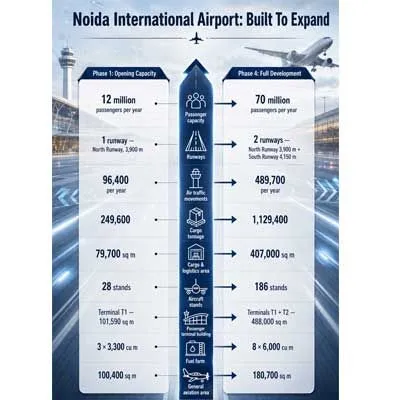
Navi Mumbai International Airport’s first phase will accommodate 20 million passengers annually, with a projected expansion to 90 million passengers and 2.5 million tonnes of cargo by 2032, while Noida International Airport is expected to begin operations with a capacity of 12 million passengers per year, eventually expanding to 70 million. After facing multiple delays, Adani Group has announced that NMIA is set for commissioning in April 2025, with regulatory approvals and licensing processes progressing towards completion.

The Directorate General of Civil Aviation (DGCA) is set to meet key stakeholders of Navi Mumbai International Airport (NMIA) on Tuesday to assess its operational preparedness for securing an aerodrome licence. This certification is crucial as it confirms that the airport meets all safety, operational, and infrastructural requirements necessary for commercial air transport operations. The meeting will be attended by representatives from NMIAL, Adani Airport Holdings Ltd. (AAHL), the City and Industrial Development Corporation of Maharashtra (CIDCO), and the Airports Authority of India (AAI). Managed by NMIAL, a joint venture between AAHL and CIDCO, the Navi Mumbai airport had previously faced a regulatory setback when its aerodrome licence application, submitted in December 2024, was rejected due to non-compliance with guidelines. This fresh review aims to evaluate the corrective measures undertaken by NMIAL to meet regulatory standards. Meanwhile, the DGCA has also received an aerodrome licence application from Noida International Airport, managed by Yamuna International Airport Pvt. Ltd. (YIAPL), a wholly owned subsidiary of Zurich Airport International AG, which is currently under review. Both airports have completed initial validation flight tests, including technical assessments, takeoff and landing evaluations, and compliance with safety and operational standards. Data from these tests is now under DGCA review, with regulatory approval for an aerodrome licence typically taking up to 90 days. Navi Mumbai and Noida airports are both critical for decongesting existing aviation hubs and enhancing air connectivity. Navi Mumbai International Airport’s first phase will accommodate 20 million passengers annually, with a projected expansion to 90 million passengers and 2.5 million tonnes of cargo by 2032, while Noida International Airport is expected to begin operations with a capacity of 12 million passengers per year, eventually expanding to 70 million. After facing multiple delays, Adani Group has announced that NMIA is set for commissioning in April 2025, with regulatory approvals and licensing processes progressing towards completion.

Next Story
Infrastructure Urban

Mount Invests Rs 250 Cr, Adds PUF & PEB Plants, 400+ Jobs

TUMKUR, Karnataka, January 8, 2025 - Mount Roofing & Structures Private Limited, one of India's  fastest-growing manufacturers in PUF and a leading solutions provider across Pre-Engineered Building  (PEB) and Polycarbonate sheets, simultaneously inaugurated its second fully automated continuous  Sandwich Panel manufacturing line and a new PEB manufacturing plant at its integrated campus in  Tumkur." The milestone expansion, part of a total investment of INR 250 crores, marks a significant  advancement in the company's commitment to engineered performance, manu..

Next Story
Infrastructure Urban

Titan Intech Strengthens UltraLED Push With Global LED Veteran

Titan Intech has announced the induction of global LED industry veteran Su Piow Ko to its Board of Directors, marking a strategic step in strengthening its UltraLED Displays roadmap and building globally competitive LED display solutions from India.The appointment aligns with Titan Intech’s ambition to position India as a hub for advanced, high-quality LED display manufacturing. With an increased focus on UltraLED Displays, the company aims to enhance technical governance, raise manufacturing standards and expand its presence across global markets.Su Piow Ko brings over three decades of inte..

Next Story
Infrastructure Urban

Dun & Bradstreet Flags New Growth Engines in India 2026 Outlook

Dun & Bradstreet has released its India 2026: D&B’s Perspective report, projecting a stable macroeconomic environment underpinned by fresh opportunities for productivity-led and inclusive growth. The report outlines how India’s next growth phase will be driven by digitised logistics, trusted data ecosystems, clean energy and rising city vitality.According to the outlook, India’s GDP growth is expected to reach around 6.6 per cent by FY2027, supported by resilient consumer demand and sustained public investment. Manufacturing is seen entering a new phase, moving beyond scale towar..

Advertisement

Subscribe to Our Newsletter

Get daily newsletters around different themes from Construction world.

STAY CONNECTED

Advertisement

Advertisement

Advertisement

Advertisement

Open In App