APCRDA Advances Net Zero Goal with IGBC Training for Officials
ECONOMY & POLICY

APCRDA Advances Net Zero Goal with IGBC Training for Officials

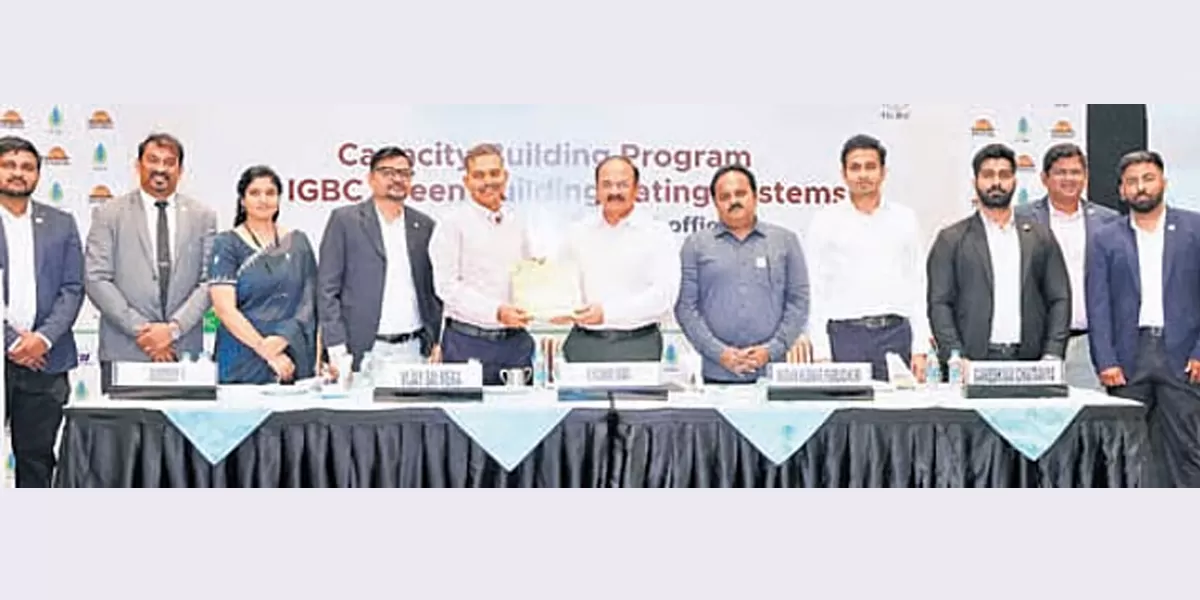
In a significant stride towards Andhra Pradesh’s Net Zero target by 2040 and the Swarna Andhra 2047 vision, the Andhra Pradesh Capital Region Development Authority (APCRDA), in partnership with the Indian Green Building Council (IGBC), conducted a high-level capacity-building programme for senior officials in Vijayawada on Friday.
Held at a city hotel, the session saw the participation of over 50 senior APCRDA officials, including the Engineer-in-Chief, Chief Engineer (H&B), Director (Planning), Director (Environment), and heads of key departments. The training centred on IGBC’s Green Building Rating Systems, designed to embed sustainability principles into future infrastructure projects across the Capital Region.
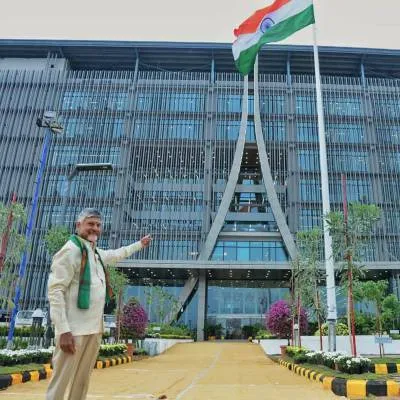
Delivering the keynote address, Commissioner K Kanna Babu reaffirmed APCRDA’s dedication to fostering a sustainable Amaravati. “Our goal is to make Amaravati a model green capital. Our forthcoming head office will be a flagship Net Zero project,” he stated, emphasising the vital support of IGBC in meeting the 2040 target.
Amaravati’s master plan had earlier been awarded IGBC’s Green Cities Platinum rating at the 2018 Happy Cities Summit, marking it as the first capital city in India to receive such certification by design.
Vijay Sai Meka, chairman of the IGBC Amaravati Chapter, praised APCRDA’s commitment, while other key participants included Ganesh Sai Chaitanya Gali, chapter co-chair, and Kiran Kumar Paruchuri, executive vice president of NAREDCO. The officials also announced the forthcoming Green Andhra Summit scheduled for 7 August.
IGBC senior counsellor Sundeep V reiterated the council’s ongoing role as a knowledge partner in Andhra Pradesh’s green transformation.

In a significant stride towards Andhra Pradesh’s Net Zero target by 2040 and the Swarna Andhra 2047 vision, the Andhra Pradesh Capital Region Development Authority (APCRDA), in partnership with the Indian Green Building Council (IGBC), conducted a high-level capacity-building programme for senior officials in Vijayawada on Friday.Held at a city hotel, the session saw the participation of over 50 senior APCRDA officials, including the Engineer-in-Chief, Chief Engineer (H&B), Director (Planning), Director (Environment), and heads of key departments. The training centred on IGBC’s Green Building Rating Systems, designed to embed sustainability principles into future infrastructure projects across the Capital Region.Delivering the keynote address, Commissioner K Kanna Babu reaffirmed APCRDA’s dedication to fostering a sustainable Amaravati. “Our goal is to make Amaravati a model green capital. Our forthcoming head office will be a flagship Net Zero project,” he stated, emphasising the vital support of IGBC in meeting the 2040 target.Amaravati’s master plan had earlier been awarded IGBC’s Green Cities Platinum rating at the 2018 Happy Cities Summit, marking it as the first capital city in India to receive such certification by design.Vijay Sai Meka, chairman of the IGBC Amaravati Chapter, praised APCRDA’s commitment, while other key participants included Ganesh Sai Chaitanya Gali, chapter co-chair, and Kiran Kumar Paruchuri, executive vice president of NAREDCO. The officials also announced the forthcoming Green Andhra Summit scheduled for 7 August.IGBC senior counsellor Sundeep V reiterated the council’s ongoing role as a knowledge partner in Andhra Pradesh’s green transformation.

Next Story
Real Estate

AI: The New Recruit

From getting ideas to evaluating designs, presenting concepts to clients and tracking projects, artificial intelligence (AI) is helping architects work better and faster.“AI allows architects to spend more time doing what only they can do: think critically, synthesise complexity and design with intent,” says Dikshu C Kukreja, Managing Principal, CP Kukreja Architects. “Every minute reclaimed from repetitive processes can be invested in creativity, contextual understanding, interdisciplinary collaboration and innovation – the qualities that define meaningful architecture.”To read the ..

Next Story
Real Estate

Redevelopment 2.0

In 2017, Mumbai identified 160,000 ageing buildings due for structural audit. Close to half of these were in the Western Suburbs. Redeveloping the oldest and structurally weakest of these would help unlock new housing, much needed given the city’s growing population density and constant developed area of 437.7 sq km. At 30,600 people per sq km in 2024, Mumbai’s density was almost thrice that of Gurugram, and 60 per cent higher than Bengaluru’s.Essentially, Mumbai’s realty market has demand. It has capital. It has realty development potential.Fast forward to 2026. Mumbai has 1,094 regis..

Next Story
Technology

Cost intelligence will become a strategic contributor to project success

As India's construction industry accelerates its digital transformation, integrated platforms, AI and connected data are becoming essential to improving cost certainty, project efficiency and sustainability. Ravi Kumar, Sales Director – India, RIB Software India, shares how digital workflows are reshaping project planning, commercial management and decision-making across the construction value chain.India's construction sector is embracing digital technologies at an unprecedented pace. From your perspective, what are the biggest shifts driving this transformation and how is RIB Software enab..

Advertisement

Subscribe to Our Newsletter

Get daily newsletters around different themes from Construction world.

STAY CONNECTED

Advertisement

Advertisement

Advertisement