Gurugram–Jaipur Stretch of NH-48 Goes Barrier?Free with MLFF Tolling
ROADS & HIGHWAYS

Gurugram–Jaipur Stretch of NH-48 Goes Barrier?Free with MLFF Tolling

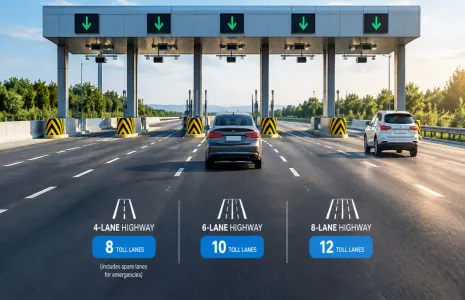
The National Highways Authority of India (NHAI) has operationalised the country's first fully barrier-less tolling corridor on the Gurugram–Jaipur section of National Highway-48. Effective from August one, 2026, the Authority implemented the Multi-Lane Free Flow (MLFF) toll collection system along the entire corridor, transforming conventional plazas into uninterrupted passageways. Vehicles are identified using FASTag-enabled Radio Frequency Identification (RFID) and Automatic Number Plate Recognition (ANPR) cameras installed at intervals, enabling electronic verification and payment without stopping. The deployment marks a notable step in digitalising toll operations across busy intercity routes.

The implementation removes physical boom barriers and allows traffic to maintain normal speeds through toll zones, which the Authority expects will substantially reduce congestion that typically forms near plazas during peak hours. By eliminating the need for braking or halting to pay tolls, the system is designed to cut travel times and lower fuel consumption, thereby reducing emissions and improving journey reliability. The combination of RFID and ANPR is intended to ensure accuracy and transparency in transaction processing while maintaining flow.

To reinforce compliance, MLFF has been integrated with automated enforcement so vehicles without valid FASTags or those that do not complete electronic payment will be identified through ANPR and subject to action under applicable laws. The Gurugram–Jaipur corridor was chosen for its strategic role linking the National Capital Region with Rajasthan and for carrying a high volume of freight and long?distance passenger traffic. NHAI expects the corridor-wide experience to provide operational insights and standards that can inform similar rollouts elsewhere.

NHAI stated the project forms part of the Government of India's broader effort to modernise highway infrastructure through digital technologies and intelligent transport systems and to improve user convenience and highway operations. The shift to barrier-less tolling should reduce idling at toll locations, lower logistics costs for commercial operators and improve efficiency of freight movement. Successful implementation on this corridor is expected to guide a phased rollout of MLFF technology on other national highways, advancing safer and faster road travel nationwide.

The National Highways Authority of India (NHAI) has operationalised the country's first fully barrier-less tolling corridor on the Gurugram–Jaipur section of National Highway-48. Effective from August one, 2026, the Authority implemented the Multi-Lane Free Flow (MLFF) toll collection system along the entire corridor, transforming conventional plazas into uninterrupted passageways. Vehicles are identified using FASTag-enabled Radio Frequency Identification (RFID) and Automatic Number Plate Recognition (ANPR) cameras installed at intervals, enabling electronic verification and payment without stopping. The deployment marks a notable step in digitalising toll operations across busy intercity routes. The implementation removes physical boom barriers and allows traffic to maintain normal speeds through toll zones, which the Authority expects will substantially reduce congestion that typically forms near plazas during peak hours. By eliminating the need for braking or halting to pay tolls, the system is designed to cut travel times and lower fuel consumption, thereby reducing emissions and improving journey reliability. The combination of RFID and ANPR is intended to ensure accuracy and transparency in transaction processing while maintaining flow. To reinforce compliance, MLFF has been integrated with automated enforcement so vehicles without valid FASTags or those that do not complete electronic payment will be identified through ANPR and subject to action under applicable laws. The Gurugram–Jaipur corridor was chosen for its strategic role linking the National Capital Region with Rajasthan and for carrying a high volume of freight and long?distance passenger traffic. NHAI expects the corridor-wide experience to provide operational insights and standards that can inform similar rollouts elsewhere. NHAI stated the project forms part of the Government of India's broader effort to modernise highway infrastructure through digital technologies and intelligent transport systems and to improve user convenience and highway operations. The shift to barrier-less tolling should reduce idling at toll locations, lower logistics costs for commercial operators and improve efficiency of freight movement. Successful implementation on this corridor is expected to guide a phased rollout of MLFF technology on other national highways, advancing safer and faster road travel nationwide.

Related Stories

Gold Stories

Next Story
Real Estate

WSB Real Estate Partners Exits Six Housing Investments

WSB Real Estate Partners recently announced the successful exit of six residential investments across Bengaluru, Mumbai Metropolitan Region (MMR) and National Capital Region (NCR), delivering an average internal rate of return (IRR) of 19–21 per cent and an overall investment return of 1.4 times.The real estate-focused investment firm invested approximately Rs 7 billion across six mid-affordable housing projects over the past four years. All six investments were fully repaid between April and November 2026, several months ahead of their original investment tenures.WSB collaborated with sever..

Next Story
Infrastructure Transport

Aluminium Industry Seeks Policy Support for Rs 4 Trillion Investment

The Aluminium Association of India (AAI) has recently urged the government to introduce supportive policy measures to safeguard the sector’s proposed Rs 4 trillion investment pipeline. The association highlighted the need for a predictable policy framework to strengthen domestic manufacturing, expand production capacity and reduce import dependence.AAI submitted its recommendations for the Union Budget 2027-28 to the Ministries of Finance, Commerce and Industry, and Mines, along with the Department for Promotion of Industry and Internal Trade (DPIIT).India’s aluminium demand is projected t..

Next Story
Technology

ABB Unveils Intelligent Motor to Accelerate Industrial AI Adoption

ABB recently launched Intelleqt, which it describes as the world’s first low-voltage motor with factory-integrated intelligence, at the SPS trade fair in Germany. Designed to deliver real-time operational insights from its first rotation, the motor enables industrial operators to integrate equipment-level data into existing digital platforms while retaining full ownership of their data.The launch addresses growing challenges in scaling artificial intelligence (AI) across industrial operations, particularly data quality and availability. According to Deloitte, while 84 per cent of manufacture..

Subscribe to Our Newsletter

Get daily newsletters around different themes from Construction world.

STAY CONNECTED

Advertisement

SPECIAL OFFER
QR Code