NHAI To Develop Arogya Van Along Highways To Boost Biodiversity
ROADS & HIGHWAYS

NHAI To Develop Arogya Van Along Highways To Boost Biodiversity

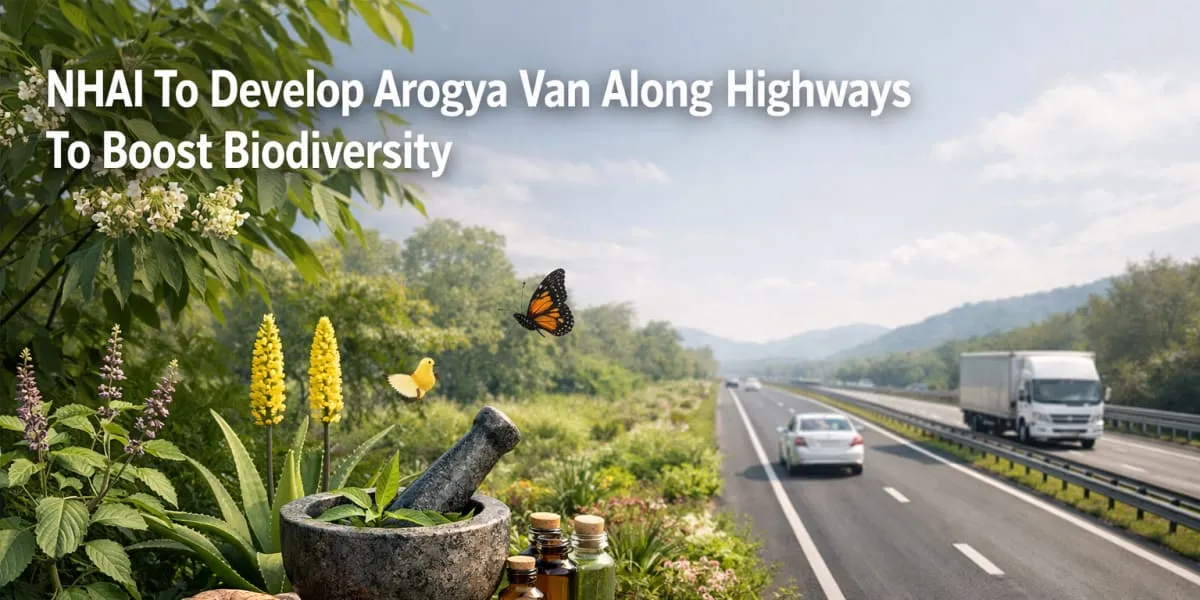
The National Highways Authority of India (NHAI) has unveiled a plan to develop Arogya Van, thematic plantations of medicinal trees on vacant land parcels along national highways, aimed at enhancing biodiversity and promoting ecological sustainability. The initiative seeks to create visible green corridors that support pollinators, birds and microfauna while improving ecosystem resilience along highway networks. The scheme will place emphasis on species known for traditional medicinal value and on public awareness through accessible planting locations.

In the first phase NHAI has identified 17 land parcels spanning 62.8 hectares across multiple states including Madhya Pradesh, Haryana, Delhi-NCR, Andhra Pradesh, Gujarat, Karnataka, Odisha, Tamil Nadu, Rajasthan, Maharashtra and Chhattisgarh. Approximately 67,462 medicinal trees are planned for planting under this phase and nearly 36 species such as neem, amla, jamun and imli have been selected for their suitability to different agro-climatic zones. Planting will be concentrated near toll plazas, wayside amenities, interchanges and other prominent highway stretches to maximise visibility and public engagement.

The Ministry of Road Transport and Highways (MoRTH) has indicated that approximately 188 hectares of vacant land has also been earmarked for future plantation during the upcoming monsoon season to ensure higher survival rates and long term sustainability of the initiative. The Arogya Van concept marks a shift from traditional highway plantation practices that focused mainly on general greening and ecological stabilisation to a thematic approach centred on medicinal flora. Officials regard these plantations as living repositories intended to conserve indigenous species and to reinforce educational and cultural connections with traditional systems of medicine including Ayurveda.

NHAI anticipates that integrating infrastructure development with environmental conservation will reinforce its commitment to sustainable and eco friendly highway expansion across the country. The programme is designed to balance ecological objectives with visibility and maintenance needs while providing community learning opportunities about medicinal plants. Ongoing monitoring and seasonal planting cycles are expected to support long term survival and biodiversity benefits along national highways.

The National Highways Authority of India (NHAI) has unveiled a plan to develop Arogya Van, thematic plantations of medicinal trees on vacant land parcels along national highways, aimed at enhancing biodiversity and promoting ecological sustainability. The initiative seeks to create visible green corridors that support pollinators, birds and microfauna while improving ecosystem resilience along highway networks. The scheme will place emphasis on species known for traditional medicinal value and on public awareness through accessible planting locations. In the first phase NHAI has identified 17 land parcels spanning 62.8 hectares across multiple states including Madhya Pradesh, Haryana, Delhi-NCR, Andhra Pradesh, Gujarat, Karnataka, Odisha, Tamil Nadu, Rajasthan, Maharashtra and Chhattisgarh. Approximately 67,462 medicinal trees are planned for planting under this phase and nearly 36 species such as neem, amla, jamun and imli have been selected for their suitability to different agro-climatic zones. Planting will be concentrated near toll plazas, wayside amenities, interchanges and other prominent highway stretches to maximise visibility and public engagement. The Ministry of Road Transport and Highways (MoRTH) has indicated that approximately 188 hectares of vacant land has also been earmarked for future plantation during the upcoming monsoon season to ensure higher survival rates and long term sustainability of the initiative. The Arogya Van concept marks a shift from traditional highway plantation practices that focused mainly on general greening and ecological stabilisation to a thematic approach centred on medicinal flora. Officials regard these plantations as living repositories intended to conserve indigenous species and to reinforce educational and cultural connections with traditional systems of medicine including Ayurveda. NHAI anticipates that integrating infrastructure development with environmental conservation will reinforce its commitment to sustainable and eco friendly highway expansion across the country. The programme is designed to balance ecological objectives with visibility and maintenance needs while providing community learning opportunities about medicinal plants. Ongoing monitoring and seasonal planting cycles are expected to support long term survival and biodiversity benefits along national highways.

Next Story
Resources

Jyoti Structures wins three CIDC Vishwakarma Awards

Jyoti Structures has received three awards at the 17th CIDC Vishwakarma Awards 2026, organised by the Construction Industry Development Council, recognising excellence across project execution, workforce and leadership.The company was honoured under Category G (Best Construction Projects) for the 400/220 kV D/C Goa–Tamnar Transmission Project in Goa, following a multi-stage evaluation covering performance, safety and quality benchmarks.In Category E2 (Artisans & Supervisors), four members from JSL’s site team working on the Torrent project were recognised, reflecting consistency in sit..

Next Story
Infrastructure Urban

Premier Energies Secures Rs 25,770 mn Orders In Q4

Premier Energies Limited has received orders aggregating to Rs 25,770 million (mn) in the fourth quarter of fiscal year 2026 for the supply of 1,600 megawatt (MW) solar cells and modules. Execution of these orders is scheduled across fiscal year 2027 and fiscal year 2028 and the contracts have been secured from a mix of domestic independent power producers, module manufacturers and engineering, procurement and construction contractors in India. Capacity increases support the order book, with cell capacity expected to reach 10.6 gigawatt (GW) by September 2026 and module manufacturing capacity ..

Next Story
Building Material

Steel Exchange India Reports Rs 280 mn Debt Repayment

Steel Exchange India Limited (SEIL), one of the leading integrated steel manufacturers in South India and the maker of SIMHADRI TMT, has reported the repayment of Rs 280 mn of debt over the last two quarters. The company informed exchanges under listing regulations that the repayment was part of scheduled deleveraging measures aimed at strengthening the balance sheet. The update followed credit facilities that were taken in September 2025 to support operations and growth initiatives. During the period October 2025 to March 2026 a partial redemption was executed with Rs 214.3 mn directed toward..

Advertisement

Subscribe to Our Newsletter

Get daily newsletters around different themes from Construction world.

STAY CONNECTED

Advertisement

Advertisement

Advertisement