NHAI To Develop Arogya Van Medicinal Tree Plantations
ROADS & HIGHWAYS

NHAI To Develop Arogya Van Medicinal Tree Plantations

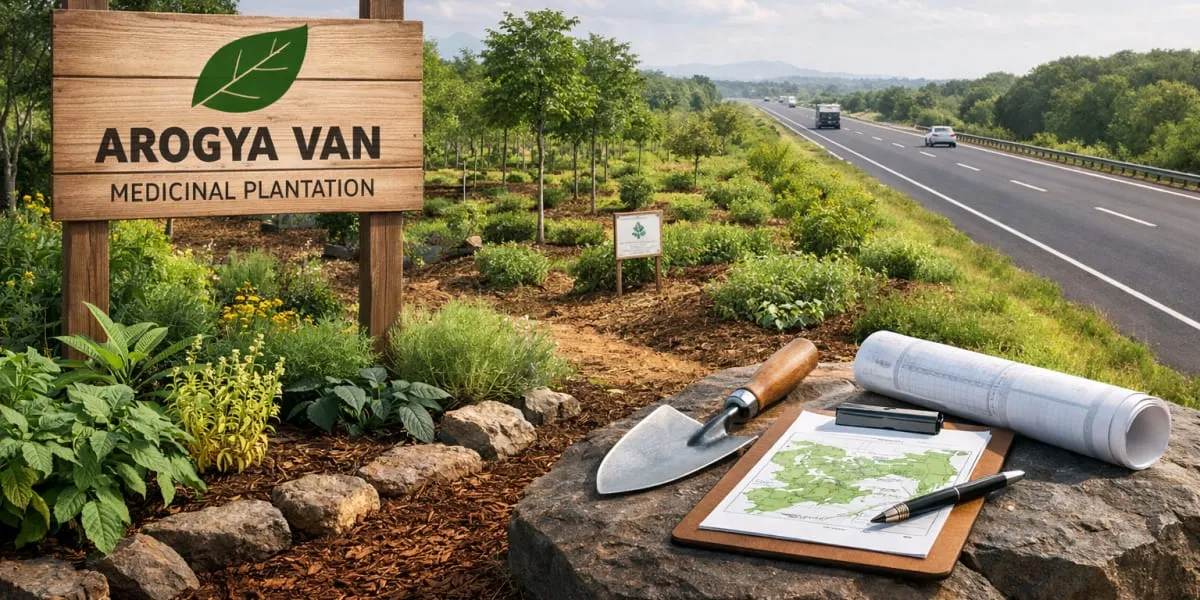
The National Highways Authority of India will develop Arogya Van, thematic medicinal tree plantations on vacant land parcels alongside national highways. The initiative seeks to enrich biodiversity by introducing medicinal tree species that support pollinators, birds and microfauna and thereby strengthen ecosystem resilience. Implementation will follow Government of India guidelines on landscaping and tree plantation.

In the first phase an action plan covers 17 land parcels spanning 62.8 hectares where 67,462 medicinal trees will be planted across National Highway projects in Madhya Pradesh, Haryana, Delhi-NCR, Andhra Pradesh, Gujarat, Karnataka, Odisha, Tamil Nadu, Rajasthan, Maharashtra and Chhattisgarh. The projects are intended to demonstrate the role of native and medicinal species in roadside ecology. Selection of sites took account of agro-climatic suitability and public visibility.

Approximately 36 tree species with recognised medicinal properties such as neem, amla, imli, jamun, lemon, gular and maulsari have been identified and will be planted according to local climatic and soil conditions. Priority will be given to land parcels close to toll plazas, wayside amenities, interchanges and cloverleaf junctions to maximise outreach. Planting patterns will aim to support pollinators and create habitat connectivity.

NHAI has identified about 188 hectares of additional vacant land for plantations during the forthcoming monsoon season to improve survival rates and long-term sustainability. The thematic model focusing on medicinal species is expected to enhance ecological, educational and cultural value of roadside green spaces. Adoption of this approach aligns with national priorities to promote traditional systems of medicine such as Ayurveda and conserve indigenous medicinal flora.

The plantations are envisaged as living repositories and knowledge hubs that will raise public awareness about traditional medicinal knowledge and sustainable living practices. The initiative reinforces NHAI commitment to develop environmentally sustainable infrastructure by integrating ecological restoration with public outreach. It aims to create a network of green corridors that strengthen roadside ecology and civic engagement.

The National Highways Authority of India will develop Arogya Van, thematic medicinal tree plantations on vacant land parcels alongside national highways. The initiative seeks to enrich biodiversity by introducing medicinal tree species that support pollinators, birds and microfauna and thereby strengthen ecosystem resilience. Implementation will follow Government of India guidelines on landscaping and tree plantation. In the first phase an action plan covers 17 land parcels spanning 62.8 hectares where 67,462 medicinal trees will be planted across National Highway projects in Madhya Pradesh, Haryana, Delhi-NCR, Andhra Pradesh, Gujarat, Karnataka, Odisha, Tamil Nadu, Rajasthan, Maharashtra and Chhattisgarh. The projects are intended to demonstrate the role of native and medicinal species in roadside ecology. Selection of sites took account of agro-climatic suitability and public visibility. Approximately 36 tree species with recognised medicinal properties such as neem, amla, imli, jamun, lemon, gular and maulsari have been identified and will be planted according to local climatic and soil conditions. Priority will be given to land parcels close to toll plazas, wayside amenities, interchanges and cloverleaf junctions to maximise outreach. Planting patterns will aim to support pollinators and create habitat connectivity. NHAI has identified about 188 hectares of additional vacant land for plantations during the forthcoming monsoon season to improve survival rates and long-term sustainability. The thematic model focusing on medicinal species is expected to enhance ecological, educational and cultural value of roadside green spaces. Adoption of this approach aligns with national priorities to promote traditional systems of medicine such as Ayurveda and conserve indigenous medicinal flora. The plantations are envisaged as living repositories and knowledge hubs that will raise public awareness about traditional medicinal knowledge and sustainable living practices. The initiative reinforces NHAI commitment to develop environmentally sustainable infrastructure by integrating ecological restoration with public outreach. It aims to create a network of green corridors that strengthen roadside ecology and civic engagement.

Next Story
Infrastructure Urban

Mineral Auction Rules Amended To Speed Mine Operationalisation

The Ministry of Mines notified the Mineral (Auction) Second Amendment Rules, 2026 on 30 March 2026 to accelerate operationalisation of mines and improve ease of doing business in the mining sector. The amendment follows a prior change to the Mineral (Auction) Rules, 2015 effected on 17 October 2025 that introduced intermediary timelines between issuance of a letter of intent (LoI) and execution of the mining lease. The 2025 change provided that one per cent of performance security would be appropriated for each month of delay by the preferred bidder and introduced incentives for early operatio..

Next Story
Infrastructure Transport

Indian Railways Strengthens Telecom And AI Safety Systems

Indian Railways strengthened its telecom and digital infrastructure during 2025-26 with the aim of improving safety, operational efficiency and the passenger experience. The programme promoted modernisation through advanced technologies, robust communication systems and passenger-centric solutions. These measures were presented as part of a drive to build a digitally integrated rail ecosystem. A key development was the enhancement of the Internet Protocol Multi-Protocol Label Switching (IP MPLS) backbone, commissioned at 1,396 stations to meet bandwidth needs of mission-critical applications. ..

Next Story
Infrastructure Transport

NHAI Holds Workshop on Litigation Management and Coordination

The National Highways Authority of India (NHAI) organised a day-long workshop in New Delhi to strengthen capacity and interdepartmental synergy for faster execution of national highway projects. The event was held under Mission Karmayogi – Sadhana Saptah, an initiative of the Government of India to enhance governance through capacity building and improved processes. The workshop focused on structured and solution oriented deliberations to address implementation constraints. The session was chaired by the NHAI chairman Santosh Kumar Yadav and brought together senior officials from NHAI, the M..

Advertisement

Subscribe to Our Newsletter

Get daily newsletters around different themes from Construction world.

STAY CONNECTED

Advertisement

Advertisement

Advertisement