Cabinet Clears Pune Metro Phase-2 Lines 4 and 4A
RAILWAYS & METRO RAIL

Cabinet Clears Pune Metro Phase-2 Lines 4 and 4A

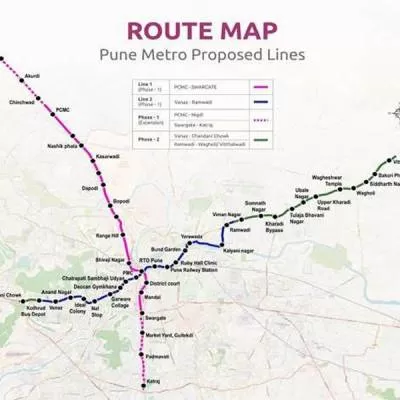
The Union Cabinet has approved the development of Line 4 (Kharadi–Hadapsar–Swargate–Khadakwasla) and Line 4A (Nal Stop–Warje–Manik Baug) under Phase-2 of the Pune Metro Rail Project, advancing plans to expand the city’s rapid transit network. The two elevated corridors will span 31.636 km with 28 stations and will be completed in five years at an estimated cost of Rs 98.57 billion, funded jointly by the Centre, the Maharashtra Government and external agencies.
Both lines form an integral part of Pune’s Comprehensive Mobility Plan and will offer seamless interchanges with existing and sanctioned routes at Kharadi Bypass, Nal Stop and Swargate, while also linking with Hadapsar Railway Station and potential future corridors towards Loni Kalbhor and Saswad Road. The alignment will connect key IT hubs, commercial districts, educational institutions and residential clusters, easing congestion along Solapur Road, Magarpatta Road, Karve Road, Sinhagad Road and the Mumbai–Bengaluru Highway.
Ridership on the two corridors is projected at 4,09,000 passengers daily by 2028, increasing to over 1,17,000 by 2058, reflecting long-term demand for improved mobility options. Maha-Metro will implement all civil, electrical, mechanical and systems works, with early-stage activities such as design and surveys already in progress.
The approval takes Pune Metro’s network beyond the 100-km mark and marks a key step towards a more efficient, reliable and sustainable public transport system. The new lines are expected to significantly cut travel times, reduce congestion and enhance last-mile connectivity across the city.

The Union Cabinet has approved the development of Line 4 (Kharadi–Hadapsar–Swargate–Khadakwasla) and Line 4A (Nal Stop–Warje–Manik Baug) under Phase-2 of the Pune Metro Rail Project, advancing plans to expand the city’s rapid transit network. The two elevated corridors will span 31.636 km with 28 stations and will be completed in five years at an estimated cost of Rs 98.57 billion, funded jointly by the Centre, the Maharashtra Government and external agencies.Both lines form an integral part of Pune’s Comprehensive Mobility Plan and will offer seamless interchanges with existing and sanctioned routes at Kharadi Bypass, Nal Stop and Swargate, while also linking with Hadapsar Railway Station and potential future corridors towards Loni Kalbhor and Saswad Road. The alignment will connect key IT hubs, commercial districts, educational institutions and residential clusters, easing congestion along Solapur Road, Magarpatta Road, Karve Road, Sinhagad Road and the Mumbai–Bengaluru Highway.Ridership on the two corridors is projected at 4,09,000 passengers daily by 2028, increasing to over 1,17,000 by 2058, reflecting long-term demand for improved mobility options. Maha-Metro will implement all civil, electrical, mechanical and systems works, with early-stage activities such as design and surveys already in progress.The approval takes Pune Metro’s network beyond the 100-km mark and marks a key step towards a more efficient, reliable and sustainable public transport system. The new lines are expected to significantly cut travel times, reduce congestion and enhance last-mile connectivity across the city.

Next Story
Real Estate

RBI Rate Cut Boosts Confidence Across Housing Market

Industry Context and Market DynamicsThe real estate industry has welcomed the RBI’s rate cut as a timely boost to affordability and demand. With home prices having risen steadily across major markets, even a marginal reduction in interest rates meaningfully strengthens purchasing power, especially for first-time and mid-income buyers.Ashish Jerath, President – Sales & Marketing, Smartworld Developers, observes:“The RBI’s 25-basis-point cut, bringing the repo rate down to 5.25%, is a timely boost for the real estate sector. Lower interest rates reduce borrowing costs, enabling homeb..

Next Story
Infrastructure Transport

BMC Resumes Rs 170 Billion Road Works, Targets 80 per cent By Jan 2026

Following the withdrawal of the southwest monsoon in October, the Brihanmumbai Municipal Corporation (BMC) has restarted work on 645 roads—covering 297.49 kilometres—under its large-scale concretisation programme. Data shows that more than 60 per cent of the resumed works are located in the western suburbs. Officials said the civic body aims to complete concretisation on 80 per cent of the roads where fresh work has begun by January 2026. Launched in 2022, the Rs 170 billion project seeks to concretise 700 kilometres of roads across Mumbai. All civil works were halted during the monsoon ..

Next Story
Infrastructure Urban

India Pushes Digital Shift In Urban Land Mapping

The Department of Land Resources (DoLR) under the Ministry of Rural Development has convened a National Symposium on NAKSHA – the National Geospatial Knowledge-based Land Survey of Urban Habitations – to advance India’s transition to modern, technology-driven land mapping. Speaking at the inaugural session, Secretary Manoj Joshi underscored the urgent need to move revenue departments away from outdated, tape-based methods and rough hand-drawn sketches. He stressed that adopting latitude–longitude-based digital mapping and GIS-linked registration systems is essential for economic stabi..

Advertisement

Subscribe to Our Newsletter

Get daily newsletters around different themes from Construction world.

STAY CONNECTED

Advertisement

Advertisement

Advertisement

Advertisement

Open In App