Panel Urges Railways To Diversify Freight Beyond Coal
RAILWAYS & METRO RAIL

Panel Urges Railways To Diversify Freight Beyond Coal

A parliamentary panel has urged Indian Railways to urgently diversify its freight portfolio beyond coal and other bulk commodities, warning that slowing revenue growth from traditional cargo could limit the rail network’s future expansion and financial resilience.

In a report tabled in Parliament, the Standing Committee on Railways, chaired by BJP MP C M Ramesh, said Railways must focus on high-growth segments largely dominated by road transport, including automobiles, FMCG and e-commerce, to strengthen freight earnings and reduce overdependence on coal.

Coal currently accounts for nearly half of Railways’ freight traffic. The committee noted that year-on-year revenue growth from coal and iron ore has begun to slow, highlighting the need for a broader commodity mix to ensure long-term stability. It recommended identifying cargo categories with low rail penetration but strong growth potential, studying their logistics requirements and removing operational constraints that discourage shippers from shifting to rail.

Referring to the National Rail Plan, the panel said India’s total freight demand is projected to exceed 6,000 million tonnes in 2025, while Railways currently handles only about 27 per cent of overall freight movement. Increasing rail’s share would be critical to sustaining freight revenues and easing pressure on road infrastructure, the report added.

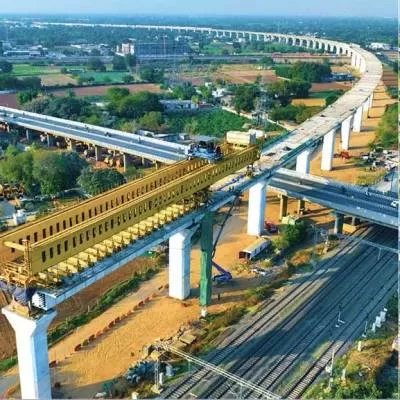
The committee also reviewed the performance of the two operational Dedicated Freight Corridors Corporation of India corridors, spanning 2,741 km, and stressed the need to attract private investment given their capital-intensive nature. While detailed project reports for three additional corridors—East Coast, East–West and North–South—have been submitted to the Railway Board, private participation remains limited due to high capital costs, long gestation periods and revenue uncertainty. The panel cited the failure of the public–private partnership model for the Sonnagar–Dankuni section of the Eastern Dedicated Freight Corridor as evidence of weak private sector appetite.

On operations, the committee flagged shortages of trained crew as the most pressing challenge for Dedicated Freight Corridors and urged Railways to address manpower gaps on priority to ensure optimal utilisation of the infrastructure.

The panel concluded that diversifying freight cargo, improving workforce availability and creating more viable investment models are essential for Indian Railways to fully leverage its freight assets and sustain long-term growth.

A parliamentary panel has urged Indian Railways to urgently diversify its freight portfolio beyond coal and other bulk commodities, warning that slowing revenue growth from traditional cargo could limit the rail network’s future expansion and financial resilience. In a report tabled in Parliament, the Standing Committee on Railways, chaired by BJP MP C M Ramesh, said Railways must focus on high-growth segments largely dominated by road transport, including automobiles, FMCG and e-commerce, to strengthen freight earnings and reduce overdependence on coal. Coal currently accounts for nearly half of Railways’ freight traffic. The committee noted that year-on-year revenue growth from coal and iron ore has begun to slow, highlighting the need for a broader commodity mix to ensure long-term stability. It recommended identifying cargo categories with low rail penetration but strong growth potential, studying their logistics requirements and removing operational constraints that discourage shippers from shifting to rail. Referring to the National Rail Plan, the panel said India’s total freight demand is projected to exceed 6,000 million tonnes in 2025, while Railways currently handles only about 27 per cent of overall freight movement. Increasing rail’s share would be critical to sustaining freight revenues and easing pressure on road infrastructure, the report added. The committee also reviewed the performance of the two operational Dedicated Freight Corridors Corporation of India corridors, spanning 2,741 km, and stressed the need to attract private investment given their capital-intensive nature. While detailed project reports for three additional corridors—East Coast, East–West and North–South—have been submitted to the Railway Board, private participation remains limited due to high capital costs, long gestation periods and revenue uncertainty. The panel cited the failure of the public–private partnership model for the Sonnagar–Dankuni section of the Eastern Dedicated Freight Corridor as evidence of weak private sector appetite. On operations, the committee flagged shortages of trained crew as the most pressing challenge for Dedicated Freight Corridors and urged Railways to address manpower gaps on priority to ensure optimal utilisation of the infrastructure. The panel concluded that diversifying freight cargo, improving workforce availability and creating more viable investment models are essential for Indian Railways to fully leverage its freight assets and sustain long-term growth.

Next Story
Equipment

PALFINGER Reinforces India Focus at EXCON 2025

PALFINGER strengthened its long-term commitment to India at EXCON 2025, marking its largest participation at the exhibition with a 1,000 sq m booth. The global lifting and technology solutions provider showcased advanced lifting equipment, digital solutions and outlined a clear roadmap for expanding its India operations.India has emerged as a priority growth market for PALFINGER, driven by sustained infrastructure development and rising demand for high-performance lifting solutions. Alexander Susanek, COO, PALFINGER, said India is playing an increasingly influential role in the company’s glo..

Next Story
Infrastructure Transport

HAL Airport Reopening Needs BIAL Consent: Centre

The Union government has said that reopening the existing HAL Airport in Bengaluru for civilian operations would require the consent of Bengaluru International Airport Limited (BIAL), in line with the concession agreement governing Kempegowda International Airport (KIA). Informing the Lok Sabha, Minister of State for Civil Aviation Murlidhar Mohol said the concession agreement between the Government of India and Bengaluru International Airport Limited stipulates that no new or existing airport—except for the development of Mysuru and Hassan as domestic airports—can be developed, improved,..

Next Story
Infrastructure Transport

Guwahati Airport Plans Second Terminal As Traffic Grows

Even as Prime Minister Narendra Modi is set to inaugurate the new terminal at Lokapriya Gopinath Bordoloi International Airport on December 20, the Assam government has begun planning a second terminal at Guwahati’s main aviation hub to cater to rising passenger traffic and the airport’s expanding regional role. Chief Minister Himanta Biswa Sarma said the state is considering a completely new additional terminal, noting that planning work is already under way. Following the inauguration, all operations will initially be shifted to the new terminal, while the existing terminal will be phas..

Advertisement

Subscribe to Our Newsletter

Get daily newsletters around different themes from Construction world.

STAY CONNECTED

Advertisement

Advertisement

Advertisement

Advertisement

Open In App