





DRDO Hands Over Seven New Indigenous Defence Technologies
DEFENSE

DRDO Hands Over Seven New Indigenous Defence Technologies

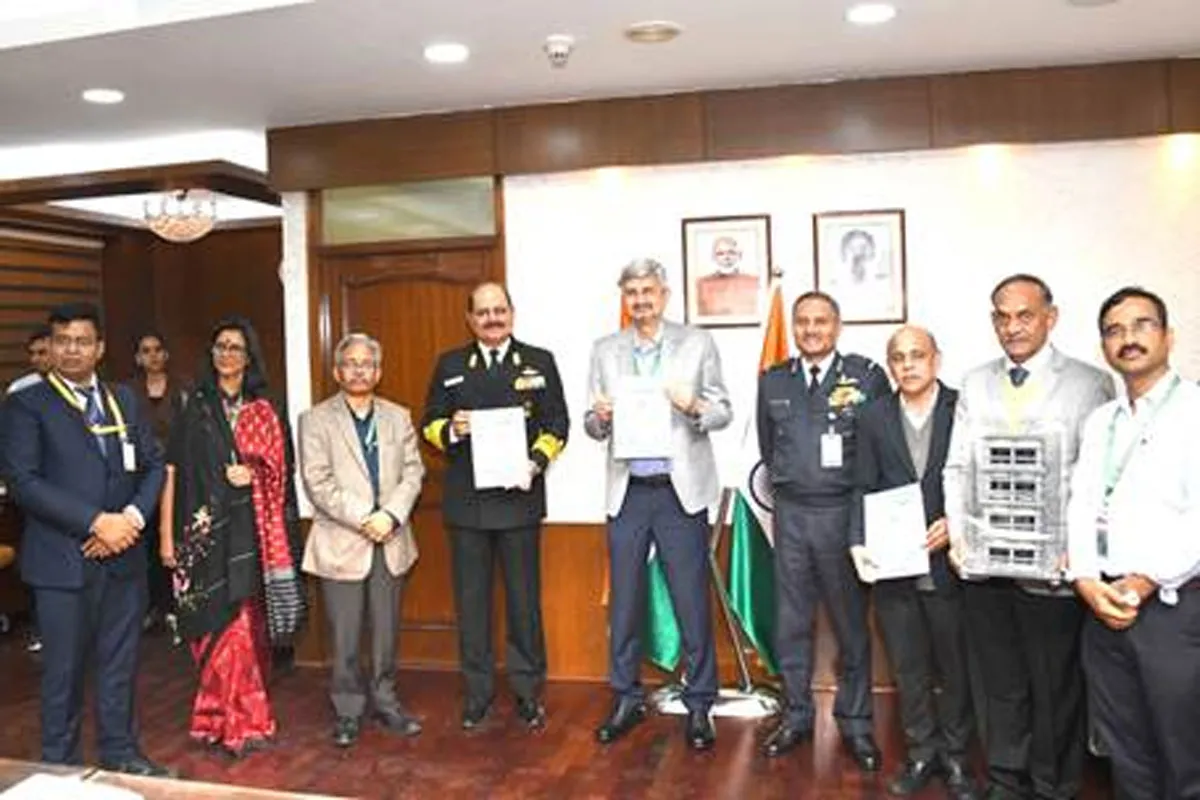
The Defence Research and Development Organisation (DRDO) has handed over seven advanced technologies developed under the Technology Development Fund (TDF) scheme to the Army, Navy and Air Force. The technologies include an indigenous high-voltage power supply for airborne self-protection jammers; a tide-efficient gangway for naval jetties; advanced very low frequency–high frequency switching matrix systems; VLF loop aerials for underwater platforms; an indigenous waterjet propulsion system for fast interceptor craft; a novel process for recovering lithium precursors from used lithium-ion batteries; and a long-life seawater battery system for sustained underwater sensing and surveillance.

Each technology has been designed, developed and rigorously tested by Indian industry in close collaboration with DRDO experts and the three Services, reinforcing the TDF scheme’s emphasis on import substitution and the development of critical indigenous capabilities. The technologies were formally handed over during the meeting of DRDO’s Empowered Committee held at DRDO Bhawan, New Delhi, on 2 December 2025. The meeting was chaired by Dr Samir V. Kamat, Secretary of Defence R&D and Chairman of DRDO, and attended by senior representatives of the Armed Forces, the Department of Defence Production and DRDO.

The Committee held detailed deliberations on a wide range of project proposals and approved 12 new projects in strategic, aerospace, naval and electronic warfare domains. These approvals reaffirm the Government’s commitment to strengthening domestic capability and reducing reliance on foreign technologies in critical and emerging areas.

Members discussed the framework for clearing projects under the TDF scheme and stressed the importance of accelerating end-to-end processing to ensure timely delivery and alignment with evolving operational and technological requirements of the Services. The Committee also reviewed the roadmap for technologies already developed and considered ways to streamline and execute subsequent acquisition processes to enable smooth induction and deployment.

The Committee further recommended key policy alignments and enabling mechanisms to fast-track operational integration of the developed technologies. Addressing the gathering, DRDO Chairman Dr Samir V. Kamat reiterated the Government’s dedication to advancing indigenous defence innovation in line with the vision of Aatmanirbhar Bharat, highlighting the need for expedited execution of the TDF scheme.

The Defence Research and Development Organisation (DRDO) has handed over seven advanced technologies developed under the Technology Development Fund (TDF) scheme to the Army, Navy and Air Force. The technologies include an indigenous high-voltage power supply for airborne self-protection jammers; a tide-efficient gangway for naval jetties; advanced very low frequency–high frequency switching matrix systems; VLF loop aerials for underwater platforms; an indigenous waterjet propulsion system for fast interceptor craft; a novel process for recovering lithium precursors from used lithium-ion batteries; and a long-life seawater battery system for sustained underwater sensing and surveillance. Each technology has been designed, developed and rigorously tested by Indian industry in close collaboration with DRDO experts and the three Services, reinforcing the TDF scheme’s emphasis on import substitution and the development of critical indigenous capabilities. The technologies were formally handed over during the meeting of DRDO’s Empowered Committee held at DRDO Bhawan, New Delhi, on 2 December 2025. The meeting was chaired by Dr Samir V. Kamat, Secretary of Defence R&D and Chairman of DRDO, and attended by senior representatives of the Armed Forces, the Department of Defence Production and DRDO. The Committee held detailed deliberations on a wide range of project proposals and approved 12 new projects in strategic, aerospace, naval and electronic warfare domains. These approvals reaffirm the Government’s commitment to strengthening domestic capability and reducing reliance on foreign technologies in critical and emerging areas. Members discussed the framework for clearing projects under the TDF scheme and stressed the importance of accelerating end-to-end processing to ensure timely delivery and alignment with evolving operational and technological requirements of the Services. The Committee also reviewed the roadmap for technologies already developed and considered ways to streamline and execute subsequent acquisition processes to enable smooth induction and deployment. The Committee further recommended key policy alignments and enabling mechanisms to fast-track operational integration of the developed technologies. Addressing the gathering, DRDO Chairman Dr Samir V. Kamat reiterated the Government’s dedication to advancing indigenous defence innovation in line with the vision of Aatmanirbhar Bharat, highlighting the need for expedited execution of the TDF scheme.

Next Story
Infrastructure Urban

Centre Boosts FPO Growth With New Credit And Market Support

The Government is implementing the Central Sector Scheme on the formation and promotion of 10,000 Farmer Producer Organisations (FPOs), under which all 10,000 FPOs have now been registered. The scheme provides Rs 1.8 million per FPO for three years as management support, a matching equity grant of up to Rs 1.5 million, and a credit guarantee of up to Rs 0.02 billion through eligible lending institutions. It also offers assistance for training, market linkages and alignment with other schemes. FPOs receive support to obtain input licences for seed, fertiliser and pesticide supplies, as well as..

Next Story
Infrastructure Urban

PM-KISAN Drives Farm Income Gains And Rural Stability

The PM-KISAN scheme, a central sector initiative launched in February 2019, aims to support the financial needs of farmers holding cultivable land. Under the scheme, Rs 6,000 per year is transferred in three equal instalments to Aadhaar-seeded bank accounts through Direct Benefit Transfer. Eligibility is based primarily on cultivable landholding, with certain exclusions for individuals of higher economic status. A farmer-centric digital infrastructure ensures scheme benefits reach farmers across India without intermediaries. With full transparency in registration and verification, the Governm..

Next Story
Infrastructure Urban

Govt Extends Pro Tem Security Certificate To Two Years

In a further push to improve ease of doing business and ensure continuity for the telecom industry, the National Centre for Communication Security (NCCS) under the Department of Telecommunications has extended the validity of the Pro Tem Security Certification from six months to two years. The Pro Tem Certification, initially launched in October 2024 with a six-month validity, was designed to prevent business disruption for IP Router and Wi-Fi CPE products, which became subject to mandatory security certification from 1 October 2024. Under this certification, OEMs submit a declaration confirm..

Advertisement

Subscribe to Our Newsletter

Get daily newsletters around different themes from Construction world.

STAY CONNECTED

Advertisement

Advertisement

Advertisement

Advertisement

Open In App











