

Indian Navy Commissions INS Androth for Coastal Defence
DEFENSE

Indian Navy Commissions INS Androth for Coastal Defence

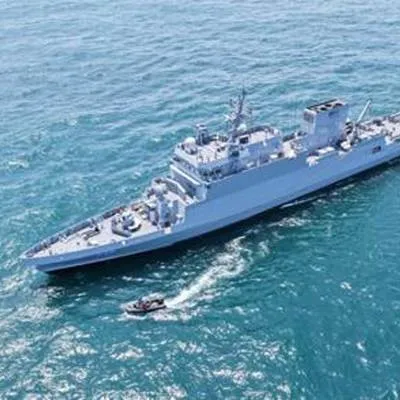
The Indian Navy has commissioned INS Androth, the second of eight Anti-Submarine Warfare Shallow Water Craft (ASW-SWC), at the Naval Dockyard in Visakhapatnam earlier this week. The vessel is designed to detect and neutralise underwater threats operating close to India’s coastline.

Named after Androth Island in the Lakshadweep archipelago, the ship represents a new generation of highly agile and compact warships tailored for operations in littoral zones where larger destroyers or frigates face depth constraints. Built by Garden Reach Shipbuilders and Engineers (GRSE), Kolkata, INS Androth boasts over 80 per cent indigenous content, underscoring India’s growing self-reliance in naval shipbuilding.

The 77-metre-long vessel, displacing 1,500 tonnes, is equipped with three diesel-powered waterjet propulsion systems. It features advanced sonar arrays, integrated surveillance suites, and state-of-the-art weapon systems designed for sub-surface detection and precision engagement.

While its primary role is to track and destroy hostile submarines, INS Androth can also perform secondary missions such as maritime surveillance, coastal defence, search and rescue, and low-intensity maritime operations.

India’s broader anti-submarine warfare (ASW) capabilities already include the Boeing P-8I long-range patrol aircraft, Kamorta-class corvettes, and MH-60R multi-role helicopters, forming a layered defensive structure. INS Androth complements these assets by covering the near-shore operational gap, protecting India’s 11,000-km coastline and serving as the Navy’s first line of defence against underwater intrusions.

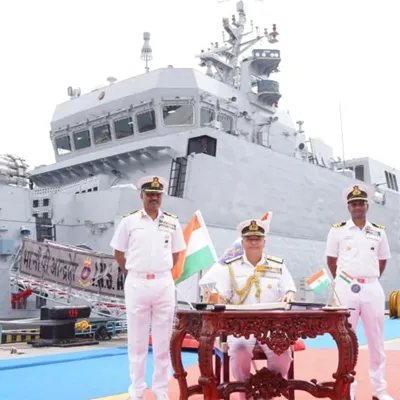
The vessel was formally commissioned by Vice Admiral Rajesh Pendharkar, Flag Officer Commanding-in-Chief, Eastern Naval Command, at a ceremony held at the Naval Dockyard, Visakhapatnam.

The Indian Navy has commissioned INS Androth, the second of eight Anti-Submarine Warfare Shallow Water Craft (ASW-SWC), at the Naval Dockyard in Visakhapatnam earlier this week. The vessel is designed to detect and neutralise underwater threats operating close to India’s coastline. Named after Androth Island in the Lakshadweep archipelago, the ship represents a new generation of highly agile and compact warships tailored for operations in littoral zones where larger destroyers or frigates face depth constraints. Built by Garden Reach Shipbuilders and Engineers (GRSE), Kolkata, INS Androth boasts over 80 per cent indigenous content, underscoring India’s growing self-reliance in naval shipbuilding. The 77-metre-long vessel, displacing 1,500 tonnes, is equipped with three diesel-powered waterjet propulsion systems. It features advanced sonar arrays, integrated surveillance suites, and state-of-the-art weapon systems designed for sub-surface detection and precision engagement. While its primary role is to track and destroy hostile submarines, INS Androth can also perform secondary missions such as maritime surveillance, coastal defence, search and rescue, and low-intensity maritime operations. India’s broader anti-submarine warfare (ASW) capabilities already include the Boeing P-8I long-range patrol aircraft, Kamorta-class corvettes, and MH-60R multi-role helicopters, forming a layered defensive structure. INS Androth complements these assets by covering the near-shore operational gap, protecting India’s 11,000-km coastline and serving as the Navy’s first line of defence against underwater intrusions. The vessel was formally commissioned by Vice Admiral Rajesh Pendharkar, Flag Officer Commanding-in-Chief, Eastern Naval Command, at a ceremony held at the Naval Dockyard, Visakhapatnam.

Next Story
Technology

AI-Enabled Workflows Lift Profitability and Productivity

Organisations modernising frontline workflows with artificial intelligence, automation and real-time data are reporting stronger financial performance, higher productivity and improved employee engagement, according to a global study by Zebra Technologies and Oxford Economics.The research covered 1,000 senior leaders across retail, manufacturing, transportation and logistics in the US, Mexico, the UK, Germany, India, Japan, Australia and New Zealand.In transportation and logistics, 54 per cent of companies that improved picking and packing operations reported faster operational performance, wh..

Next Story
Real Estate

India Leads Global AI Readiness but Implementation Lags

Indian companies lead global averages across all eight artificial intelligence readiness indicators tracked by JLL, but only 19 per cent have started making changes to their workplaces, according to the JLL 2026 Future of Work Survey.The study found that 77 per cent of Indian business leaders expect AI to change their office requirements, creating a 58-percentage-point gap between awareness and implementation. The survey covered more than 2,200 CEOs, CFOs and real estate leaders across 21 countries during the first quarter of 2026.Despite concerns over automation, 58 per cent of Indian leaders..

Next Story
Equipment

Three WOLFF Cranes Build Riyadh Cable-Stayed Bridges

Three WOLFF 180 B luffing jib cranes are supporting the construction of two cable-stayed bridges alongside the existing Wadi Laban Bridge in Riyadh, Saudi Arabia. The project is being developed for the Royal Commission for Riyadh City and executed by the ICRC joint venture comprising IC Ictas and Al Rashid Trading & Contracting Company.The cranes are handling lifting operations including formwork, reinforcement, concrete placement, work platforms, surveying equipment and other construction materials. Each crane is fitted with a 40 m jib, reaches a hook height of 157 m and offers a maximum ..

Advertisement

Subscribe to Our Newsletter

Get daily newsletters around different themes from Construction world.

STAY CONNECTED

Advertisement

Advertisement

Advertisement