



Navy Hosts Seminar On Cybersecurity In Maritime Sector
DEFENSE

Navy Hosts Seminar On Cybersecurity In Maritime Sector

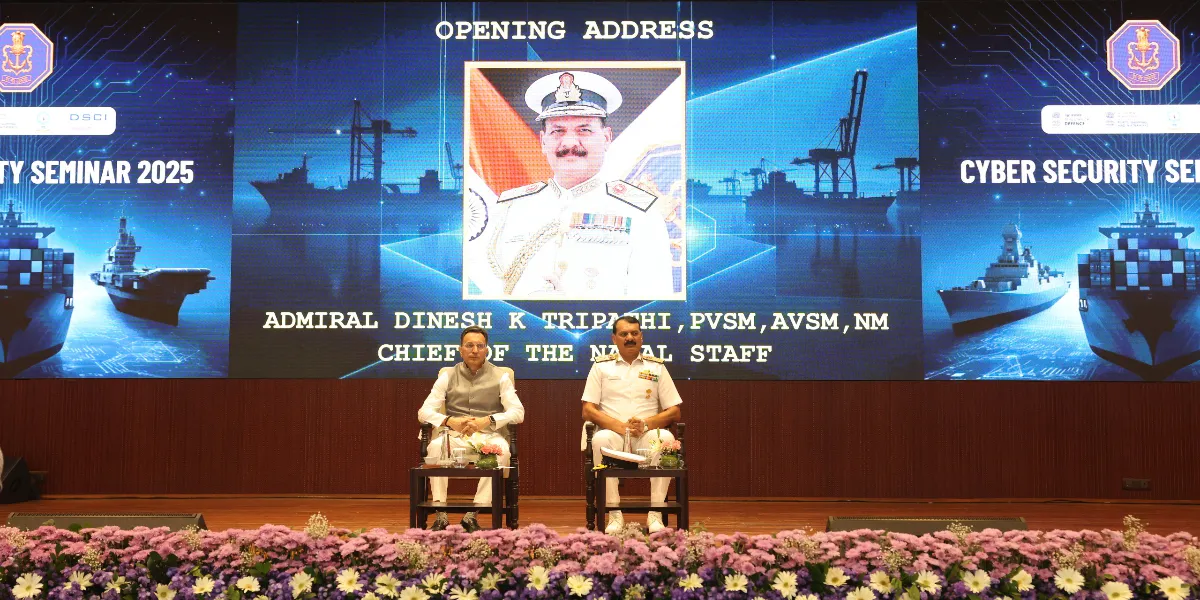
The Indian Navy successfully organised a seminar on ‘Impact of Cyber Attacks on Maritime Sector and Its Effects on National Security and International Relations’ at Sushma Swaraj Bhawan, New Delhi, on 16 October 2025. The event aimed to deepen understanding of cyber threats in the maritime domain and enhance collaboration among key stakeholders to strengthen India’s national cybersecurity framework.

Admiral Dinesh K. Tripathi, Chief of the Naval Staff, welcomed Jitin Prasada, Minister of State for Electronics and Information Technology and Commerce & Industry, who served as the Chief Guest and delivered the keynote address. Prasada emphasised the growing importance of cybersecurity in protecting the maritime sector and the collective responsibility to build a robust and resilient cyber defence architecture.

In his address, Admiral Tripathi underlined the government’s focus on the maritime sector as central to India’s economic and security ambitions. Guided by the vision of ‘Samudra se Samriddhi’, India’s maritime progress is being shaped by initiatives such as the Maritime Amrit Kaal Vision 2047, Sagarmala, and PM Gati Shakti. He stressed the need to integrate cybersecurity from the design stage of all maritime systems and to improve coordination and information sharing across stakeholders.

The seminar featured three high-level panel discussions led by experts from various ministries and organisations, including the Ministry of Ports, Shipping and Waterways, Ministry of Petroleum and Natural Gas (MoPNG), National Security Council Secretariat (NSCS), Gas Authority of India Limited (GAIL), Directorate General of Hydrocarbons (DGH), CERT-In, NCIIPC, and the National Maritime Foundation (NMF). Leaders from the private sector also participated in discussions on global cyber threats, civil-military partnerships, and maritime critical information infrastructure.

Deliberations highlighted the need to recognise the maritime sector as an independent Critical Information Infrastructure (CII) due to its vital role in trade, defence, and energy supply chains.

A tech exhibition, organised in collaboration with the Data Security Council of India (DSCI), showcased indigenous innovations in cybersecurity and defence technologies developed by Indian startups. The exhibition reflected the nation’s focus on Aatmanirbharta and the vision of a Viksit Bharat by 2047.

Key outcomes from the seminar included identifying vulnerabilities in the digital maritime ecosystem and formulating strategies to mitigate cyber risks, ensuring a more secure and resilient maritime infrastructure.

The Indian Navy reaffirmed its commitment to enhancing maritime cyber resilience, promoting collaboration between policymakers, industry experts, and technologists to safeguard India’s digital maritime future.

The Indian Navy successfully organised a seminar on ‘Impact of Cyber Attacks on Maritime Sector and Its Effects on National Security and International Relations’ at Sushma Swaraj Bhawan, New Delhi, on 16 October 2025. The event aimed to deepen understanding of cyber threats in the maritime domain and enhance collaboration among key stakeholders to strengthen India’s national cybersecurity framework. Admiral Dinesh K. Tripathi, Chief of the Naval Staff, welcomed Jitin Prasada, Minister of State for Electronics and Information Technology and Commerce & Industry, who served as the Chief Guest and delivered the keynote address. Prasada emphasised the growing importance of cybersecurity in protecting the maritime sector and the collective responsibility to build a robust and resilient cyber defence architecture. In his address, Admiral Tripathi underlined the government’s focus on the maritime sector as central to India’s economic and security ambitions. Guided by the vision of ‘Samudra se Samriddhi’, India’s maritime progress is being shaped by initiatives such as the Maritime Amrit Kaal Vision 2047, Sagarmala, and PM Gati Shakti. He stressed the need to integrate cybersecurity from the design stage of all maritime systems and to improve coordination and information sharing across stakeholders. The seminar featured three high-level panel discussions led by experts from various ministries and organisations, including the Ministry of Ports, Shipping and Waterways, Ministry of Petroleum and Natural Gas (MoPNG), National Security Council Secretariat (NSCS), Gas Authority of India Limited (GAIL), Directorate General of Hydrocarbons (DGH), CERT-In, NCIIPC, and the National Maritime Foundation (NMF). Leaders from the private sector also participated in discussions on global cyber threats, civil-military partnerships, and maritime critical information infrastructure. Deliberations highlighted the need to recognise the maritime sector as an independent Critical Information Infrastructure (CII) due to its vital role in trade, defence, and energy supply chains. A tech exhibition, organised in collaboration with the Data Security Council of India (DSCI), showcased indigenous innovations in cybersecurity and defence technologies developed by Indian startups. The exhibition reflected the nation’s focus on Aatmanirbharta and the vision of a Viksit Bharat by 2047. Key outcomes from the seminar included identifying vulnerabilities in the digital maritime ecosystem and formulating strategies to mitigate cyber risks, ensuring a more secure and resilient maritime infrastructure. The Indian Navy reaffirmed its commitment to enhancing maritime cyber resilience, promoting collaboration between policymakers, industry experts, and technologists to safeguard India’s digital maritime future.

Next Story
Infrastructure Transport

Large Format Store Planned At M G Road Metro Station

M G Road station in Bengaluru is set to host the city’s first large-format commercial and experience space, with planning led by Bangalore Metro Rail Corporation Limited. BMRCL has invited proposals to develop and operate a central business district destination at the Purple?Pink Line interchange. The plan positions the station as a commercial hub designed to serve a broad commuter base across the city. The proposal is part of a broader effort to activate transit nodes commercially. Tender documents set a minimum monthly rental of Rs 0.944 million (mn), inclusive of GST, for the large-format..

Next Story
Infrastructure Energy

Government Cancels Auction Of Eleven Critical Mineral Blocks

The government has cancelled the auction of 11 critical and strategic mineral blocks after receiving a poor investor response and failing to attract a sufficient number of qualified bidders. The decision represents a setback to plans to ramp up domestic exploration and production of critical minerals amid global supply chain disruptions and rising demand for materials used in clean energy and advanced technologies. The mines ministry issued an annulment notice setting out the reasons for the cancellations. The annulment notice indicated that the auction process for five mineral blocks was canc..

Next Story
Infrastructure Energy

Gujarat Pushes Biogas Growth With 193 Operational Units

Gujarat has operationalised 193 biogas plants across the state and is planning to add 60 more units as part of a broader push to scale up clean and sustainable energy solutions. The existing plants, established under various government-supported schemes, process organic waste including cattle dung and agricultural residue to produce biogas and a nutrient-rich slurry. The output is mainly used for cooking and other energy needs in rural and semi-urban communities, while also improving local waste management practices. The Gujarat Energy Development Agency (GEDA) is leading the initiative and is..

Advertisement

Subscribe to Our Newsletter

Get daily newsletters around different themes from Construction world.

STAY CONNECTED

Advertisement

Advertisement

Advertisement